|
Folk Dance Federation of California, South, Inc.
|
|
CLICK AN IMAGE TO ENLARGE
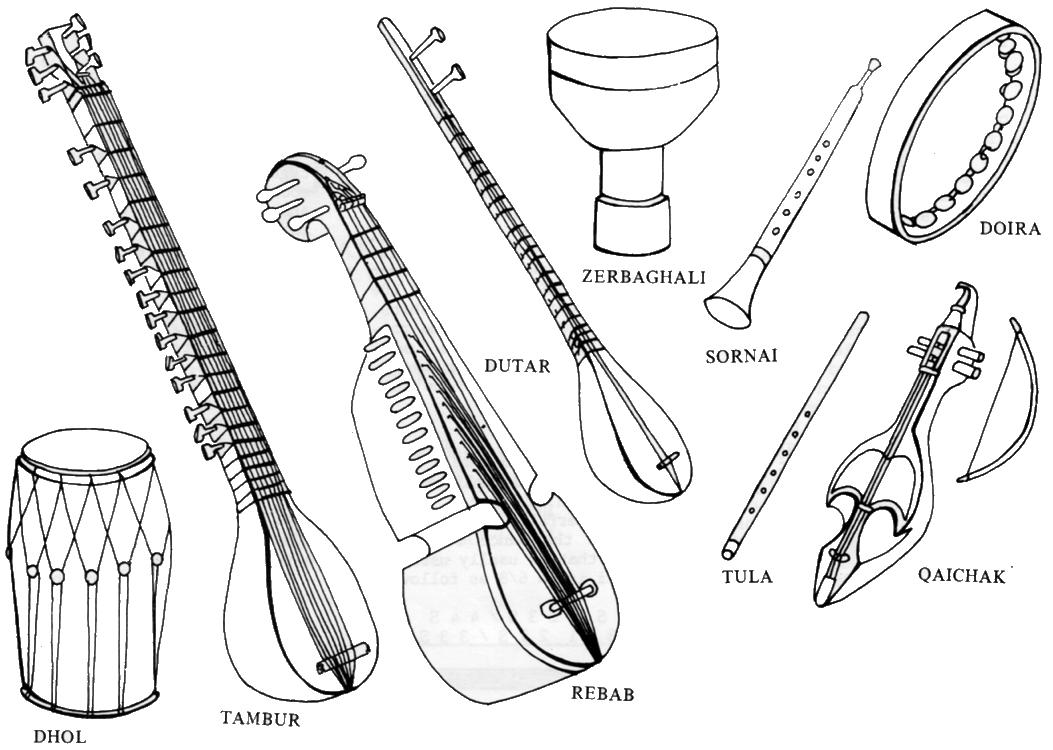
Dhol
The dhol is a large cylindrical drum with two skinheads and is generally struck on one side with a wooden stick bowed at the end, and with a large thin stick on the other side, though it is also played with the bare hands.
Tambur
The tambur (or dambura) is a long-necked instrument with four melody strings, the top two of that are tuned in unison, and 12 sympathetic strings that are tuned to the particular scale chosen. The highest sympathetic string is used as a reference string clanged during breaks in the melody or along with the melody. The melody is mostly played on the one set of high-pitched strings and ornamentation is achieved by squeezing the strings across the string frets that are wound around the neck and tied with a special knot. Although anciently such instruments had silk strings and were played with the fingernail(s), now a wire placrum (nakhonak) is worn in the index finger of the right hand.
Rebab
The rebab (or rubab) is a plucked instrument with a long, deep sound box, hollowed out of mulberry wood and covered with skin. Four melody strings are complemented by several sympathetic strings that are tuned to the notes of the modal scale selected and which vibrate in sympathy with the corresponding notes of the melody, creating an echo effect. An archeological find in the Nangahar region of Afganistan demonstrates that the rebab has been in existence for at least 2,000 years.
Dutar
The dutar is a long-necked two-stringed lute. Its name comes from the Persian word for "two strings," although the Herati dutar of Afghanistan has fourteen strings.
Zerbaghali
The zerbaghali is a single-headed, baked-clay drum played horizontally on the lap using the hands and fingers. Playing techniques are similar to the ones used in Persia, Central Asia, and India. Sometimes wood is used for the body of the drum.
Zornai
The zornai (or zurna) is a double-reed wind instrument. It is a relative of the oboe, and is found almost everywhere where the common reed grows because it uses a short cylindrical reed that is tied to a conical brass tube on one end, flattened to a narrow slit on the other end as a source of the sound.
Doira
The daira (also spelled doira, dayereh, doyra, or daire) is an ancient, medium-sized frame drum characterized by a wooden hoop with a single skin head. It is widely used across the Middle East, Central Asia, the Caucasus, and the Balkans.
Tula
The tula (or tola, tule) is a traditional Afghan whistle flute or end-blown recorder. Historically, these instruments are hand-carved from mulberry wood and are typically used to play melodic folk music.
Qaichak
The qaichak (or ghijak) is a spiked fiddle with a round resonating chamber. It features a wooden or metal resonating chamber (sometimes made from a hollowed-out gourd or a can) topped with an animal skin, and is played vertically using a bow.
Dilruba
The dilruba (not shown) is a North Indian bowed string instrument, often described as a cross between a sitar and a sarangi. Featuring a fretted neck and a goatskin-covered resonating chamber, it is played with a bow (gaz) to produce a warm, haunting sound closely mimicking the human voice.
AFGHAN MUSIC
 Afghanistan was one of the first stops of the Indo-Aryan tribes on their way to India and Persia. It is the area where the original Vedic and Avestan hymns were developed and from whence most of the great Persian poets hail.
Afghanistan was on the path of Buddhism that found its way to Central Asia and China with Bamyan as a major Buddhist center, with it's huge statue of the Buddha carved in a cave. Afghanistan is a land of three main ethnic groups: the Pashtuns who inhabit the southern half, the Tajiks who are said to be the former inhabitants of the area, and the Asiatic people of the north (mainly Uzbek), and the Turkoman in the northwest.
The southwest is inhabited by the Baluchi (or Balochi) who spread over from Iran and Pakistan. The western border area of Afghanistan, Herat province, is inhabited by people similar to those living on the other side of the border in Iranian Khorasan. Music in Afghanistan seems to be divisible along ethnic lines: Pashtun, Herati, Uzbek, and the less predominant Baluchi and Turkoman styles.
Logar province, south of Kabul, is known for its musicians and dancers and has a special style all its own. In recent decades, Indian classical music has influenced the Kabul area.
The instruments common to the main musical divisions are:
Pashtun – rebab, tambur, dhol, and dilruba;
Herati – dutar, and zerbaghali;
Uzbek – tambur, qaichak, and zerbaghali.
Afghan music is played in the modal scales of India and Persia, many of which are similar in nature. It is postulated that, because Afghanistan was a cultural center of the Islamic world during past eras that the music of that area may be representative of an older parental form of North Indian music and may also represent an older tradition of some Persian modal sequences.
During the last decades, the Tea House of Samovar was the local gathering place where music was performed and enjoyed. The atmosphere was informal like a jam session in jazz clubs of the West where performers would drop by and join for a few tunes. Because of the interdiction supposed to have been imposed by Islam on public performances of music, Afgan instrumentalists usually insist that they only perform as a hobby (shauqi) and are not professional entertainers (kepsi), which would place them in a very low stratum of society.
Afghan music is both modal and melodic, performed in free-rhythm or rhythmic sequences in 4/4, 6/8, or more commonly 7/8. The chaharbaiti styling of Herat is played and sung in free-rhythm and introductory improvisations (shakal) are common in other parts of the country. Pashtu, Logari, and Kabuli music is sometimes performed in patterns of alternating passages of fast rhythmic and medium or free-rhythm sequences.
The Herati musical form is a poetic format of two couplets in the Hazaj meter, rhymed A A B A. This free-form vocalizing of quatrains has become a free-rhythm musical improvisational style played on the two- or three-stringed dutar. Chaharbaiti improvisations emphasize a pentachord in the Shur scale, concentrating on the notes 5 6p 7p 8 9 (p = semi-flat). The Homayun-Isfahan Persian modal scale, which was the third flat and the 6th semi-flat, is also common for chaharbaiti. Free-rhythm interpretations stressing the 8th and 9th of this scale are interchanged with rhythmic sections that are: Herati, Maldarri, Kuchipaghi, Jawandi (from the city of Jawand), Chisti (from the sufi city of Chishte), Hazaragi (from Asiatic Hazara people of central Afghanistan), and Saradi (from the border area near Iran). To these might be added Khauf and Torbat-e Jam. The traditional tune, Shaikh Ahmad Jam, is a dutar melody that is played in a chaharbaiti style, as are a few other Herati tunes. In Herat, when women play the daira (frame drum), other than the standard way of holding the instrument, it can be rested on the tops of the insteps, leaning on the shins, in a seated position. One rhythm, typical of the nomads (Kuchi) is called duchakegi, and is a 6/8 scanned dum-taka-dum-taka.
Aushari is a musical piece that has become a dance form. This is actually a pronunciation of abshar (waterfall), and serves to describe the dance form. The melody that is usually used for Aushari is in 6/8.
One should not confuse Aushari with the Persian dastagah (mode) Afshari where the modal scale is not the same. Another name for this melody in Herati dialect is Wokh Baloka-a Panja Meri, which in standard Dari would be Way Banokh-a Panja Meri (Oh, you walk on the tips of the toes).
The words to the song are:
|
Wokh balokh-a panja meri, Chal sala dukhtar asti, Merorom as gham-a tu, Cha kheyal-a dilbar astit? |
Oh, how you walk on the tips of your toes, It is forty years you have been a maiden, I die from sorrow over you, What kind of sweetheart are you? |
Printed in Folk Dance Scene, April 1984