|
Folk Dance Federation of California, South, Inc.
|
|
CLICK AN IMAGE TO ENLARGE
Some of our dance traditions are many thousands of years old, and demonstrably so. As an "Old World" archeologist who has been folk-dancing for over 75 years, I keep noticing little details of dance in ancient – even prehistoric – artifacts. Through cognitive science, we know that humans long ago developed the possibly unique cognitive ability to match external rhythms, and hence the ability to dance to music. (Oliver Sacks, in his book Musicophilia, discusses circus elephants and the like that can beat a regular rhythm, but not match it to music: human musicians have to match the animals.) We have probably been dancing since the Palaeolithic (Old Stone Age) – primitive musical instruments have even been found from that era. But the first really clear evidence for dance comes from the Neolithic (New Stone Age), defined by the invention and adoption of agriculture and accompanied by settling down in permanent villages. After all, one had to watch over one's crops and one's stores of harvested food! (Dates of that signal event vary in different parts of the world, but here we will follow the Near Eastern and European tradition, from which come most of the dances we do.
Palaeolithic hunter-gatherers moved around all the time, following the food, but also came together at times for socializing and sharing information. And if you didn't like your neighbors at such a gathering, you could just leave. But settled Neolithic farmers couldn't leave: they had to find ways to get along. To store their grain safe from varmints, they soon invented baked pottery, and it is on this pottery that we find the evidence for how they learned to get along and to bond.
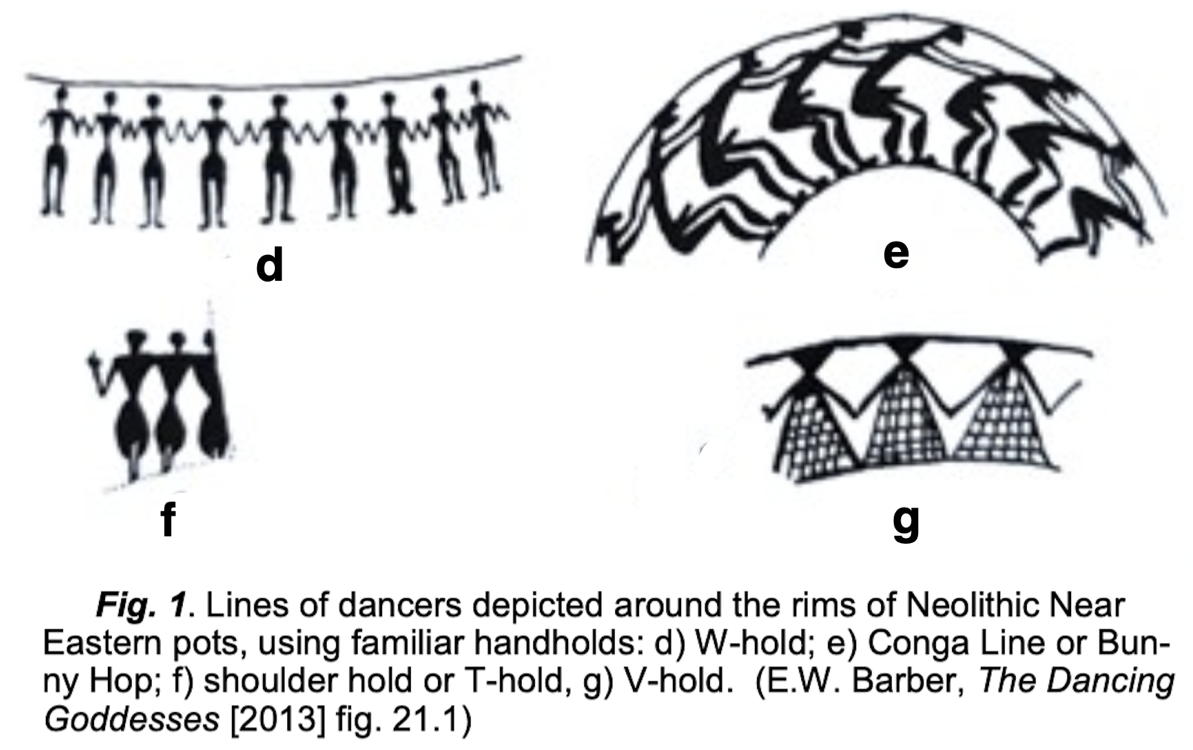
About 6500 BCE, they began painting their pottery, and all around the rims we see little figures of people dancing in long lines, all looking the same and holding hands in familiar ways. Most common are the ubiquitous "V-hold" (Fig. 1g) and the "W-hold" (Fig. 1d). But sometimes we see hands on neighboring shoulders: the "T-hold" used now mostly by men (Fig. 1f). And at least one pot shows the two-handed "Bunny-Hop" or "Conga-line" hold (Fig. 1e). Note that everyone is equal – all the dancers are the same size and shape, within one line. Men and women are indeed distinguished, but always dancing in different lines (or occasionally totally alone), just as has been the case in Orthodox Eastern and Southern Europe until very recently.
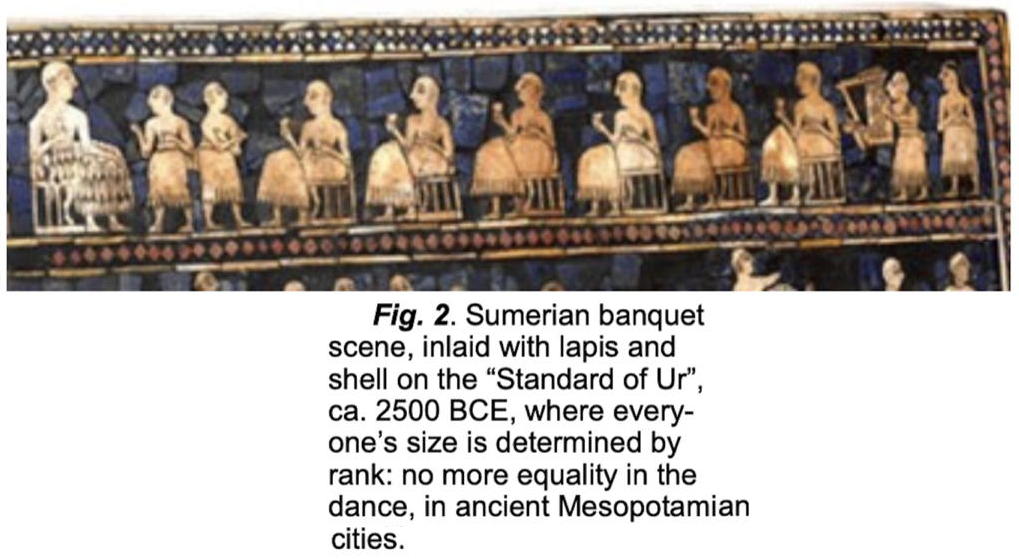
We see this equality broken suddenly in the Near East with the development of cities, around 3500 BCE or so. Now, instead of all figures equal, we see a King – far bigger than anyone else – presiding over a banquet of men half his size who sit facing him (Fig. 2). And sometimes, just sometimes, we see an even smaller (hence, even lower ranked) musician at the back of the feast, perhaps with a single small dancer, providing dinner entertainment for their "betters." Life had changed.
Agriculture, and dancing together in long lines, entered Europe with early, equality-minded, immigrant farmers from the east, who first arrived around 6000 BCE. But until very late, Europe never created cities the way the Near East did. (Classical Athens, at 400 BCE, was tiny compared to the great cities of Mesopotamia 2000 years earlier.) And so the Neolithic rural tradition of bonding through dancing with one's fellow villagers stayed on and developed into our European folk dances of today. It is harder to catch glimpses along the way, because European farmers seldom painted dancers on their pots. But the Minoans of Crete (famed in Homer for their love of dancing) depicted this sport in both frescoes and small sculptures.
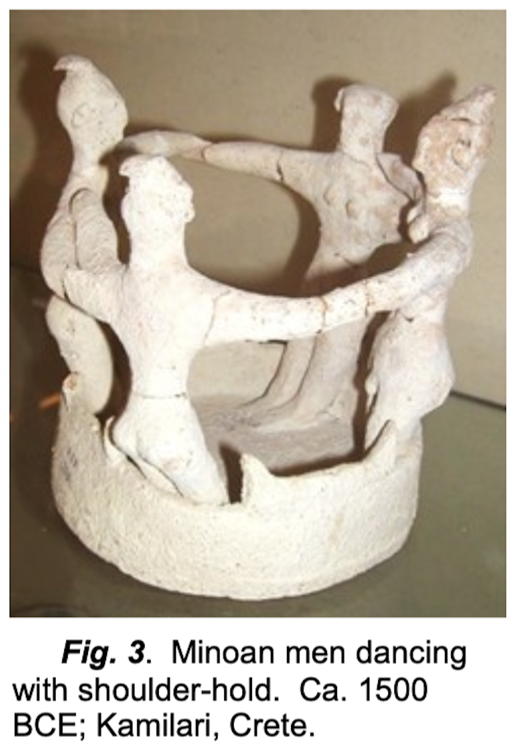
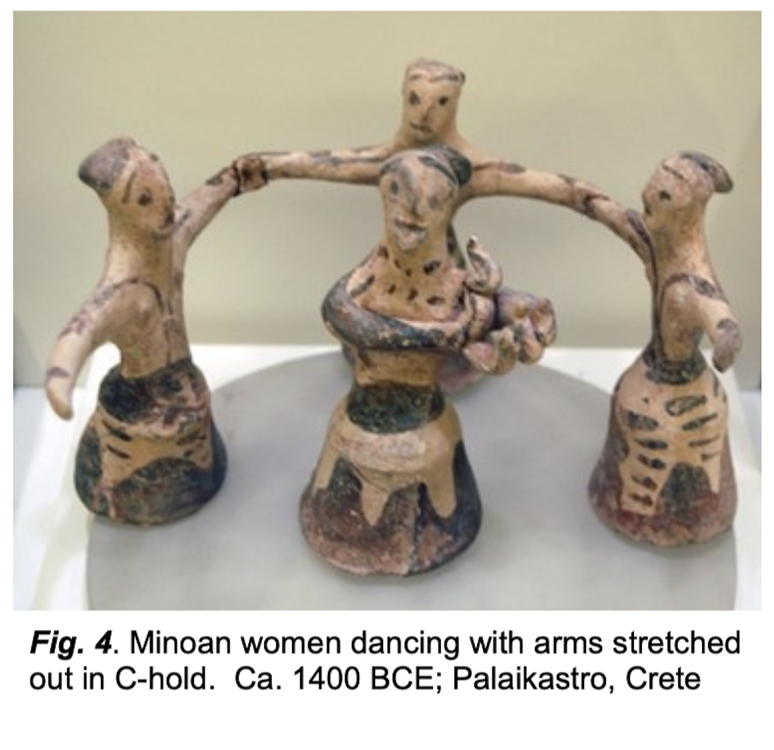
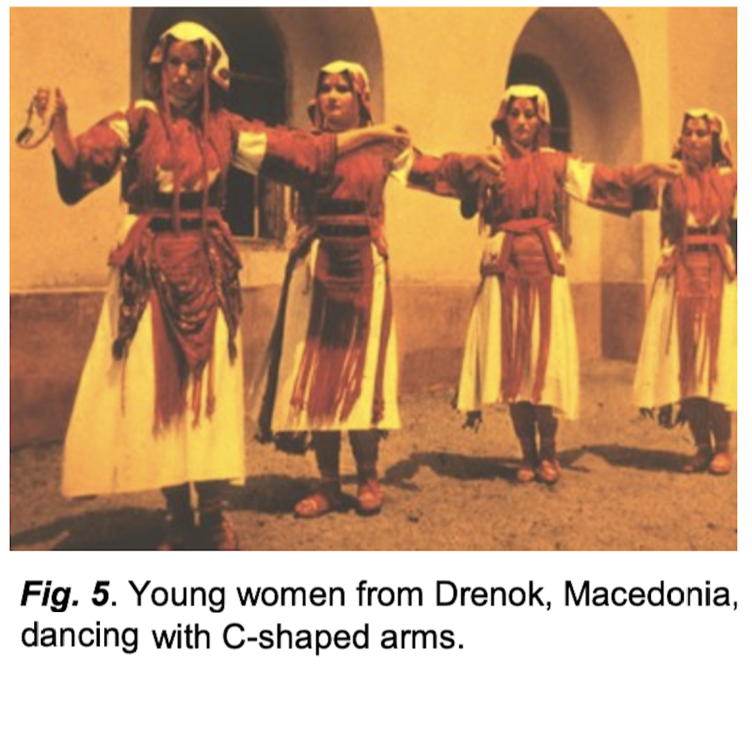
My favorites are two clay models from around 1500 BCE, one of men dancing in "T-hold," just as today (Fig. 3), and the other of women dancing using the "C-hold" – the "W-hold" modified by lifting one's elbows elegantly to the height of one's hands to form C-shaped arms (Fig. 4), as still done by Macedonian women today (Fig. 5). (I know . . . most of us are too lazy to dance that way now!)
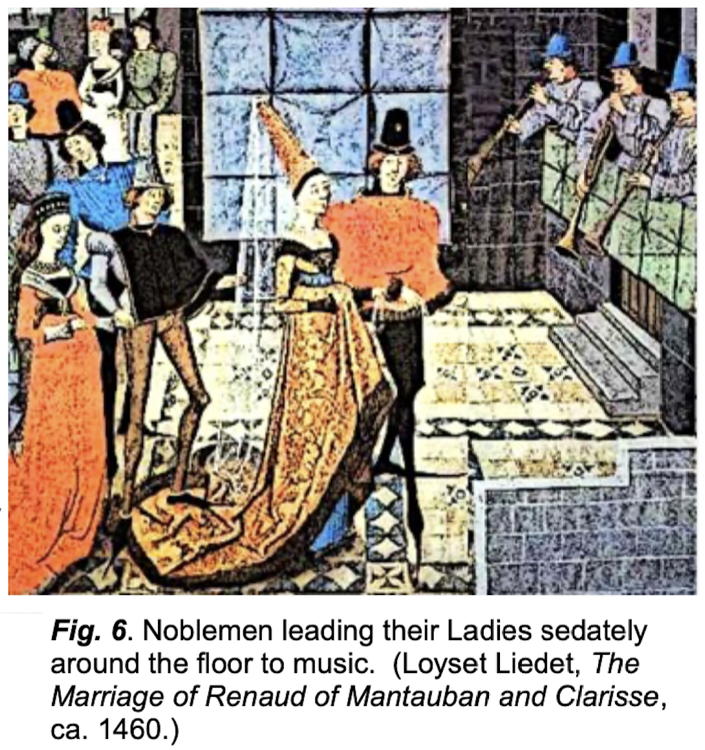
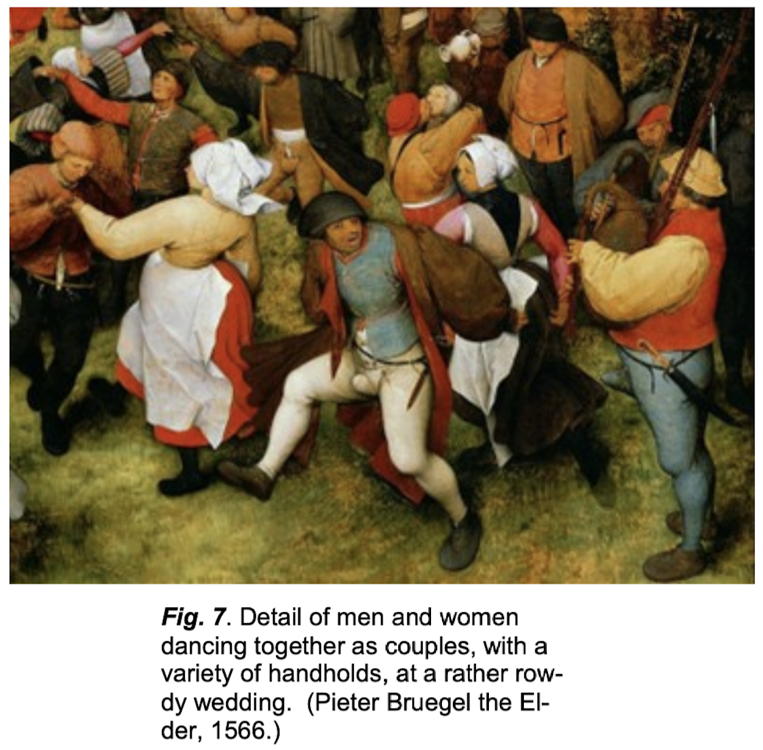
And couple dancing? In the Middle Ages, western (Catholic) Europe broke free of the rule that one danced in strictly segregated lines (or by one's self), starting with the privilege of the courtly knight to lead his lady by the hand around the room (Fig. 6). Little by little, promenading in pairs to music shifted into closer holds for couple dancing – a trend taken up with gusto by the peasants (Fig. 7) and eventually making possible the wonderful "turning dances:" polka, waltz, hambo, double-pivot, and more.
Printed in Folk Dance Scene, February 2025