
|
Folk Dance Federation of California, South, Inc.
|

|
CLICK AN IMAGE TO ENLARGE
Not an independent nation – rarely included on any map – it exists as the only political and social reality of the hundreds of thousands of its inhabitants who have never heard of America, Coca Cola, or Mickey Mouse.

Baluchistan, pronounced bah-LOOCH-ee-stahn (also Balochistan) – "Land of the Baluch" – is just that. The Baluch, pronounced bah-LOOCH (also Baloch), an ethnic group of disputed orgin and composition have inhabited these deserts and mountains of western Pakistan and eastern India for at least a millenium (Arab chroniclers mention them in this region in the 11th century). Since the 19th century, they have migrated into southwestern Afghanistan to create a semi-autonomous political entity spanning three countries and thousands of square miles. The Baluch do not refer to Pakistan or Afganistan or India as their homes – only to Baluchistan. They roam across national borders with impunity, and freely ignore tariff, custom, and trade restrictions between the three nations.
I was fortunate to visit Baluchistan in 1974 and 1975 as part of the Helmand-Sistan Project, a team of American archaeologists and geologist surveying and excavating in the Afghan portion of Baluchistan.
Afgan Baluchistan consists of one thin band of territory, scarcely more than two miles wide in most places, which forms the bed of the lower Helmand River as it cuts through the deserts of western Afghanistan. The Helmand River, born in the Hindu Kush, and garnering its waters from most of southwestern Afganistan, breaks out of the mountains near Khandahar. It joins the Argandhab River near the modern city of Lashkar Gah (ancient Bost) and then courses across the sand dunes of the Dasht i Margo (Desert of Death), the Dasht i Jehannum (Desert of Hell), and the Registan (Land of Sand), only to turn north and disappar in a series of three shallow lakes, called the Hamuns.
The Hamuns are the remains of a much larger system of water which in prehistoric times covered most of the river's northward course. This flat lake bed, devoid of water for thousands of years, is called the Sistan, and once sported a large population of agricultural inhabitants who brought water to the desert by an extensive system of irrigation canals from the river. The existence of permanent water in this barren region has been an attraction to settlement over the millenia. Archeologists have discovered remains of habitation in this area as old as the first civilization in the Mesopotamian and Indus valleys. The legendary Persian hero, Rustam, was said to have come from Sistan. Alexander the Great's armies passed through this area in their return from the Indus Valley and founded a Greek city at Bost. Over the ensuing centuries, the region was dominated by a series of Persian, Indian, and Moslem dynasties – Parthians, Kushans, Sasanians, Arabs, Ghaznavids, Saminids, and others.
When Europe was in the throes of its Dark Ages, Sistan was a center of enlightened culture, and later became one of the centers of the Mongol emperors. After the decline of the Mongols, the area fell into decay, a process unchanged to the present.
No greater contrast can be imagined than to compare the delicately constructed mud brick houses of the Mongol period, or the beautiful architectural palaces of the Ghaznavid dynasty (11th century) with the squalor of a modern Baluch village and its wattle and daub huts.
THE TRADITIONAL BALUCH VILLAGE
 Were it not for Nur Ali Khan's house, one could drive by Khwaj Ali Sehyaka (or Sehyak) and never know it. The village is, like most Baluchi villages, located on the fringe of the irrigated valley and the desert, allowing all the better land to be used for the myriad of walled fields and orchards, canals, and overgrown grazeland that makes up the narrow Helmund Valley. It also sits at the foot of a small hillock which was crowned by a Greek temple 2000 years ago.
Nur Ali's house represents the power of the Kahn, a study mud brick collonaded building crowned with three domes and surrounded by a high wall of the same brick material. In contrast to the rest of the reed and mud huts around his, it is a palace. One Kahan ordered his villagers to pack up and move their entire village further away from the water to allow greater irrigation area. They complied. Such is the power of the Kahn.
Like many others born to power, Nur Ali does not need to demonstrate it. When we set up camp in his courtyard, he quietly moved into one of the mud huts outside the walls to allow us full run of the house. He dresses like most other Baluch, eats the same food, and spends a good deal of his time sitting on the dusty ground conversing with the villagers. One has a hard time picturing him as being absolute monarch of Sehyak.
But he is. He is ruler over a village of willing serfs, people who will give 11/12 of their grain as tithes to him and pay an additional 1/10 of what is left to have their flour ground in his mill. His word is the law. He can have peasants conscripted for canal building, sent into the army, marry or not marry as he wishes. The rare peasant who will run away from this domination will likely find his lot even worse at his new abode, knowing he cannot go back.
Power can be abused, and on on occasion in Jui Nao the peasants were so downtrodden, that they migrated en masse to the village of the neighboring Kahn, leaving their former Khan with untilled fields and a deserted village. But for the most part, the word of the Kahn is law. The peasant, subject of imperial whim, can ill afford to spend his time challenging the Khan's power. His life is fraught with hardship and hard work, leaving him but little time or energy for questioning the system.
His first danger is at birth. The high infant mortality rate of 50% is matched by a child death rate of 50% of those who survive infancy. Malaria runs rampant, as do a host of intestinal diseases, periodic outbreaks of cholera, and malnutrition. Those who survive these attacks are subject to relapse. It is not unusual to see one of our workmen lying down next to the trench and shivering in a recurrence of a childhood malarial attack. Because western medicine is virtually unknown, only the Koranic inscription worn around the neck in a leather pouch is what they have. Too often, these amulets are found hanging from grave markers after a recent burial.
 The adult life of the peasant is equally tenuous. The weather is so severe that Lord Curzon, a British governor of India in the 19th century, called the region "one of the most inhospitable places on earth". Most of that attribution is due to the "wind of 120 days" that blows incessantly at speeds of up to 100 miles oer hour for the entire summer. This creates huge clouds of dust and sand that gets into eyes, throat, ears, lungs, and every pore and make visibility impossible. Those caught without shelter during one of these storms often do not survive them. The fall, particularly in a dry year, can bring drought; the winter has flash floods;; and the spring heralds periodic flooding of the river from the fast-melting snow in the Hindu Kush.
 Freedom is not a concept known to the peasants. As children, the boys begin the tasks that will carry them through the rest of their lives (which rarely lasts past 45 years), tilling the wheat fields, shepherding flocks, transporting goods by stubborn mule or unruly camel, or fishing (in the Hamun delta). Some will serve in the army; all will serve the Kahn's public works projects. One 10-year-old boy we talked with, who had old and infirm parents, was fully responsible for the family flock by day and tended to his parents by night.
A young girl has it perhaps even harder. At the age of 4 or 5, she is betrothed to a man 10 or 15 years her senior, then spends her time waiting for him to pay off the bride price, which can run up to $1000 or $2000. In a region where tha average annual salary is $50, it takes all of the man's wealth and most of his family's to get married – and often a decade or more to raise the necessary capital. The girl learns to make bread, spin wool, weave, wash clothes, and to keep hidden from strange men. During our stay in Nur Ali Khans village, there was only one woman we could speak with, and very few others that we got more than a quick glimpse of.
This separation of the sexes leads to forms of institutionalized homosexuality among the men (I was unable to gather any information on the women). Some boys in their mid-teens will take to wearing makeup and adopting feminine mannerisms and, presumably serving as prostitutes for the other men in exchange for favors. The few boys we employed who played this role were treated royally by the other workmen, given all the best jobs, well fed, and attended to. This form of behavior lasts only a few years before the boy reverts to a male role and seeks his own wife.
The Craftsmen
There is a third class of people in the Baluchi village besides the Khan and the peasant – the craftsmen. They live off the tithe given them by the Khan, taken from the peasants' harvests. Their job is to keep the peasant supplied with useable tools. The two craftsmen of Sehyak, a carpenter and a blacksmith, were primarily engaged in this work. Good wood and metal were both hard to find and had to be imported from the city. These materials were then made into a variety of finished implements – pitchforks, hoes, shovels, spindles, even baby cribs! These craftsmen used very simple tools – the carpenter worked with a hand-operated lathe – the blacksmith operated an open-air forge with bellows propelled by a bicycle wheel and chain.
 Other people in the village could be fitted into this third class. the Mullah and his students ran the village mosque, also living off the Khan's tithe money. One Khan had his own "charge d'affaires" who represented his interests in the village. Nur Ali had enticed a mechanic to his village to help with his mill and his brother's trucks. An itinerant silversmith worked his way up and down the valley, making jewelry out of silver provided by the villagers (and keeping a bit of it for his pains).
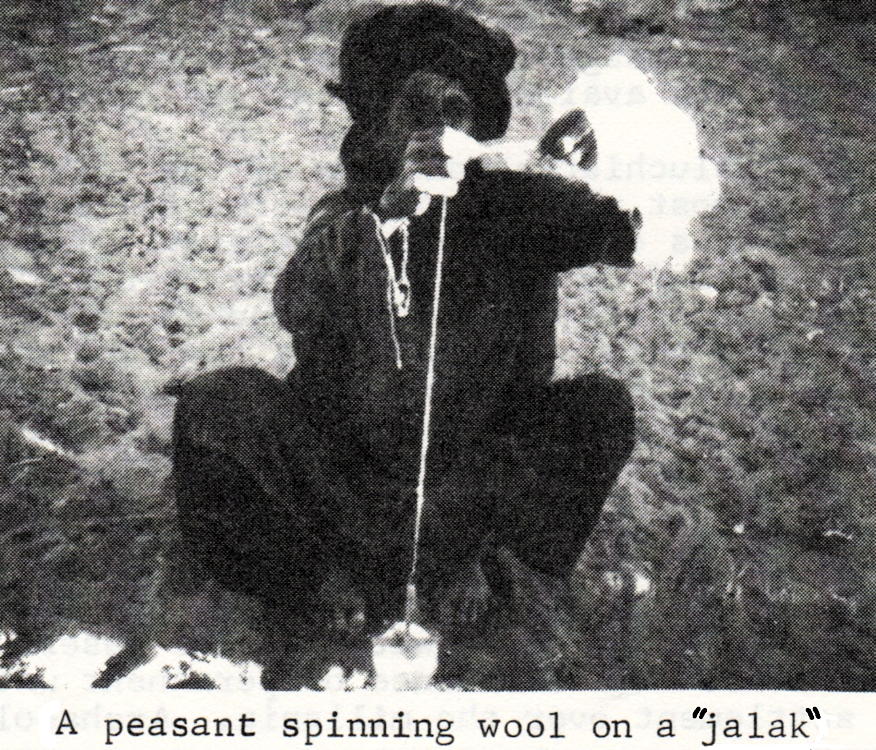
Several forms of folk crafts are practiced by the villagers. Baluchistan is well-known for its carpets that, in this area, are made by the women. They are not "professional" rugs, but are used locally rather than sold on the market. They are made using a simple loom consisting of an uneven tripod of local branches and loom weights of rock, potsherd, bone, or anything else available. In spite of this, the finished product is beautiful. Materials for these rugs are all local. The sheep's wool comes from the village flock; the yarn is spun on a wooden spindle (jalak) made by the village carpenter, and is dyed in colors made from local plants or imported from neighboring Pakistan.
Two other "crafts" ought to be mentioned – house building and bread making.
 The Baluchi hut is a marvellous invention. Given the proper materials, it takes less than a day to erect one and less than two hours to take it down and pack for transporting. It is highly mobile, yet sturdy enough to withstand the "wind of 120 days".
The hut is structured around a series of tamarisk branches, bent and tied together at the top to form a sturdy frame. Mats are then woven out of reeds (that grow in abundance by the river) and tied to the frame. This compromises the summer hut, with the mats providing enough air conditioning to catch whatever cooling breeze is available. During the winter, the huts will be entirely mudded up, except for a small doorway, to provide a warm enclosed shelter against the wind. A large Baluchi family might build more than one of these huts. During the summer, they will separate them to catch every available breeze. In winter, they will be moved close together in a square to provide a sheltered courtyard. Furniture is always very scant, usually just rugs and mats to sit and sleep on, and a hearth for warmth and cooking.
An old Baluchi folk tale tells of Adam and Eve, who, when banished from the Garden of Eden and forced to work for their bread, were promised by God that this bread will always be in abundance. To this day, it provides the cornerstone of the Baluchi diet and is eaten daily in large quantities.
Bread is made by the women in ovens (tandura) and consumed at every meal. The tandur is a beehive-shaped structure, usually dug into the ground and lined with baked brick or mud. When mealtime approaches, a roaring fire is built in the oven, the bread miraculously adheres to the wall and, with another quick movement, is removed ready to eat. That the women are not burned by constantly sticking their hands into the fire is also miraculous. The tandur has an extremely long history – our excavations turned up ovens over 500 years old, identical to those currently used.
Besides bread and water, the rest of the Baluchi diet is limited. Onions, melons, and a few other fruits and vegetables are periodically available. Most cooking is done with animal fat (ghee). Many villagers have chickens, sheep, goats, and cattle, so eggs, milk, meat, and other similar products are available when times are good. Indian and Pakistani tea is also available, sweetened by sugar for those who can afford it.
Though at this date, cigarettes have not reached Baluchistan, the villagers do take tobacco in a blend of ground green tobacco, the ash of alkali desert plants, and lime (nasoir). Nasoir is held under the tongue for a minute or so, then spit out. It is mildly intoxicating, probably addictive, and extremely bitter to the taste. Only the Khans though, seem able to afford the opium that passes through the area. Many of them are addicted to it.
BALUCHI MUSIC AND DANCE
Information on ethnic music and dance among the Baluch was gathered as an incidental part of our roles as archeologists in the Helmand Valley. As such, we did not scour the countryside for virtuoso musicians, attend weddings and festivals, or corner the village wiseman for tales of "How it was in the old days!"
The impoverished Baluch, who often had to pay a bride price of 10 or 20 times their annual incomes in order to marry, did not have many wedding parties (none during the time we were in their villages). Funerals were much more frequent, but were not occasions for song and dance. And, though we spent the Moslem Ramazan holiday in a village one year, we again saw no dancing, only the village congregating in the cemetery for a picnic.
In fact, our only dance and song "festivals" were ones we created ourselves. On two occasions during my two seasons in the field, the American ambassador to Afghanistan came to visit the project. Each time, we asked our workmen to provide an evening's entertainment for him and his party. We hired the local orchestra, and the workmen danced and sang with and for the audience. Most of my observations come from these two evenings.
In addition, several afternoons were spent recording folksongs and ballads among our workmen and listening to them play their native instruments. These men were not noted for their prowess, but were average villagers.
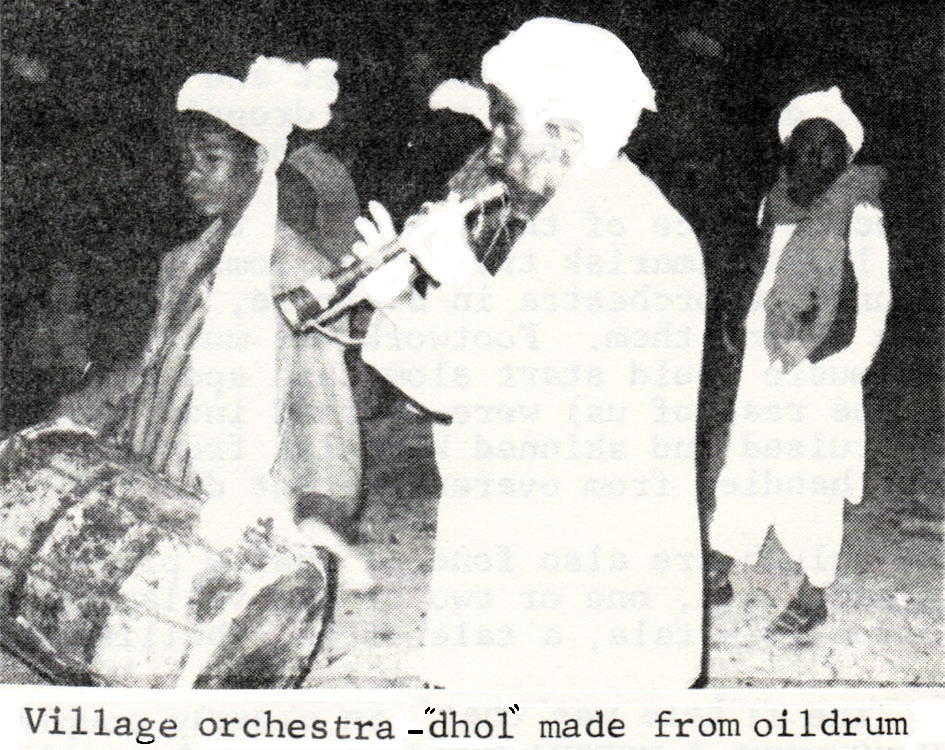 Baluchi folk instruments do not differ appreciably from those of their neighbors. The village orchestras we heard consisted of a double-reed flute (sournai) and a two-headed drum (dhol) played with both hands. One of the dhols we saw was made not of wood, but of a hollowed oil drum with skins over both ends. These orchestras were apparently professional and played for all the villages in the neighborhood.
Our workmen also owned and played a variety of other instruments. One possessed a two-stringed guitar (dotar) that he showed to us but could not play. The brass penny whistle (tulak) was available in shops in the nearby towns and was played, albiet poorly, by a couple of our workers.
A one-stringed cello (rebab) belonged to Khodai Nassar, a Brahui we had working for us. The Brahul are the desert cousins of the Baluch, and considered rather exotic and wild by the village peasants. Khodai Nassar was fairly accomplished at his instrument, playing both solo tunes and accompanying some of the ballads of the cook (Ghulam). For the ambassador's party, he spent a long time tuning his instrument (partially constructed out of tin cans and old scraps of wood), with the dexterity and discrimination of a concert cellist.
Songs
The Baluch had several kinds of songs: ballads, work songs, and probably (although we did not hear any) religious songs. Ballads were usually lengthy and repetitive, following a single melodic line over 10 or 20 couplets. Often the last line of a couplet would be repeated as the first line of the next. They were generally unaccompanied, though, as indicated above, there was a rebab used to accompany some songs. Vocal style was nasal and high pitched.
Topics for these ballads were generally found in Koranic literature or Persian epic literature. The legendary hero of epic Persian poetry, Rustam, who is said to have come from this region, figured heavily in the songs.
Work songs were often sung responsively or chorally, some spoken as poems. That the literature is not all of high antiquity was indicated by the fact that one of the songs known to the teenagers (though not the older workmen) had been written only a few years before by a poet living in a neighboring village. One interesting fact of these work songs is that we never heard the Baluch working to them, although we employed them to dig in the trenches for months on end.
Dance
 Most of our information on Baluchi dancing also came from our two evening parties. Though they took place in two villages about 60 miles apart, we could discern no essential difference in dancing between them. Villagers from Hauz were generally better dancers than those from Lat, and had a slightly larger repertoire of variations to their basic Baluchi dances, but the dances and their styling were the same.
The national dance of Afganistan (Atam) is considered belonging to the Pashtu majority in the country, but the Baluch were proficient in it as well.
The basic Baluchi dance was described to us by one of the villagers, as symbolizing the sowing and harvesting of grain. It consisted of a smooth flowing side-to-side step around the circle with arm movements accompanying, some of which did in fact resemble (in a stylized way) the scattering of seed, the threshing of wheat, and winnowing of grain as it is practiced in that area. The dance generally begins slowly and builds up speed until the movements become smooth gliding motions of the entire body in time to the music. It resembles, in some respects, skating on ice. On one occasion, the premier dancer in his village (Mohammed Omar) outlasted the rest of the dancers in one musical set and became a soloist, leaping at a furious pace to the music, doing graceful spins, dropping to one knee, while his hands flowed with a grace one is accustomed to expect from female dancing, but not often seem in men's dances.
A second dance of the Baluch is the stick dance (chop i chob). Using branches of the local tamarisk trees (and some of our extra tool handles) the dancers would rotate around the orchestra in a circle, alternately hitting the stick of the person before. then behind them. Footwork was much the same as the first dance, and is in the other, the music would start slow then speed up to a frenetic pace. The ambassador (and some of the rest of us) were coerced into joining the circle and escaped with a small variety of bruised and skinned knuckles from faulty hits. We also lost a fair percentage of tool handles from over exuberant dancers.
The Baluch are also fond of shadow plays, two versions of which we saw during our stay. In each case, one or two of the villagers would be dressed up as animals to act out a common folk tale, a tale often embellished and changed by the audience.
The first tale was that of an elderly couple (with one an wearing his cloak as a veil to represent a woman) who met up with a tiger (palang) in the wilderness. In a Punch-and_Judy-like routine, they strongly whack the beast (a man dressed up in a cloak with a turban-wrapped bowl for a head). On the second occasion, the beast was a bull, played by two villagers under a cloak and using wrapped sticks (our tool handles again!) for horns. In each case, after telling the tale (in Baluchi, and therefore lost to us), the cast of characters joined the rest in a dance.
Dress:
Baluchi dress was extremely simple, and also very similar to that worn in other parts of Afghanistan.
Women wore long, loose-fitting dresses, embroidered and decorated with mirrors, and billowing out in printed cloth at the bottom. The floral patterns were usually oriented on a black or dark blue background, but some of the younger women and girls wore brighter cloth – greens, purples, even orange and pink. Cloth was imported from across the border in Iran. Women also wore shawls, usually black, though they avoided the ankle-length silk veils (chadri) worn by the city women. Shawls were pulled across the mouth and nose whenever strange men, such as us, approached, leaving only a pair of eyes peering out from behind the shawl. For ceremonial occasions, some of them had a change of clothes and white shawls, but it was generally the same style.
Men dressed in loose-fitting cotton "pajamas," wool vests in muted patterns and solids adorned with a myriad of zippered and buttoned pockets, a box-like cap usually decorated in gold thread and mirrors, and a white turban. Headgear varied somewhat. Some Baluch wore smaller knot skullcaps, either alone or under a turban. Others wore orange wool caps (balaclavas) which could be pulled down over the face like a ski mask. These were imported from Pakistan. Baluchi turbans, unlike the varied colors worn by the Pashtuns, were always white. For overgarments, most Baluchi men had a cloak, generally blue-green, to wrap themselves in. In addition, there was quite an incredible array of old suit jackets, military garb, and trenchcoats picked up at the nearest used-clothes bazaar. One of the workmen was bedecked like a bandmaster in a tight-fitting navy coat with red braid. He unfortunately lost his coat when the local soldiers locked him up for several days for some real or imaginary misdemeanor.
Footgear consisted of either plastic sandals (for most of the women and some of the men), rubber sandals made from old automobile tires, or used western shoes from the used-clothes bazaar again. Many of the peasants went barefoot most, or all, of the time. I did not see any wearing the traditional decorated slippers available in the city bazaars.
TOWARD THE TWENTIETH CENTURY
In the last 30 years, Western influence has infiltrated the Valley, causing radical changes in the political and social fabric of Baluchi life.
The first major incursion was by the United States agricultural experts and engineers who attempted to increase the agricultural yield of the Valley by modern farming methods.
Though the project ultimately failed, it did accomplish one thing: it brought western technology to the isolated world of Afghan Baluchistan. A city built by the Americans to support their work (Lashkar Gah) consists of wide paved and lighted streets, air-conditioned villas, a motion picture theater, tractor dealership, airstrip, and other trappings of western life. As the center of the Valley's economy for over 20 years, Lashkar Gah introduced innumerable Pashtuns and Baluchs to the ways of the West (unfortunately, not all of them flattering to the Central Asian personality). This knowledge filtered throughout the Valley. Even the ruler of the out-of-the-way village of Lat (Biband Khan), brought his own 1940 model Chevrolet (now rusting in the sand a quater mile fr9om his village), which he later replaced with a late model Russian jeep.
Mechanics became priceless commodities to Khans attempting to purchase autos, milling machinery, and other agricultural implements. Our project mechanic (Niaz Muhammed), a Tadjik who worked for a tractor company after a long stint with the American AID program, was, according to our joke, the richest man in Afghanistan.
Two other demands created even farther reaching changes in village life.
 With the international crackdown on opium exporting, smugglers searched for ever more obtuse routes to the West from the poppy fields of the eastern Afghanistan highlands. The Helmand Valley, a major trade route to the West in ancient times and sufficiently inaccessible in modern times, was a natural road for this type of trade. At first, this "Baluchi Connection" was in the hands of the enterprising Pashtun merchants from Kandahar and Iranians, but in the early 1970s, the Baluchi Khans, realizing that the immense profits available were bypassing them, moved into the market. In a fierce smuggler's war, during which our own and another team of American archeologists, were periodically shot at – they ousted the foreigners and took over the trade themselves.
This victory led to an almost complete metamorphosis of Baluchi life. Overnight, the Baluchi Khans, formerly proprietors over poor, subsistent peasants, and therefore poor themselves, found themselves exceedingly wealthy. One began filling a bank account in Lashkar Gah and spending most of his time in the city. Another bought a fleet of a dozen new Ford pickups to move the ever-increasing amounts of material over the border. Diversifying their trade. they bagan running Indian and Pakistani tea and gold to the West and finishing Iranian textiles to the East, all without paying duty or being restricted by tariffs. Iranian textiles, a valuable commodity in the markets of Kabul and Kandahar, led hordes of wealthy Afghans to visit previously provincial border markets (such as Zaranj) in search of the latest Persian styles.
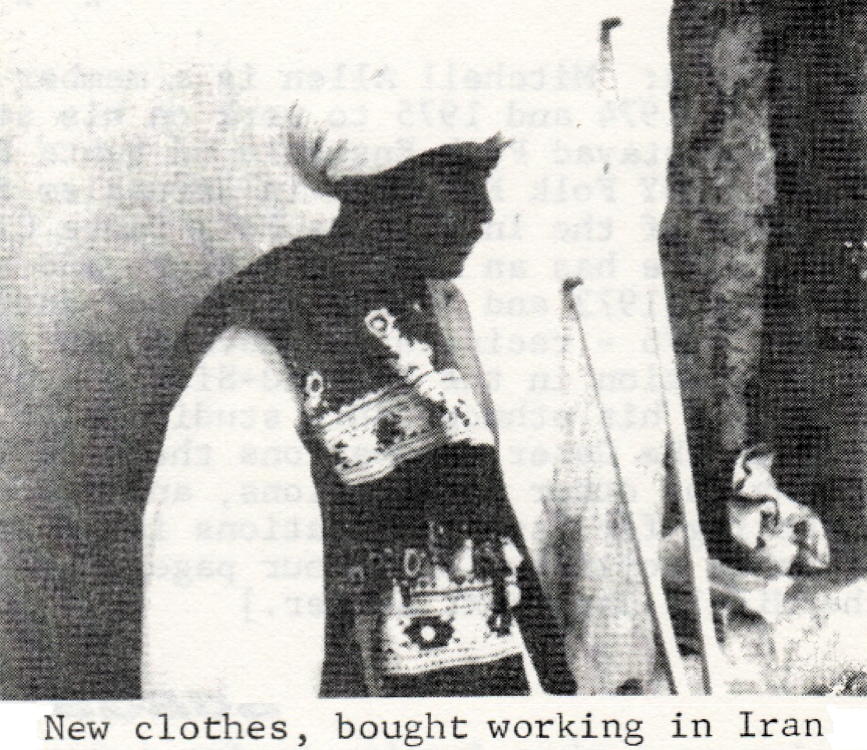
A second Western craving, oil, led to similar changes in the life of the peasant. With Iran's newly found oil money, large construction projects requiring vast quantities of cheap labor were begun. The poor Afghan peasant, a hardier and cheaper worker than the Iranian, was preferred help, so the Ford pickups began loading up with village workmen who would ride across the border at night and find jobs in Iran for a few months at ten times the salary they could get in Afghanistan. The Khan, who collected a nice commission on transporting the workmen, supported this effort. Soon the word was out and Pashtuns from as far as Kandahar would come to take the smugglers' trucks across to Iran to "make their fortunes." Some made it, others were turned back (and robbed) at the border. The Baluch, under the special protection of their Khans, had no difficulty in making the night run and soon started filtering back with new clothes, Timex watches, Japanese transistor radios, and European motorcycles and bicycles.
The incongruity of this lifestyle with the traditional abode on the dirt floor of the mud huts was absolutely confounding at first. One village we stayed in, very involved with the smuggling trade, had the vast majority of able-bodied men gone and the remainder were unwilling to do the archaeological work for the mere pittance we paid them (five times the going salary for most of the country!). As a result, that part of the season was carried on with young boys, old men, and a few bored individuals. There was no end though, to the number of visitors who would bring their transistor radios up to the mound to sit, watch, and talk to the workmen.
This smuggling route was made almost foolproof through the cooperation of the authorities. The Afghan government, unable to control the traffic and unwilling to spend money policing the Baluchi borders, granted these same Khans concessions to patrol that section of the border with their own men and camels! We were even guests of one of these Khans on a casual commute to the border post and back. We passed enroute, a large number of trucks bearing workmen returning to Afghanistan, and numerous tracks of other vehicles that had passed recently.
One can only speculate as to how the Baluchi village will change in the next 30 years as a result of these diverse influences. One thing is certain, as the transistor radios and the bicycles spread farther into the Helmand Valley, the traditional village way of life will change, and the old village lifestyle will be unrecognizably distorted. In a few short years, the age-old Balluchi village will be no more.
Printed in Folk Dance Scene, May 1978.