|
Folk Dance Federation of California, South, Inc.
|
|
CLICK AN IMAGE TO ENLARGE
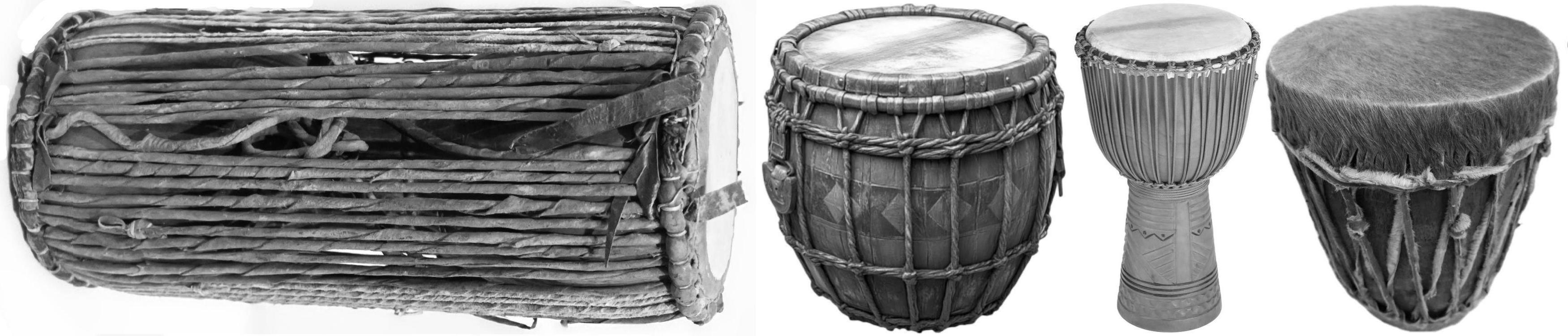
The drum is the most widespread and significant of all musical intruments. Drums date from Paleolithic times and have served all over the world for religious ceremonies, dancing, singing, marching, and communal work, for the exorcism of evil spirits and expulsion of scapegoats and evil-doers, for divination, for the induction of a state of possession suitable for communication with the gods and the supernatural forces, as fertility charms, and as a means of signaling. Their absence in any given area, as among some Indian tribes of modern Brazil or the early Greeks and European people, is an oddity rather than the rule. As a matter of record, works of art in Mesopotamia dating from 3000 BCE show a wide range of drums in use, and sculpture reliefs of India show their importance there at least 2000 years ago. Though the actual origin of the drum is unknown, various cultures have legends about its creation. In a story from the Fjort people, the drum's creation is credited to a bird, the Cnchonzonkila bird, who beats the ground with it's drum-shaped tail. Also, many Pacific and South American people believe that the slit drum was the invention of a water deity.
THE MAKING OF THE MAGIC
Whatever the origin of the drum, its making involves a number of magical practices and strange techniques. For example, Lapp drums are made of wood selected solely for the favorable direction of the wood grain. Melanesian drum makers climb the tree selected for the body of the drum and make the whole drum before descending. In making the Haitian voodoo drums, the maker, before cutting the tree, offers invocations, lights a candle, and sprinkles cornmeal around the roots. He breaks an egg against the trunk, rubs it well over the bark, and offers a bit of rum. Rum is also poured into the hollow of the drum after it is scraped out, at the threshold of the drum-maker's house and out towards his cornfield. The first peghole for attaching the skin is marked, and called the mother. There, the first peg must be driven in, the first attachment of the skin must be made, the lacing first knotted, and the tuning begun. Before any skins are attached, all the drums must be aligned in the sun and rum is poured before each, and the maker, calling on the father, the son and the holy ghost, lights a candle on each mother peg.
The drums are not played until they have been baptized. For this they are dressed, by a set of godparents, in apron-like christening garments, with prayers and offerings of meal and pouring of water. The largest of these drums is called the "manman," the next, the "seconde," and the smallest, th "bula" or "bebe." Each is named and endowed with a soul or spirit. The Babylonian drum, which was worshipped and played in lamentation the darkness of the moon, was made of the hide of a special black bull who was sacrificed in the temple of Ea, God of Music and Wisdom. The great honor of its fate was carefully explained to the bull in incantations sung to it before its ritual slaying. The earliest drumheads were probably made of the skins of fish and snakes and lizards – water animals – and only later, when drumsticks began to be used, were game animals – cattle, sheep, and goats used. For the huge log war drums of Africa, some tribes considered skins of wild beasts most suitable.
Human skin, flayed from captives or slain enemies, was sometimes used for the ancient Peruvian "huancar," the belief being that the use of a part of his body gave possession of the enemy's strength and vigor and would strike terror in his companions. Attaching the skin to the frame with nails has special significance, both for the barrel drums of the Far East and the "huehuetl" of Aztec, Mexico. Nails had a protective virtue, as they do today in many cultures. Also, the inclusion of various objects inside the drum was thought to add to its power. Small bits of crystal or obsidian from a volcano were used in the shaman's drum for their curative effects.
KINDS OF DRUMS
The "idiophone," which is any instrument that makes its sound from its own material, without a stretched skin or string, is the oldest and simplest form of drum. Rattles, stampers, clappers, grapers, are also idiophones. If you crack two sticks or bones together, you have a simple idiophone. If you dig a hole in the ground and place a board over it, and stamp on it, you've made a stamping pit, another kind of idiophone. Or take two clam shells and clap them between your palms. Pick up the jawbone of a bison, rasp it with a femur – these, too, are idiophones. In Papua, New Guinea, you'll hear the clap-clap of shells and crayfish claws, while in Zaire, the Vili would slap the thick expanse of their thighs with hollowed-out baobabs. The San of South Africa fill springbok ears with pebbles and wear them on their ankles. In West Africa, the top of a gourd is removed and the player pounds the open end against the ground, producing a percussive pop as the trapped air vibrates against the fruit's tough skin. The gourd can be kept intact and beaten with sticks or chopped in half and placed hollow-end down in the water and struck.
In Northern Haiti, players put metal thimbles on their fingers to excite the board's body, while in the Solomon Islands, topless gourds are plunged in and out of the water. Africa certainly has plenty of drums, but when tribes wanted to send coded bursts of noise far across the jungle, they used sophisticated wooden drums, slit gongs, which were capable of producing up to seven different tones. They are basically hollowed-out logs with a slit, or several slits, carved into the top. They can be as large as an elephant or as small as your forearm. If you put your ear to the slit gong, you can hear the same kind of faint roaring that you hear when you put a seashell up to your ear – the voice of the gods – the voice of the dead – the voice of the unborn. Each belief has its adherents.
Technically, a slit drum is idiophonic, as distinct from a membranophone (e.g., a skin drum), an aerophone (e.g, a trumpet), or a chordophone (e.g., a violin). distinctions were elaborated in the 1930s by the musicologist, Curt Sachs, but to a drum player, these distinctions are meaningless. The Haitians play a clay pot that encompasses all of these musical categories. Sometimes they beat on the pot with sticks, sometimes by singing into it, they distort their voices (a sort of an aerophone), and sometimes they cover the mouth with sheepskin or goat skin, making it a membranophone (the technical name for what most of us think of as a drum).
DECORATION OF THE DRUM
It is common in primitive societies for the largest drum to have the greatest magical power and to be dedicated to the most important divinities, while smaller ones take on lesser spirits and serve for more ordinary, utilitarian purposes, or even descend in time to the level of toys. The two largest drums of the Shango cult of the West Indies speak to St. Michael, the Catholic identification of Ogun, and John the Baptist Sango. Sometimes the original or older type of drum of an area retains its function for solemn ceremony while later importations serve for lighter, secular entertainment. Indians of the Sierra Nevada of South America do their religious dances to a large single-headed wooden drum and use a double-headed European-type instrument for secular dancing. The Miskito tribe of the Carribean lowlands play a goblet-shaped drum for funerals and memorial rites and use the European type for signaling and less important ceremonies. Special dress for drums is not unique in Haiti. Among others, the "huehuetl," still used by the Huichols of Mexico, has a holiday garb for festivals. The master drum of India, the Sahibnahabat, of India, a pair of huge silver kettle drums mounted on an elephant for processions, wears long drapery. The Japanese "da-daiko," a spoon-shaped instrument used for great occasions in the Bugaku orchestra, is enthroned on a tasseled and draped platform. More integral forms of drum decorations include carving and painting, and the attachment of various objects to the frame, nearly always with the purpose of furthering the powers of the instrument. Some of the most ancient log drums which stood upright or tilted on the ground for playing were given feet or tooth-like appendages to be driven into the earth. The foot, a phallic symbol in itself, was often carved in Malaya and among the African Bakunda, a Bantu tribe, to resemble human legs and feet. In other areas, the foot was conventionalized into a decorative stand. Many slit drums, such as the Aztec "teponaxtli," represent complete human or animal bodies – pumas, jaguars, alligators – with the powers of these creatures.
Some, as among the Uitoto of Colombia, have a woman's head at one end and that of an alligator or water creature at the other. The dragon and the phoenix, each with its own life associations, appear often on Japanese and Chinese drums, the tongues of flame may be carved above the frame. The Assiniboin of North America paint an image of the drum itselt on the drum head and surround it with symbols of the rainbow, clouds, and sunshine, while on the other side, appear a star and colors and symbols for night, twilight and sunsnine. Signs and figures painted with blood or alder bark juice on the head of a type of Lapp drum were used for divination. A collection of small rings on the head were kept in motion as the drum was beaten, and according to the signs upon which they came to rest, the shaman made predictions. The use of rattles or jingles attached to the drum adds to the special powers of these instruments.
THE VOICE OF THE DRUM
The sound of the drum and certain drum rhythms have their own meanings. West Indian Negroes believe that the drum will remain voiceless until an invocation calls the spirit into it, and each supernatural being of the Vodun group, as in the parent African tradition, appears in answer to his own particular drum beat. The voice of the drum is the speech of the god. Chaco Indians distinguish certain traditional rhythms as the beat of the jaguar or the beat of the vulture, and the Sumerian Balag spoke with the voice of the bull, and, like the Lapp drum, was used for divination. Amongst drums used for rain-making, the sound is thought of as the voice of thunder.
Sometimes drums are used to modify the human voice and give it a non-human sound more suitable to incantation. The Chukchee shamans of Northeastern Siberia speak into the drum for this effect, and in the Yaqui Koyote dance of Mexico, an old man drummer sings into the hole in the side of his drum as he beats it with a muffled stick. Actual language can be conveyed by drums. The Ashanti and other West African tribes, as well as some American and Ocean peoples, by the use of defined rhythms and intervals in beating their log drums can so imitate the speech melody of their languages as to convey messages in words and be understood over long distances.
Many methods are used for tuning and changing the timbre of the drums. For both musical and magical purposes, different tones are desired. Islamic music distinguishes carefully between muffled beats achieved by wetting the skin and clear beats struck from the heated skin. The Siberian shaman may achieve the same effect by heating his drum head at his fire or moistening it with urine. Additionally, tightening or loosening the lacings of the skin may produce different tones. One African side drum was called the "hypocrite" because of the many different tones that could be produced by changing the pressure of the arm under which it was held. Its sound is said to have survived in the Negro humming called "moaning." When the hand strikes the instrument, the tone may be changed by using the flat of the hand, the fingers, or the base of the thumb. African, West African, and Asian drummers produce intricate variations by the manipulation of their flying hands and fingers. Some drums are sounded not by beating at all but by friction. Resin or grit is used on the fingers and rubbed over the head, or a vibrating cord or stick put on the membrane, producing a continuous rumbling sound. Europe also has friction drums, now chiefly toys, but originally probably used in fertility ceremonies.
One tuning method for drum heads, the application of a paste to the center of the skin, originated in sacrificial ceremonies and offerings to the drum. Though the primary significance of this practice is now largely forgotten, and only the achievement of two different tones from the area with and without the paste is intended, the custom originated in smearing the blood of enemies or sacrificial animals on war drums to bring strength in battle and good fortune to the armies. Later, any red-colored substance served the same purpose and still later, the offerings changed to agricultural symbo's of abundance such as rice and saffron. In India, some barrel drums are treated with a different paste for each head, so that greater tonal range is obtained. Chamar women of southern India paint five cinnabar spots on the drum head before ceremonies for mother earth, and the Haitian vodum drums are still treated with alcohol and flour before service, not so much for the tonal changes as for an offering to the spirit of the drum.
CARE AND FEEDING OF THE DRUM
A part of the Mexican coyote dance includes the offering of meat to the drum. Dancers carry it in their teeth from the plates where it is laid out for the drum. An allotment of meal was regularly provided for the Sumerian drum, "a-Lal." The Aztec slit drum was also the recipient of sacrifices and offerings. The novices of the cult of Attis in Rome would eat sacrificial meals from the drum in a sacred reenactment of the death and resurrection of the god. Certain drums are assigned special houses, guardians, and properties. The sacred jar drums, the "bajbin" of the Chamulas and Tzotzils of Mexico are brought out only at carnival times. In the interim, they are cared for by two attendants. Every week or two, incense is burned before the drums which rest on tables in the houses of the guardians. The day before a carnival, they're given a drink of brandy or washed with hot water and chamomile and fitted with new lacings. While one attendant waves a banner in the four sacred directions, the other, in ceremonial headdress, dances through the washing. Then fireworks are set off. Only after such attention can the drums be carried to the church door for the carnival dancing. The African Bayankole maintain a dome-shaped drum house for their two greatest drums which are served by a woman known as the wife of the drums. Her duties are to attend to the milk and butter making from the herd of the cattle owned by the drums, to offer milk to the drums daily and to keep house for them.
No one may kill any of the dedicated herd except on order of the chief, and the meat is presented to the drum before it can be eaten by the guardians. Hides from the cattle are used to repair the drums and the butter, made from their milk, is smeared on the drum heads. Another woman is charged with keeping the fire in the drum house to the temperature preferred by the drums. At the birth of a son or any occasion for rejoicing, the prominent men of the tribe bring cattle or beer as offerings to the drums.
THE DRUM AND IT'S USE
So powerful and holy are the drums in East African society that the drum yard provides sanctuary for criminals and other fugitives as the church did in the European tradition. In contrast to this, drums have also served instruments of execution, expulsion, and disgrace. Thieves have been drummed to their very hanging. The role of the military drum in European armies beats a cheat or disgraced officer out of camp and out of the regiment and the drum beat prefaces the volley of the firing squad, when a spy or traitor stands with his back to the wall. In China, human scapegoats selected as the embodiment of pestilence have been driven from their villages to the beat of drums so that the community might be restored to health. In Burma, cholera epidemics have been broken up by creating an uproar to frighten away the disease demons, the drums adding their sound to the chaos. And on the island of Boru, day long beating of drums and gongs preceded the departure of a boatload of evil spirits driven out to sea with all the troubles of the community on board.
Singing, dancing and drums are an almost inseparable in folk custom. Some Native Americans have no concept of song without the undercurrent of the drum, today's Egyptian street singers are accompanied only by the drums they carry, Ethiopian chants are set to drums and hand clapping, wedding songs of modern Jews of Yemen are sung to drumming and dancing, much as Jewish singing was done before the temple at Jerusalem was built, and Sengalese Hasa and Eskimo have their drum songs. Among the dances dependent on drum rhythms are the healing dances of the shamans in Sumatra, in South America and in Siberia, and the whirling derishes in Cairo, the convulsive dancing of Vodum and Shango and their distant connections in West Africa. Then there are the classical Bugako dances and Noh performances in Japan, the prancing of the Morris dancers in England and their characteristic pipe and tabor accompaniment, the frenzied tarantella of Italy with its tambourines, the sword dances of Medieval Europe, and the jazz of America. Negro slaves transported from Africa to America without any of the ceremonial objects basic to their lives improvised drums of barrels, nail kegs, and boxes slapped with the bare hand in order to preserve some vestige of their background. When forbidden to drum, as they were in Louisiana in 1740, they pounded the wooden floors of their shacks with their feet in intricate drummed and shuffled rhythms essential to their religious ceremonies.
The greatest use of drums for purely musical purposes is perhaps Asiatic. There, drumming assumes a melodic as well as a rhythmic function in the orchestra, in a manner unknown in the West until the modern experimental art music of the 1920s. In Burma, where the chief outlet for orchestras is as accompaniment for the Pwe shadow plays, a full drum chime is characteristic. It consists of as many as twenty-four tuned drums arranged in a circle around the player who plays with his hands in an extraordinary display of virtuosity. The Javanese and Balinese Gamelans also feature drums to guide the changing tempi for the choir of gong instruments. In India, the drums frequently outnumber all the other instruments in an orchestra or band. On a strictly practical level of everyday use, drums have served to set the pace for communal work groups such as the Combit and Gayap, and for the strokes of rowers in Egypt. American slang holds an indication of the application of showmanship to business in the term "drummer" for salesmen and the phrase "drumming up business". They bring to mind a picture of the ballyhoo of the medicine show and the sales talk from the tailboard of a wagon, with a straggling parade behind a single bass drum painted boldly with the name of the nostrum. Finally, drums have boomed as a battle rally on every continent and have stood as the talisman of victory and the symbol of royal and military might in many cultures. The tradition surrounding the military drums of Europe and American armies are of comparatively modern origin. The importance of the drum grew up as the foot soldier superseded the armored and the mounted knight as a tactical element in war.
SUMMARY
In Mickey Hart's book, "Drumming Magic," he says that fifteen or twenty billion years ago, the blank page of the universe exploded and the beat began. What emerged from that thick soup of neutrinos and photons were rhythmic pulses vibrating into empty space, keying the formation of galaxies, solar systems, planets, and us. He goes on to say that everywhere you look you see rhythms – patterns moving through time. Rhythms in the cycle of stars and the migration of animals, in the fruiting and withering of plants. He says rhythm is at the heart of the world's mysteries. Strike a drum with a stick, the ear fills with noise, unmelodiois, infrasonic sound. Strike it a second time, a third, you've got rhythm – rhythm and noise reverberating like a thousand distant thunders.
BIBLIOGRAPHY
- Bayley, Harold. The Lost Language of Symbolism. Citadel Press, Carol Publishing Group. New Jersey. 1993.
- Budge, E.A. Wallis. The Egyptian Book of the Dead. Dover Publications, Inc. New York. 1967.
- Hart, Mickey. Drumming at the Edge of Magic. Harper & Row, Publishers, Inc. San Francisco. 1990.
- Hatcher, Evelyn Payne. Visual Metaphors: A Methodological Study in Visual Communication. University of New Mexico Press, Albuquerque. 1967.
- Leach, Maria (ed). Funk & Wagnall's Standard Dictionary of Folklore, Mythology and Legend. Harper & Row, Publishers, Inc. San Francisco. 1972.
Printed in Folk Dance Scene, November 1995