|
Folk Dance Federation of California, South, Inc.
|
|
CLICK AN IMAGE TO ENLARGE
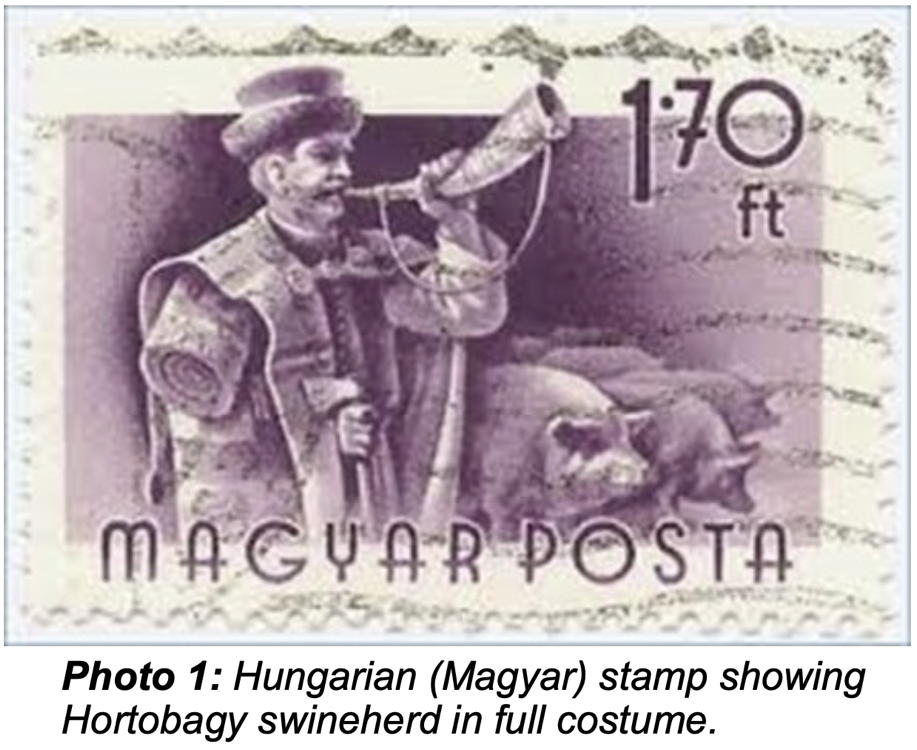 The Hungarians, or Magyar as they call themselves (Photo 1) – live right in the center of Europe, yet speak a language unrelated to any ot their neighbors! The Slavic, Germanic, Romance, and even Albanian speakers, who almost entirely fill up Europe, all speak varieties of the "Indo-European" language family (which, yes, reaches all the way to India). But not the Hungarians, who as nomadic herders moved southwestward out of their Central Asian homeland just east of the Urals some 3000 years ago, first into eastern Europe, and finally reaching their present location in the 9th century. So if you go to Hungary, you won't recognize a word: they haven't even borrowed the usual words for hotel and restaurant! (Their closest linguistic relatives include Finnic and other peoples of the far north.)
Being so isolated linguistically, the Magyar also retained many old indigenous customs, until conversion to Catholicism, followed eventually by urbanization, began to shift things. Until World War II mixed people together and provided far more roads, the village customs remained archaic and quite different from city ways. One interesting example – because it often involved dancing – is the set of customs of courting. How did villagers go about acquiring a mate? The ages of prospective spouses were somewhat different. Girls became eligible to marry between roughly fourteen and eighteen, often when they finished school.
But boys had to finish their years of service as a soldier first, hence they might be twenty-five or more. Village children usually knew each other, of course, and might have chosen a szeretoje (sweetheart) early. But this could make life difficult when the debonair army recruiters came around, strutting their showiest, boot-slapping Verbunk dances and flirting with the girls till the poor village boys had to sign up to win their girls back! (Verbunk is actually a loanword from German Werbung meaning "recruiting.")
 All the villagers knew who was "available." The girl, known as eladó lány (girl for sale) was given a ceger – a pole bedecked with ribbons, red corn, and a pitcher on top, set up in front of her house. (Marriage no longer actually involved selling the bride, but the term long survived that custom, which had replaced the even older custom of kidnapping her.) In Transylvania, the boy used to receive a silver coin from his father with which to (symbolically)
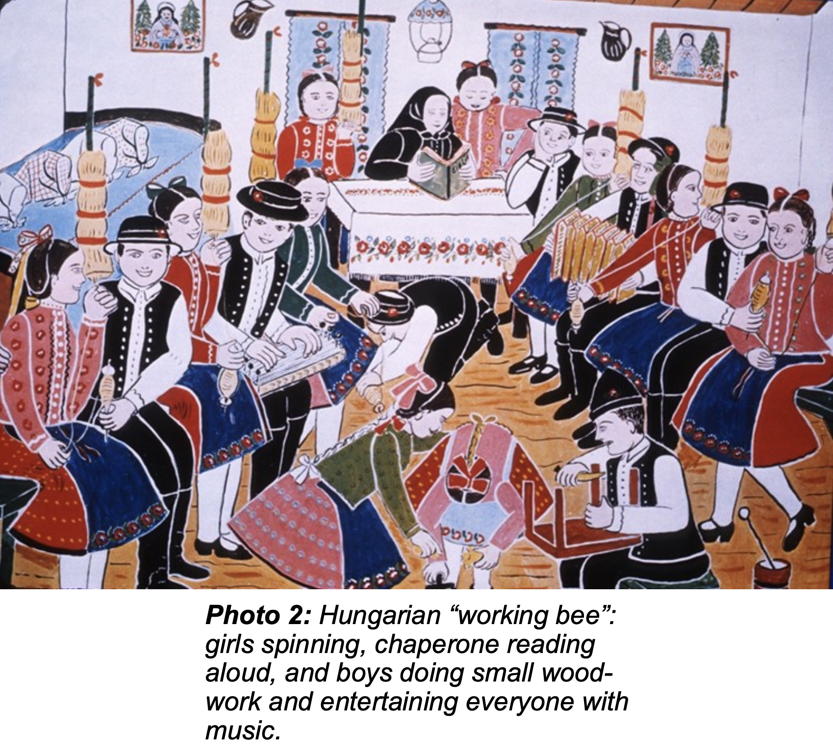
"buy" a wife. He would offer it to the girl of his choice – but she had the option of handing him a basket to show refusal! Usually, however, the young people had ample time and place to make up their own minds. The young men could visit the girls as they sat together spinning, weaving, and embroidering their future trousseaus (Photo 2); or chat with them on "girl's day" (generally Tuesdays, Thursdays, and Saturdays), standing together at the gate to a girl's yard; or join in the dancing all afternoon in the village square after mass on Sundays – a custom that I saw still in full swing during the 1980s, and which was shared with most of Hungary's Slavic neighbors.
All the villagers knew who was "available." The girl, known as eladó lány (girl for sale) was given a ceger – a pole bedecked with ribbons, red corn, and a pitcher on top, set up in front of her house. (Marriage no longer actually involved selling the bride, but the term long survived that custom, which had replaced the even older custom of kidnapping her.) In Transylvania, the boy used to receive a silver coin from his father with which to (symbolically)
"buy" a wife. He would offer it to the girl of his choice – but she had the option of handing him a basket to show refusal! Usually, however, the young people had ample time and place to make up their own minds. The young men could visit the girls as they sat together spinning, weaving, and embroidering their future trousseaus (Photo 2); or chat with them on "girl's day" (generally Tuesdays, Thursdays, and Saturdays), standing together at the gate to a girl's yard; or join in the dancing all afternoon in the village square after mass on Sundays – a custom that I saw still in full swing during the 1980s, and which was shared with most of Hungary's Slavic neighbors.
In general, marriages took place within the village, in which case a whole series of visits back and forth occurred between the two households: first to sound out whether both families were okay with this, then to clinch it with a ritual full of delightful symbolism (once again shared with, for example, the South Slavs). The young man would arrive at the girl's house with his parents, relatives, and perhaps friends too, making a lot of noise to let everyone around know that the official leánykérés (asking about the girl) was about to happen. They would ask, for example, if the family could supply them with a mate for their dove, or a flower to grow beside their own flower. Usually the girl was supplied in answer, but if the family had changed its mind, the boy's coat was set out on the front porch.
Once the engagement was official – signaled by the kézfogáls (handshaking) and an exchange of gifts – the boy was free to visit the girl any day of the week, and indoors (not just at the gate!). And she could finally visit his family.
If the girl came from a different village, she continued to wear the folk costume from her own village after marriage. This is unusual in the Balkans, where the bride had to wear a simple version of her new village's costume. (It was simple, untortunately, because she had not had her whole childhood to make and lavishly embroider it. The elaborate one she had made at home she could wear no longer, her work wasted.) The one place in Hungary, apparently, where the girl was expected to change to the local dress was in Mezökövesd, the center of the Matyó area.
Bibliography
- Andor and Ann Czompo. Hungarian Pre-Wedding Customs. 1975.
Printed in Folk Dance Scene, October 2024