|
Folk Dance Federation of California, South, Inc.
DANCING WITH TWO LEFT FEET |

|
CLICK AN IMAGE TO ENLARGE
 Most of my previous articles covered the subjects of dancing. This one will touch on a subject that is an integral part of the dancing culture of the Balkans. It is about the culture of drinking Turkish coffee consumed throughout the Middle East, North Africa, Caucasus, and the Balkans, and in their expatriate communities and restaurants in the rest of the world.
You might ask how Turkish coffee is connected to dancing. Just as identical or similar dances and melodies are claimed as their own by each one of the Balkan countries, so is Turkish coffee claimed by them as well. Despite all the claims and called by different names, the black muddy concoction is almost identical in all the countries.
You would seriously offend an Armenian or a Greek by asking for Turkish coffee and not for "Armenian" or "Greek" coffee even though the black and thick liquid you get is the same. In Yugoslavia, you are welcome to say Turkish coffee or better yet "Turska kafa."
My Young days in Yugoslavia were spent with my Sarajevo coffee drinking, cigarette-smoking aunts that included coffee rituals similar to all the other regions. The raw green coffee beans roasted by my aunt in the flat pan emitted an aroma that still lingers in the nostrils of my memory.
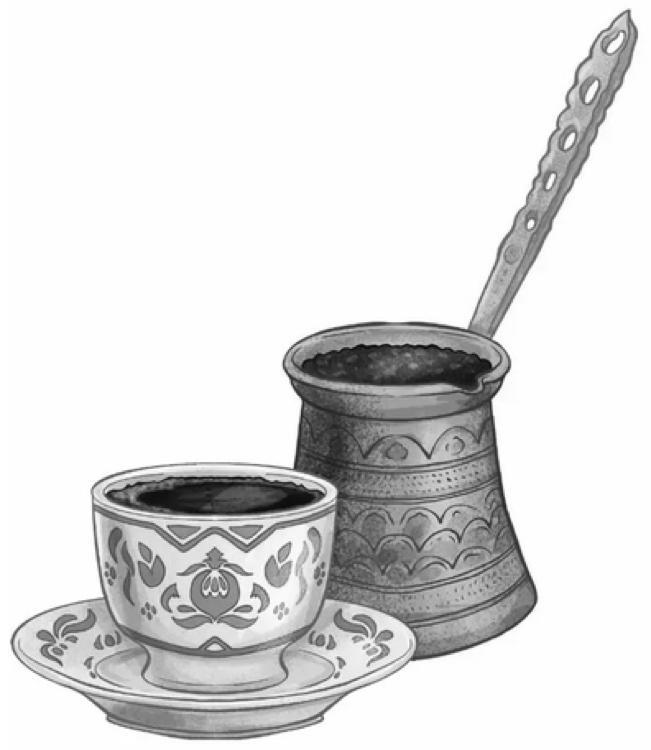 Once roasted it was my chore to grind the dark beans in a brass grinder into a fine powdery dust. Brewing the coffee was also a ritual that had to be precisely followed. Water, boiled in a copper pot with a wooden handle called džezva was sweetened by three teaspoons of sugar and then followed by stirring in exactly three teaspoons of the finally ground coffee. It was crucial to allow the brew to boil, removing the pot from the heat source just prior to boiling over, allow it to settle, and then repeat the process exactly three times.
The coffee had to be immediately poured into small tea cups with no handles called findžan and the boiling hot coffee sipped with a definite slurping sound to cool the liquid.
While I, at my tender age, was not a coffee drinker, I anxiously awaited my reward as the finished cups were overturned into small saucers and the muddy coffee drippings seeped out of the upturned cup. Once turned back up, the cups revealed a plethora of black and white pictures all around the insides of the cup. The pictures interpreted by my aunt, predicted each drinker's fortune and were embellished by her into fantastic stories of marriage, birth, death, money fortunes, and lucky and unlucky events. I listened, my eyes wide open, wondering how she was able to see all of this just by looking into a muddy cup. Like an experienced fortuneteller, she would never reveal her secrets and I am still wondering how she was able to see fantastic pictures and tell such intricate stories hidden in the small cup.
Doing a bit of "scientific" research into this "occult art," I found out that the white images, peeking out of the dark coffee grounds predicted good happenings when the dark ones predicted bad happenings to come. Rings indicated completed deals, and if they contained a dot inside, they fulfilled the desire for children. Images of flames stood for quarrels, lines for a journey, crosses for victory over an ordeal, and ladder for promotions. My conclusion is that these are the only interpretations of one person and that the symbols are interpreted differently not only in each different region but also by each individual coffee grounds reader.
Just like the coffee drinking tradition folk dances may be interpreted differently in various regions. We may often listen to a familiar rhythm that we are associated with Bulgaria, only to find the Greeks are doing their own steps to the same beat.
So, no matter how you sip your coffee, or dance, it might be Turkish, Bulgarian, Armenian, or Greek. Enjoy.
Printed in Folk Dance Scene, "DANCING WITH TWO LEFT FEET (31), December/January 2007/2008.