|
Folk Dance Federation of California, South, Inc.
|

|
CLICK AN IMAGE TO ENLARGE
HISTORICAL OVERVIEW
Contra dance arrived in this country with the English settlers. In the beginning, everyone of every social class in the thirteen colonies knew and danced them. After the Revolution, the dance titles took on a different significance. Such names as British Sorrow, Jefferson and Liberty, and Hull's Victory were considered to be more "American" and replaced some of the older dances. With time, and particularly after the War of 1812, contra dances grew out of favor within some of the regions and the new French quadrilles (later named "square dances") grew in popularity in these areas. The one region where contras continued to survive, and eventually thrive and evolve, was New England.
CHARACTERISTICS OF THE DANCE
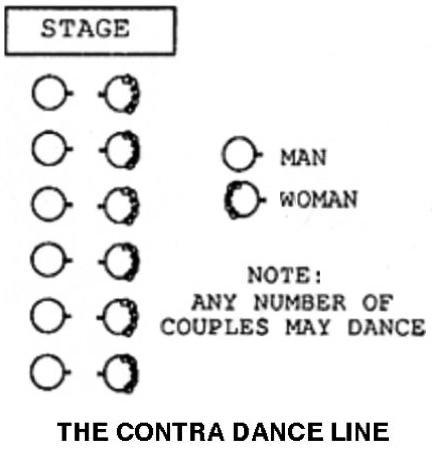 Contra dances are done in longways sets (see graphic at right). Couples stand opposite their partner and couples line up down the dance hall (from the stage if there is one). If there are too many couples in the hall, they form an additional second or even a third set if the hall is wide enough. The band and a caller sit and stand at one end of the hall (on a stage if there is one). This end of the hall is referred to as the "top" or "head" of the hall, and the other end is termed the "bottom" or "foot." Historically, these terms are held over from European courts in which the end of the hall where royal "presence" sat was the "head" of the hall.
Sub-sets are formed within the greater set by having the first couple joining hands with the second couple, and the third couple joining hands with the fourth couple, and so on down the set. Every odd numbered couple is considered "active" and the other couple in the sub-set (even numbered) is "inactive." These sub-sets of two couples are what give it the designation "duple." There have also been many old-style dances that are danced in a "triple" formation where each sub-set has one active and two inactive couples.
In every contra dance there is a "progression" in which, during one cycle of a 64-beat choreography (a complete AABB phrasing), the "active" couple progresses down the set one position and starts the cycle all over again with the next "inactive" couple. If there were no progression, the result would be that the couple would remain in the same position, dancing with the same people over and over again. This "progression" gives the dance its visiting-couples effect.
Dances such as the Virginia Reel are called "whole-set dances" because all the couples in the set are considered to be one "whole" with no sub-sets. The top or head couple is the only active couple, while all others are inactive. Sets are formed with the men all on one side in a long line facing the women's side with partners directly across from each other. These are among the oldest dances. Also among the older dances are those that are done "duple" and "proper." In these sets the "proper" refers to the men staying in one long line opposite the women's line as in whole-set dances. A newer development is dances that are done "duple" and "improper." In these sets the "improper" refers to the active couples crossing over and exchanging places with their partners. The active women now being in the "men's line" and the active man now being in the "women's line." Therefor, the term "improper." As the couples hold hands in their circle-of-four, they are now positioned man, woman, man, woman. Most of the dances done today are in an "improper" formation.
HISTORICAL DEVELOPMENT AND TRENDS
Contra dancing went through a series of changes over the years. In the early nineteenth century "proper" dances are preferred. By the mid-nineteenth century the preference is for "improper" dances. Around 1900, the longway set continues to hang on in New England, but squares (quadrilles) start to move west and south. Although contra dances are preserved in New England, they decline in popularity even there.
In 1926, Henry Ford's Good Morning is published. Among other dances, it contains fifteen contras. Ford attempts to influence his workers to engage in the wholesome "dances of our northern peoples" instead of those "immoral" dances of the dance hall. Around 1930, a square-dance revival begins. "Square dance" programs included squares, contras, and couple dances such as Fox Trot and Waltz.
Ralph Page (1903-1985) was very influential in perpetuating contras and squares in New England. As a dance musician turned caller, he became the dean of contra dance by calling the old-time squares an contras and being a repository of tradition. After World War II, the "club" square dance movement starts and changes the way Americans look upon the old form. Club squares eventually became too complicated for most dancers.
Around 1950, the first contra dance revival begins in New England. Squares and contras reach fad status because urban dwellers who skied in Vermont and New Hampshire discovered country dance an began hiring callers such as Ralph Page for their parties in Boston and other urban centers. A few of these cityfolk learned to call, and contra dance became a pert of the urban scene once again. The old-style contra involved the active couples doing most of the dancing and the inactive couples waiting their turns to become active. Caller Herbie Gaudreau starts to change all of that by choreographing "equal, all-moving" dances, which are in demand today.
In the early 1960s, the second contra dance revival begins in New England. During the 60s, interest in squares and contras declined somewhat. A few "traditionalists" however, assisted in breaking away from the club square dance movement and caught the attention of college students in the northeast. By now, they were referring to it as "contra dancing" rather than square dancing to distinguish it from the club movement. Many new, young people learned to play contra music and new, young callers came on the scene. Contra choreographers, in a quest for new material, borrowed from English country dance and figures such as Hey Gypsy and Half-figure-eight are introduced into the American contra dance scene.
In the 1970s, contra dancing spreads to many urban areas across the United States. Dancers in these communities are very sophisticated and highly educated urbanites who are not opposed to using the tools of modern-day technology to promote their groups. Today, virtually every contra dance group across the nation has a web page announcing their dance schedule.
Some of the current trends and controversies of today's contra dancing involve whether it's becoming too complicated like club square dances, whether there is too much standardization across the nation, thus losing its regional variations, and whether its becoming too professional because the callers and musicians are being paid increasingly larger fees.
REFERENCES
Parkes, Tony. Contra Dance Calling. Bedford, MA: Hands Four Books, 1992.
Sannella, Ted. Balance and Swing. New York: Country Dance and Song Society, 1982.
Tolman, Beth & Ralph Page. The Country Dance Book. Weston, VT: Countryman Press, 1937.
Printed in Folk Dance Scene, May 2004