|
Folk Dance Federation of California, South, Inc.
|
|
CLICK AN IMAGE TO ENLARGE
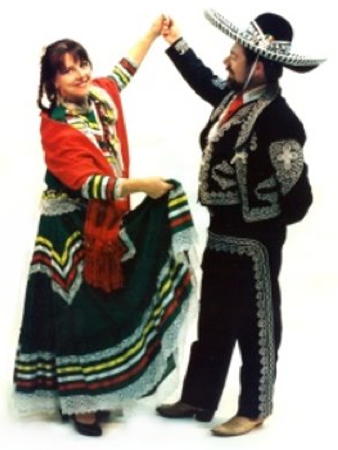 One of the most popular and diversified regional dances of Mexico is the jarabe. Many states of Mexico have their unique and regional style, filled with special local folklore, as witnessed in the dance steps, the musical aCcompaniment, the regional costumes and the attitudes of the dancers.
The highly regarded Mexican musicologist, Gabriel Salazar, traces the origin of the jarabe as a dance form to Spain. He asserts that in the middle of the 18th century, the Spanish dance Seguidilla Manchega began to be called Jarabe Gitano, and that with this name the dance was eventually transported to Mexico. It is now generally accepted that this dance is a direct descendant of the 16th century Spanish dances such as the aforementioned Seguidilla, the Fandango, and Sambra. During the 16th and 17th centuries, the Spanish colonists carried these dances to the rural areas of Mexico, to small villages and ranchos where they underwent changes as the Spanish and Indian cultures intermingled. These Spanish dances became more subdued and less elevated. As the races intermingled, so did the music and dances, forming a mestizo music, termed son.
The main characteristic of the son is its vigorous rhythms played in combination of 6/8 and 3/4 time. Inherent in the sones are both the song and the dance. They generally begin with a musical selection, followed by the song which then alternates with the choruses and musical interludes throughout the piece. During the instrumental sections, the dancers execute fast steps, called zapateados. Usually during the singing, the dancers go through slower steps, called a paseado or valseado section.
Many sones are named after animals and have dance steps in imitation of the movements of those animals. Often the instrumentation will mimic the sounds of those animals, as well (e.g. trumpets made to sound like a horse's whinny or violins creating the effect of a burro braying).
The jarabe and son were prohibited during the Inquisition and those performing either were subject to excommunication by the Church. In 1802, the Mexican Viceroy was told about the Jarabe Gatuno which was then being introduced into Mexico. Because of its "indecent movements, actions, and verses," it was said to cause "shame" and displeased persons who had "delicate feelings." Reacting to this, the Viceroy decreed that anyone who did this dance would be subjected to public shame and be put in prison for two years. Those watching the dance would be jailed for two months.
Despite all of these prohibitions, the regional sones and jarabes gained in acceptance amongst the populace in the last half of the 18th century. This was partially due to their inclusion under the category of "sonecitos del pais" in the popular theatres all through Mexico.
During the wars for independence (1810-1821), the insurgents utilized the jarabe as a rallying cry and a means by to popularize their ideas. With independence, it became one of the most popular of the mestizo dance forms. It grew to maturity during the first third of the 19th century, when different forms of the dance became associated with different regions. 1821-1856, the jarabe was danced throughout the country. Antonio Garcia Cubas, Mexico's chronicler of 19th century customs, gives the following description of how a jarabe was danced around 1840, by the lower classes on the canoes which traveled on the Canal de la Viga, carrying people on outings to the pueblo of Santa Anita on the outskirts of Mexico City:
"To the beat of the gay, lively music of the jarabe the dancers execute fast zapateados on the wooden floor, and others, though not wearing shoes, their still take pride in ability to dance barefooted; everyone moves their feet with agility, moving about and alternating the rhythm of the rapid footwork; sometimes they approach their partner and at other times they back away; sometimes they dance erect with their hands placed behind them; sometimes they bend the body forward, letting arms fall to their sides...."
Throughout the 19th century, certain of the sones and jarabes were popular under special circumstances. El Telele (the fainter) was danced and sung in 1833 during the year of the first cholera epidemic. The dancers publicly imitated the contortions and grimaces of those attacked by the disease. La Guacamaya (the macaw) ironically comments upon the political struggles between Santa Ana and Comonfort in the years 1854-1855. The only way people of the pueblo could openly comment upon political without danger themselves was in the allusive form of singing and dancing to the verses of a jarabe. During the War of the Reform (1858- 1861), the chinacos, the soldiers of Benito Juarez, used the son "La China" battle hymn.
The sones and jarabes were generally rejected by the upper classes as this music was considered to be vulgar and in poor taste and because these songs and dances were always associated with the Liberal revolts of the era. It was not until 1862 that the jarabe began to be noticed by the upper classes. At that time, Emperor Maximilian, wanting to win popularity with the Mexican people, included some of the jarabes at the functions he sponsored in high society in the city of Guadalajara.
In the year 1918, the jarabe gained international recognition. In that year, the famous ballerina, Pavlova, was giving dance recitals in Mexico City. She included a Mexican ballet of popular dances, of which the jarabe was one, in her repertoire.
The Revolution of 1910 placed a new emphasis upon the regional folk art of the Mexican pueblo. The mestizo music and dance of rural Mexico began to play a vital part of the Mexico. In the period 1920-1924, the native Mexican folk arts, song and dance, came to be officially promoted by the Mexican government. The Department of Physical Culture of the Ministry of Education adopted the stage form of the jarabe, which was essentially composed of sones from the state of Jalisco, and made it a part of the regional dance curriculum to be taught in all federal public schools.
During the 1930s, a new interpretation was placed on the styling of these dances. The village style was modified and came to be danced in a subdued and controlled manner, with the couples facing each other and dancing around one another. The village women did not use their body or skirt for flirtation. The couples danced with their teet only, with very little movement of the upper part of the body and with little interest shown between the partners. So, the jarabe, in its new interpretation, became a dance of courtship. The man flirtatiously followed the woman throughout the dance and courted her until she yielded; then the woman picked up a sombrero from the ground and the couple danced the final son, La Diana, together.
It is this stylized form of the jarabe which is now danced throughout Mexico under the name Jarabe Tapatío. The sones played for the Jarabe Tapatío are always the same, but there are many versions of the choreography. This dance is the one commonly known in the U.S. as The Mexican Hat Dance.
Paraphrased from the ANGF Journal, Vol. V, No. 1, with permission from Susan Cashion, editor.
Printed in Folk Dance Scene, December 1986