|
Folk Dance Federation of California, South, Inc.
|

|
CLICK AN IMAGE TO ENLARGE
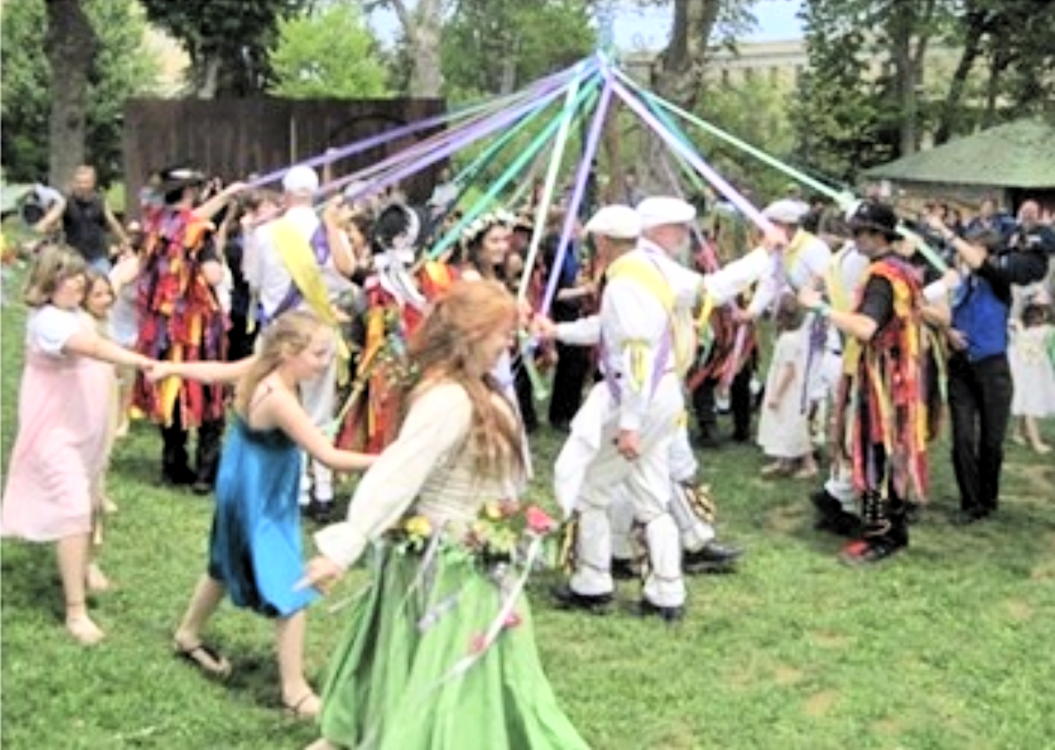 The traditional Maypole Dance has its roots in the ancient tradition of dancing around a living tree to celebrate spring's fertility as part of May Day celebrations. Colorful ribbons are attached to the tree or pole, and dancers circled around, weaving ribbons into intricate patterns. Similar ribbon dances were performed in pre-Columbian Latin America and were later integrated into ritual dances of Hispanic origin.
While the dance is typically done at May Day celebrations on May first, similar dances are done at midsummer in Scandinavia and at various times of year elsewhere. They are common through Europe, from the "Sellinger's Round" in England to the "Baile del Cordón" of Spain, and even in India.
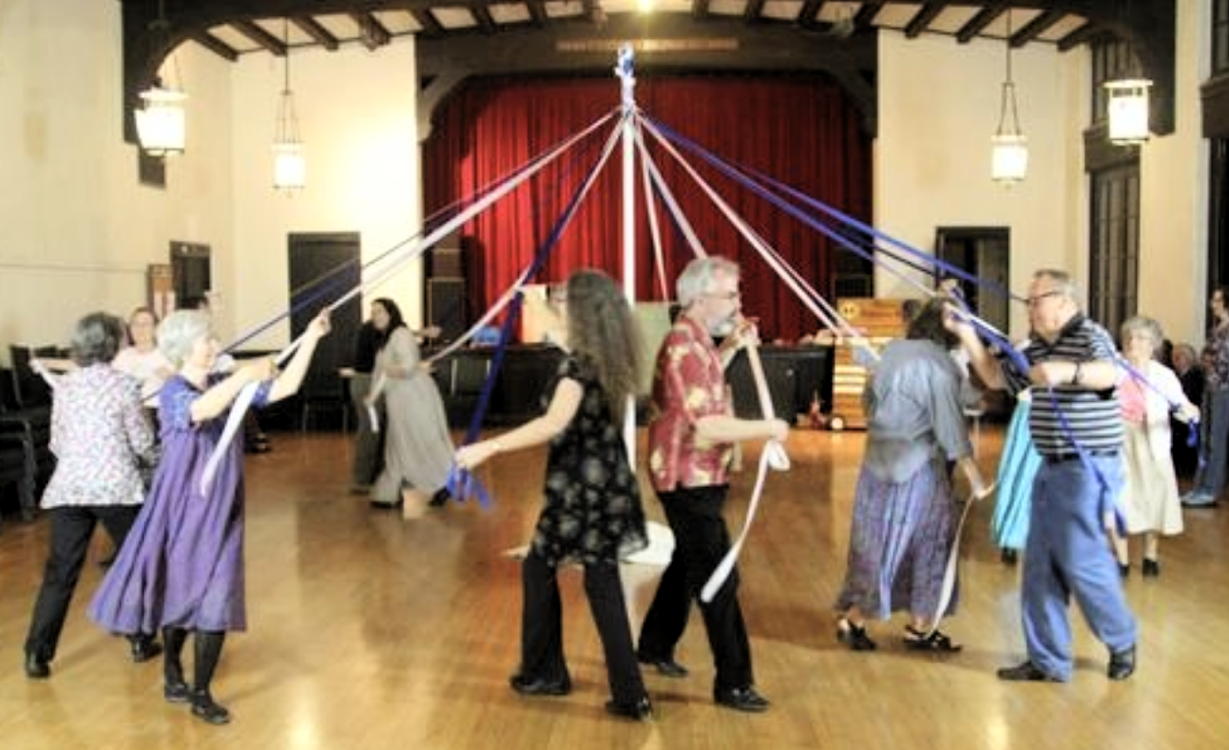 In England in the 1500s, the established church and state saw these May Day festivals as pagan rituals and decried them as "a heathenish vanity generally abused to superstition and wickedness." When they were officially banned, riots ensued in which fourteen rioters were hanged and 400 more were sentenced to death, but were pardoned by King Henry VII. Following the English civil war when the Puritans took control of the country in 1645, legislation was passed that ended village maypoles throughout the country. Dancing did not return to the village greens until Charles II, "The Merry Monarch," helped ensure the support of his subjects with the erection of a massive 40-meter-high maypole in London's Strand. This pole signaled the return of the fun times, and it remained standing for almost fifty years.
The first recorded Maypole Dance in America was held in 1622 on Damariscove Island, Maine. The dance began to be popular in this country in the late 1800s, and May Day celebrations often included crowning a Queen of May to celebrate spring's fertility. In addition to the Maypole Dance, these celebrations sometimes featured Scottish, English, and Morris dancing.
May Day is still very popular around the world. It is an official holiday in 66 countries and unofficially celebrated in many others. Celebrations are not as commonplace in the U.S., but they can be found in schools and at Renaissance faires, historical museums, and community festivals. For example, Prague, Nebraska, features an annual traditional Czech Maypole Dance. And the Maypole Dance was declared the Official State Dance of Delaware in 2016 (but only for one year!).
Printed in Folk Dance Scene, February 2025