|
Folk Dance Federation of California, South, Inc.
|
|
CLICK AN IMAGE TO ENLARGE
The Pow Wow (also Pow-Wow and Powow) can be seen as a spiritual and physical gathering of the Native American people of the plains. Though there are many tribes that compose these people all are united by common philosophies, common symbolism, and a common spiritual base. This is not to say that they are all the same, but rather they share many of their ways and ideas.
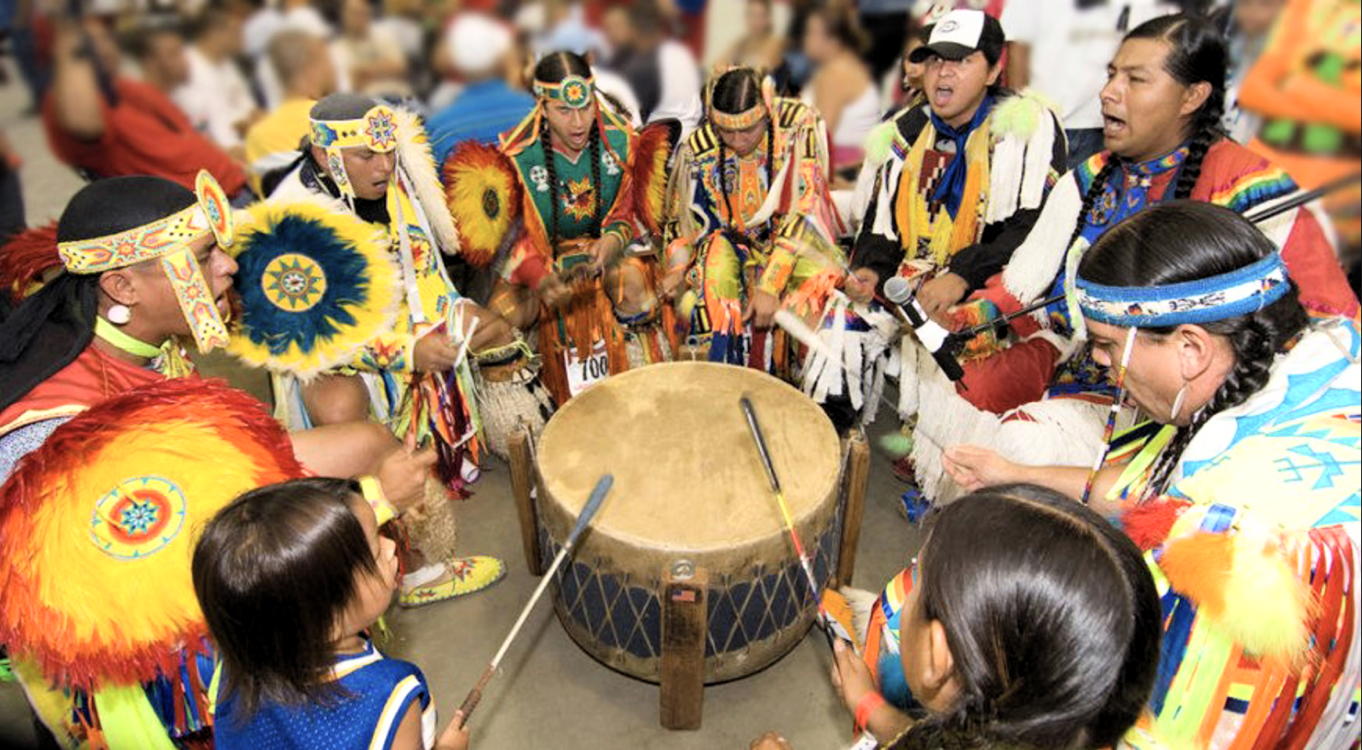
The dance area is set up as a series of concentric circles, with the center containing the main drum (representing the "circle of life") being the most important. Symbolically, the drum is equivalent to the buffalo, the staff of life to the plains Native Americans. And the drum beata is "the heartbeat of the people." The next circle out contains the singers and their drums, those who determine what dances will be done at 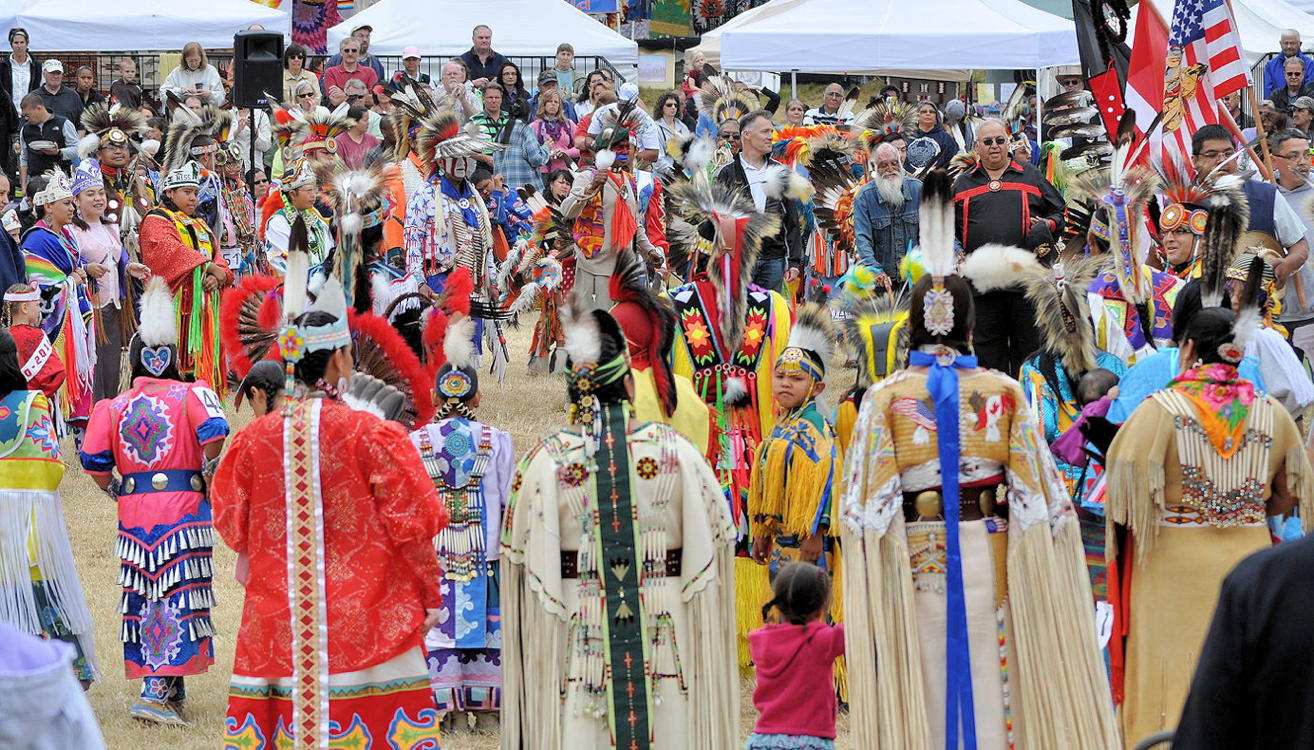 that Pow Wow session (there is a different song for every dance). Next come the dancers, who move clockwise around the drum and singers, always in time to the drum, thereby coming into harmony with themselves. The dancers' path around the drum clockwise as it is seen as symbolic of the revolution of the planets around the sun. On the rare occasions when the dancers move counterclockwise around the "sun," they do so to symbolize strife, disaster, death, or oppression. The outermost circle contains the non-dancers, flanked to the outside by non-Native American observers.
Structurally, monthly and annual Pow Wows follow the same pattern, the main difference between the two types being the location and length of the event. Monthly Pow Wows last for one evening only and are generally held indoors at a large gymnasium or other hall. Annual Pow Wows are held outdoors, as far removed from the city as possible, and usually start on a Friday evening and end on Sunday. Primarily due to the location, the annual Pow Wows are more in the public domain than the monthly one, open to "outsiders," who are charged an entry fee.
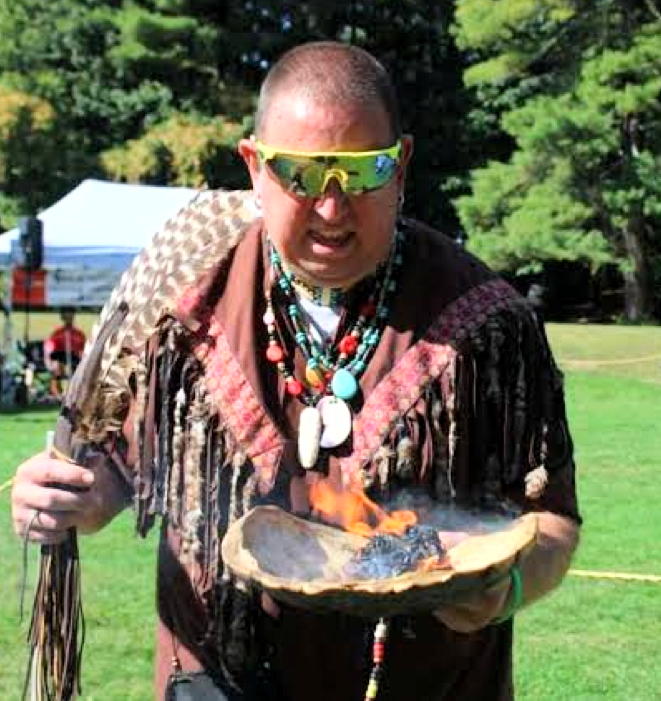 Though the Pow Wows officially start with the consecration of the dance arena, in which a respected elder offers a prayer for the community (in English and the Native American tongue) and the "Flag Song" (the national anthem of the Native American people) is sung, there are activities for the people beforehand. At the monthly Pow Wows, Round Dances are played by the "drums" (singer and drummer groups), and all who wish to dance form small lines, standing shoulder to shoulder, facing the drummers. Everyone moves clockwise around the central drum, and continues dancing for as many "songs" as they like. As the dancers tire, they move to the perimeter of the room to socialize. Though the annual Pow Wows start "officially" on Friday evening, they run on "Native American time" (always a little late), so, to fill time before ceremonies begin, members of the Kiowas tribe, for instance, generally perform Gourd Dances and songs.
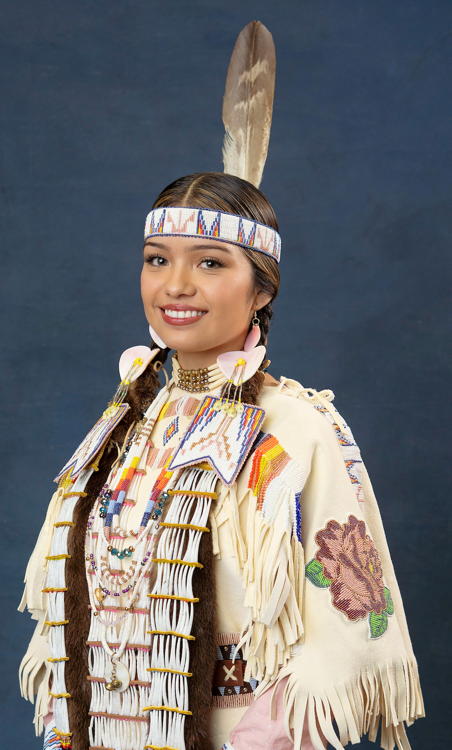 Once the dance arena is consecrated at the monthly Pow Wow, no one other than the head dancers and Pow Wow princess enter or cross the dance area until the first war-dance song is done to honor the princess. She enters the area in full costume and moves clockwise around the center drum. After she has made one circuit around the drum, others may join her, and generally do so in small clusters of peers. Most dance using a basic step, which is a kind of stylized walking, and add their own improvisations as the inspiration moves them. Following this first dance will be at least fifteen more war-dance songs performed, and all may dance.
At the annual Pow Wows, each session (Saturday day, Saturday evening, and Sunday day) has the "Flag Song," an invocation, the Grand Entry, Round Dancing, intertribal war dances, announcements, contests, give-aways, and some specialty dances. Gourd Dancing is a common prelude to each session. On Saturday night, there is also the "Forty-Nine" a social round dance that stretches from midnight to the wee hours of the morning.
After the "Flag Song," there is about a half hour of Round Dances. Everyone then stands as the "Starting" or "Entry Song" is played and all the dancers enter the arena for the first time. They do so in a preset order: flag bearers are first, followed by the head male and female dancers, who are in turn followed by the Pow Wow princesses and visiting princesses.
The "Special" is an honoring song, offering tribute to a particular member of the Indian community. During the song, a family member usually holds a hat into which all wanting to pay tribute to the honoree may place money. They shake the hand of the honoree, put money into the hat, and then join the honoring procession. Often a shawl is given to the honoree as a gift to be worn during the dancing after the "Special" is sung. After the "Special," the honoree and his family host a give-away. During the give-away, the honoree shares his/her honor with the community by giving various gifts to people present at the Pow Wow. Items include blankets, shawls, groceries, jewelry, personal and household items, and cash. These gifts are both symbolic and tangible, serving to reinforce social alliances and interdependence amongst the People, and to manifest the ideals of the community.
Then there is the Two-Step Dance, a woman's choice dance which is led by a head couple who initiate all the figures of the dance. This is followed by a Blanket Dance during which a blanket is laid out to collect money to pay the drummers, and then several more war-dance songs. There is also a raffle, followed by more war-dance songs and finally, the "Veteran's Song," done to honor all men present who served in the armed forces. All except the singers stand during this song in a gesture of respect. The finishing song is the "Quitting Song," which everyone stands and sings. Nobody dances. And the event is over.
Bibliography
Gilbert, Tamara Beth. American Indian PowWow Dance in Los Angeles: Dancers' perspectives. Doctoral Dissertation, UCLA. 1982.
Southern California Indian Center, Inc. 27th Annual Pow Wow. August 4, 5, & 6, 1995. Event Guide. SCIC, 1995.
Storm, Hyemeyohsts. Seven Arrows. Ballantine Books, New York. 1972
Used with permission of the authors.
Printed in Folk Dance Scene, December 1995.