|
Folk Dance Federation of California, South, Inc.
|
|
CLICK AN IMAGE TO ENLARGE
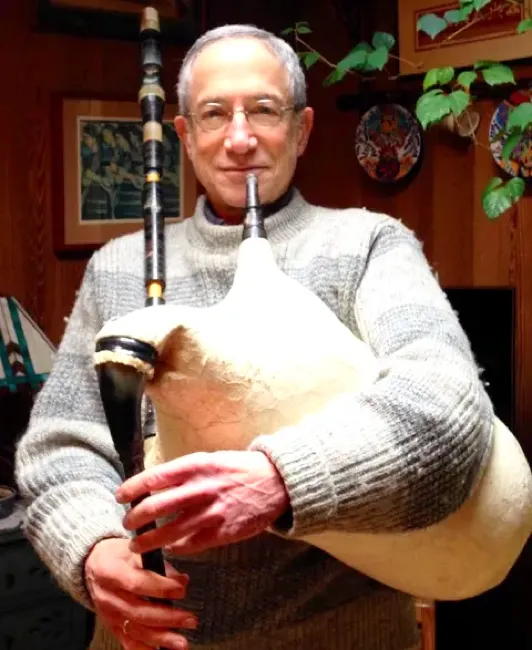
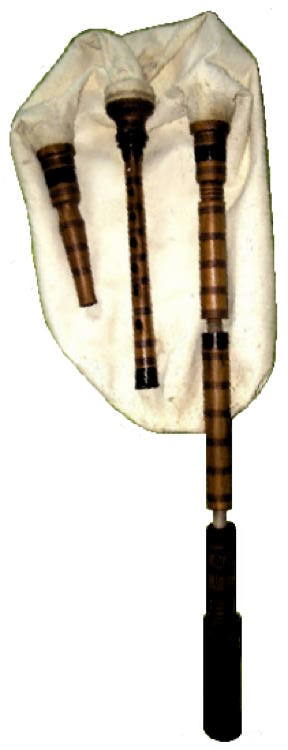 Bagpipes are found in great variety through Asia, North Africa, and Europe. In Bulgaria, the gajda continues to play an important role in music-making events. The following comments focus on the roles and functions of gajda playing in both traditional and contemporary village life in the central Rhodope Mountains. Data were gathered during research trips in 1976 and 1979-80. First, I shall discuss those contexts for music making which were most common before the socialist revolution of September 9, 1944. Then, we shall see how these have continued, changed, or have been replaced by different contexts during the post-war period. This division between "past" and "present" reflects the native categories of Rhodope villagers, who speak of situations and events predi deveti or sled deveti, i.e., before or after "the ninth."
In the Rhodopes, the gajda is played primarily by Christian males and has a close association with shepherding. The instrument is most commonly played alone or in pairs, often to accompany solo or group singing. In most areas of Bulgaria, there has traditionally been a separation between male and female realms with respect to daily work, ritual, and leisure activities. This in turn is reflected in differences between male-dominated instrumental music, and female-dominated singing. In the Rhodopes, however, there is a closer association between instrumental and vocal music than in other parts of the country.
Men have a comparatively greater role in singing here. In addition, there is a tradition of men and women singing together in unison, a rare or unknown phenomenon in other areas. As a result, one of the main functions of the gajda in the Rhodopes is to provide accompaniment for singing. This role is reflected in the instrument's repertoire, which consists mainly of instrumental versions of song melodies, with only a few genres which are not based directly on songs. In Thrace, the gajda was an integral part of calendrical rituals during the pre-war period. Since agriculture was not as widespread in the Rhodopes, such rituals were less important. Furthermore, the absence of the village males for half of the year, while they grazed the sheep along the Aegean coast, prevented them from participating in winter and spring rituals. The gajda was, however, indispensable at weddings, social gatherings involving eating and drinking around the table, village Saint's Day festivals, dancing on Sundays, while tending sheep, and at work-parties and name-day celebrations.
WEDDINGS
Weddings were an extremely important context for music-making. The gajda player (gajdar) was generally hired and paid by the groom's family, with a second musician sometimes engaged by the bride's side. It was desirable to have more than one gajdar, for there were often simultaneous activities in different locations. Even in a single location, the cacophony of different songs being played and sung at the same time contributed to the festive atmosphere.
While the most important rituals and festivals took place on Sunday, preparations for the wedding would occupy the preceding week. Gajda music and singing accompanied such activities as the preparation of the dowry and the ritual shaving of the groom. On Sunday morning, there were processions through the village to announce the wedding and gather the important relatives and guests. The gajdari lead the procession, playing slow songs in free rhythm. The procession eventually made its way to the bride's house, where the bargaining and payment for the dowry took place. Next followed the most important and emotionally intense moment of the wedding, the departure of the bride from her parents' house to become a member of the groom's family. Gajda playing accompanied the ritual klanene, in which the bride bowed to her family, asking for their forgiveness.
Throughout the banquet which followed, the wedding guests sang with the gajdari while sitting at long tables. One song followed another, sometimes initiated by a guest, sometimes by a gajdar. After the banquet, there was a dance (horo) in the village square with music provided by the gaydar. While the preceding wedding activities were intended for invited guests only, the horo was open to the entire village. Various members of the wedding party took turns leading the line: parents, godparents, uncles, etc., and finally the groom and bride. In larger villages, there would sometimes be more than one wedding on a particular Sunday. In the afternoon, participants from each wedding would converge at the village square and have a combined horo, resulting in as many as five or six gajdari playing together simultaneously. After the horo, the bride's family departed, and the groom's family continued the festivities.
Later, processions accompanied various relatives and guests as they returned to their homes. Another important context for gajda playing was the village Saint's Day festival (subor). Once a year, each village celebrated the feast day of the patron Saint after which its church was named. A gajdar would know when and where the important Saint's Days were held in his region and would travel to them to participate in the festivities. Some festivals lasted for two or three days.
In general, these festivals were opportunities for those who had moved away from the village to return and see relatives and friends once again. It was also a time for shepherds and masons, who spent a good part of the year away from the village, to look for potential brides. In many homes, a lamb was slaughtered and roasted over an open fire. Later in the day, everyone gathered at a designated meadow. Some gajdari accompanied singing around the periphery of the dance area, while others provided music for the horo. In the evening, there were work-parties in various homes and gatherings at the local taverns, many involving music. While some Saint's day festivals were celebrated locally, others attracted participants from all over the Rhodopes.
I have shown that an important part of both the wedding and festival was the time devoted to the dance, or horo. Before the war, the horo also took place regularly on Sundays after church, and sometimes in the evenings outside the tavern. The majority of Rhodope dance songs are intended to accompany the commonly done pravo horo in duple meter. Singing was done by the entire dance line or only by thoses at the head of the line (i.e., near the gajdar). The decision to change from one sona to another was made by one of the gajdari or one of the dancers.
After a number of dance songs, the gajdar began playing the purely instrumental improvisatory music called sitnez, whereupon the dancers began moving more vigorously, swinging their arms and shouting. After a while, the gajdar would initiate a return to more dance songs, at which point the line once again moved more sedately. The hours-long horo was thus punctuated by numerous changes in mood and energy. While the shepherds were away during the winter, and at other times during the year, the villagers would frequently gather at evening work-parties mezii, poprelki, sedenki). These were important times for socializing and courtship among unmarried men and women.
As the women worked (at spinning, sewing, embroidery, lacework, tobacco stringing, etc.), they would sing together in small groups. During the course of the evening, bachelors might. join the gathering, with those who could play bringing gajdi or other instruments. A number of musicians today say that they learned a good portion of their song repertoire at work-parties following along while the women sang. The gathering would often end with a horo.
Up to this point, I have described the most important contexts of gajda playing in the Rhodopes during the pre-war period. It should be noted that within these varied contexts, there were three major distinct activities associated with the gajda: playing at the table, for dancing, and tor processionals. These three activities were imbedded in multiple contexts. For example, table music occurred at weddings, on name-days, at taverns, etc.
PRESENT CONTEXTS
While some traditional contexts of gajda playing continue to the present in much the same form, others have changed dramatically, and still others have been replaced by newly-created contexts. With respect to past events, gajdari usually mention weddings, Saint's Day Festivals, and the Sunday dance as being most important. On the other hand, they also speak of banquets, concerts, and government-sponsored ceremonies, and festivals. Let us now turn to these contemporary contexts.
Although weddings remain the most important village context for music and dance throughout Bulgaria, in the Rhodopes the gajda has virtually disappeared from this event, replaced by amplified bands of clarinet, saxophone, accordion, electric bass, and trap drums. This music differs dramatically from the that of pre-war gajda playing.
Whereas the gajdar played almost exclusively local songs and dance music, the contemporary bands perform a more varied repertoire. In addition to the local songs, they play Thracian, west Bulgarian, Macedonian, Serbian, Greek, and Rom music, as well as contemporary songs composed in a "folk" style, and Western popular music. At some Rhodope weddings, one or more gajdari are hired in addition to the band. This is done for variety's sake and to please the older guests.
Whereas formerly the gajdar was from the same or a neighboring village, nowadays semi-professional bands are hired from a nearby urban center. While the most important Saint's Days are still celebrated in the Rhodopes, the music has changed a great deal. As at weddings, amplified bands are usually hired to play for dancing. Travelling Rom bands consisting of clarinet, accordion, and brass instruments may also be present. The gajda, however, still plays a role. At one village festival in 1980, for example, a sudden downpour forced the band to pack up their equipment and leave. At that point, a gajdar began playing, and those who remained danced and sang around him. In this horo, there was much more interaction between the musician and dancers.
The gajdar played in the center of the circle, while earlier the band had been off to one side. With the gajda, the dancers themselves sang; earlier, only members of the band had sung through the sound system. Today, the motivation for holding festivals is often secular rather than religious. Eastern Orthodox holidays are being replaced by government-sponsored celebrations. For example, the regional Saint's Day celebration at Rozen is now a government-sponsored festival held to commemorate significant historical and political events. At such contemporary festivals, there are formal staged presentations by village folklore collectives and professional ensembles, in addition to informal music-making throughout the area.
A few kolektivi have been organized which consist entirely of Rhodope gajdari. A group of 100 players, organized by the local Cultural Committee, first appeared in 1961 at the Rozen festival. In 1972 and 1979 at that festival, an orchestra of 300 gajdari accompanied a mixed chorus of over 3,000 singers. This contemporary phenomenon of mass folk music performance parallels the strong feeling of unity which is generally promoted at commemorations of political events, where enormous groups march and sing together.
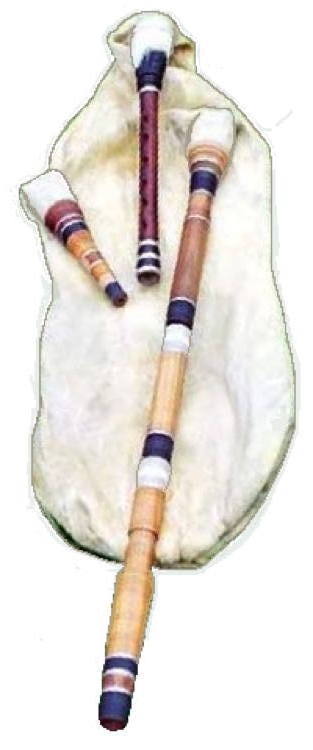 The higher-pitched Thracian gajda has adapted well to the changing melodic and harmonic demands of the contemporary music. With its incorporation into the ensembles, its intonation has become standardized, repertoire expanded, and new playing techniques developed. The Rhodope gajda, on the other hand, has generally been excluded from the ensemble movement. Its larger size, lower pitch, less stable intonation, and less strident timbre have resulted in its being less adaptable to change than its Thracian counterpart. The absence of Rom players in the Rhodopes has perhaps contributed further in making this tradition more conservative and less innovative. Even the professional ensemble established in the Rhodopes has an orchestra of Thracian instruments. At concerts, the Rhodope gajda is restricted almost exclusively to accompanying as a solo instrument.
Because it has not adapted to the demands of contemporary music, the Rhodope gajda is considered by many to be old-fashioned and obsolete. This is especially the sentiment at the folk music schools, which have been established as part of a national ettort to disseminate folk music to young people. At schools in the Rhodopes, pupils prefer to study the Thracian, rather than the Rhodope gajda. Thracian classes are taught by younger schooled musicians, who focus on the contemporary, ensemble-influenced music. In Rhodope classes, local songs are taught by older unschooled village gajdari. At the Siroka Luka school, where every gajda pupil is required to study both traditions, Rhodope songs are often played with Thracian styling and ornamentation. Very few of the pupils studying Rhodope gajda continue playing in later years.
This is also true of those who participate in the folk music "study groups" throughout the region. As a result, older Rhodope players are not being replaced by younger ones. The opposite is true in the Thracian tradition, where young people are actively learning the new music in schools throughout the country. In conclusion, there have been many changes in Rhodope village life and contexts of music-making during the post-war period. Some contexts, such as the work-party, no longer exist. In others, such as the wedding horo, the gajda has been replaced by (often amplified) Western instruments.
In many "table" situations, on the other hand, gajda playing is still found. The contemporary phenomena of government-sponsored folklore collectives, staged festivals, and folk music schools are newly-created and did not exists at all in the past. In general, many music-making events are less communal and participatory in nature than formerly, with stage situations exhibiting a much greater role distinction between performer and audience.
Perhaps the greatest motivation for the continued importance of the Rhodope gajda is its regional symbolism. While Thracian-type ensemble instruments are homogeneously found throughout the country, the Rhodope gajda and its repertoire are uniquely associated with a particular region. Pride in the instrument is linked with similar feelings toward the local dialect, crafts, costume, and history. However, the gajda is not merely a museum piece which promotes nostalgia, but is still a vital element in both informal and formal contexts.
Printed in Folk Dance Scene, May/June 1984