|
Folk Dance Federation of California, South, Inc.
|

|
CLICK AN IMAGE TO ENLARGE
We will highlight the wedding customs and traditions of the American Rom, the Machwaya who immigrated from the western province of Mačve, Serbia. They brought with them much of the adopted Orthodox Serbian culture, such as the language, Eastern Orthodox religion, folk customs, and traditions. In this country they have lost some of the culture, such as the Serbian language, but retained the songs, music, and kolo, and adopted some American ways.
First, marriages were and are arranged, initiated by the parents of the young man. This may be a search when the lad is in his teens, or they may have had their eyes on the prospective bride for some time. She would have been in evidence at parties, celebrations, and other events, enhanced by being sent to the dance floor to perform her "solo" dance while all looked on.
And then there is the bride price, paid by the groom's father. This can be justified by the reasoning that the one family loses a "worker" and the other gains one; and these are the breadwinners in the family. Price has gone up with inflation from the low thousands to double-digit thousands, which of course is negotiated.
Once agreed upon, it is announced to the community and an engagement party is planned. It used to be a simple family event in the home, now usually in a rented hall or hotel ballroom where the wedding will take place about a week later. It is a typical party with music, usually now a disk jockey, dancing, and buffet catered by the hotel. At some point, the fathers, together with some relatives and elders (all men) will sit down and surround a table where final points will be ironed out, and the bride price will be counted out in big bills and paid. This will be sealed with lots of shots of liquor, hugging and kissing, unifying the two families.
Families are extended families, reminiscent of the zadruga, the old Serbian family collective and commune. The population is relatively small, the more prominent families prefer selecting within the clan, though they may live far apart. Family unity and loyalty are quite evident. But this does not exclude disagreements and grudges, typical of Balkan people. Fights are rare, but occur.
In announcing the wedding, actually phone calls within the community or word of mouth in casual conversation, an interesting phraseology is used, such as "Big Joe is geting a daughter-in-law." This reflects the bride's entering the family of the groom. Also, while "bride" and "groom" are used here for identification, the words in Slavic and Rom languages covey a somewhat different connotation. In Slavic the bride is the nevesta, in Romanes, bori (pronounced boree). For example, both words, by the Slavic people and the Rom, are carried into the marriage and she is referred to as such, hence daughter-in-law might be a more true translation.
 Then the wedding takes place, usually a week after the engagement. They use to rent an out-of-the-way hall such as the Grange Hall, a fraternal lodge hall, or small ballroom. Now it is in a major hotel ballroom. It was all do-it-yourself, the cooking on the premises (suckling pigs outside on the spit, men and boys hand-turning), girls setting the tables and sweeping. These days it is all catered by the hotel, everything first-class; not only decorations but usually a theme! One such was a Cinderella Wedding with a huge coach, horses, even the fairy god-mother, covering several tables. Elaborate floral arrangements are displayed throughout the ballroom, where little or none were in evidence at early events. Once rather modest, now a very elaborate and very costly affair.
The bori will arrive wearing an elaborate gown, escorted by her extended family. After being acknowledged and greeted and having been seen, she will disappear for a while, only to return in a more elaborate gown, a gift from her new family. This may be repeated with even another fancier gown!
 Finally, the bride will emerge in an elaborate white wedding gown, noticeably headbare, no crown or veil; these come later in the ceremony. Originally the bride wore her traditional best garment, the same as in the old country in peasant cultures, recognizable only with additional flowers and ribbons plus adornments such as gold necklaces. She will socialize and join in the dancing.
It must be pointed out that there are two divisions of seating and socializing. First, the men together, with the women and children in another area of the hall. Secondly, by age level, the teen-age girls together; the older men seated around a table, some with hats on (they all used to wear hats throughout the event). So the groom will be with his teen-age buddies. There will be no rapport or communication between the near-newlyweds until after the ceremony, and even that is low-key. But times are changing.
 The music was largely by records, 78s of kolos, Russian and Jewish dances, the faster the better. Sometimes there would be tamburitza music or a Greek or Armenian band or musicians from their own families. The men would sing Serbian folk songs, losing to this day both pronunciation and meaning with each generation. The same applies to recent weddings, the records replaced by a disk jockey who plays mostly disco music. The Rom took to disco dancing quite naturally because it fit right into their code: no touching, such as in couple dances. Unfortunately, it replaced their "solo" (Balkan, Middle-East style) dancing to a considerable extent.
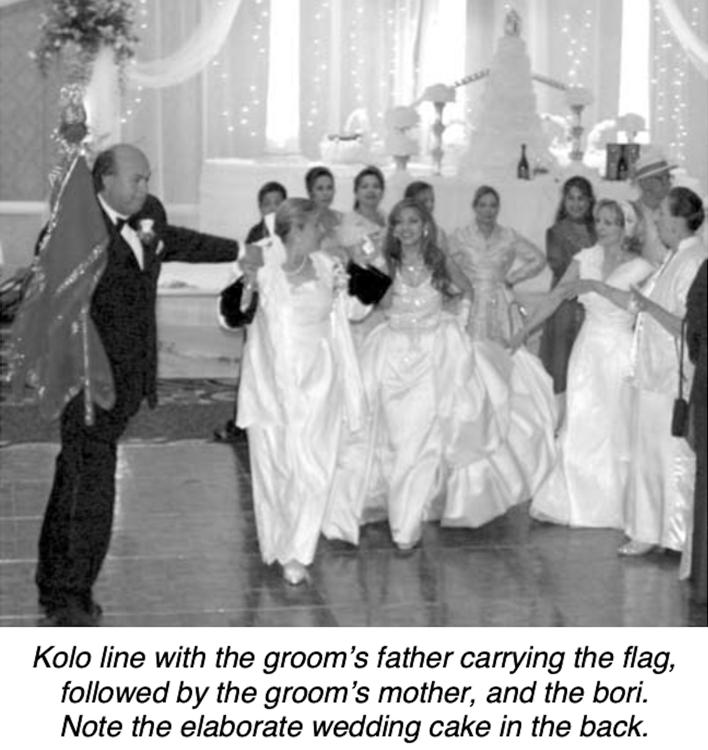
The main dance at weddings was the same dance common at other events: the kolo. It is only one dance, using walking, shuffling, some near-stamps, and grapevines at will, done to fast music (now they like Hava Nagila?). The only difference is that the male leader carries the "flag." The flag is red, mounted on a pole, and adorned with ribbons, flowers, a green sprig, and a small American flag on top. Obviously adopted in the old country where the national flag is prominent at weddings and carried in the procession (house to church and back to venue). This flag is carried by male members of the families plus others throughout all the kolo dancing, which all enjoy. Because this dance is seen less and less, it might be predicted that it might be relegated to only the preparation of the wedding ceremony.
The emphasis of the entire event is on the groom's family, as they are getting the bori (daughter-in-law). And the most prominent is the mother-in-law. She conducts the ritual, which has neither religious nor civil aspects. And no "I do's," because they don't ask. After a long wedding kolo led by the father-in-law carrying the flag, the mother-in-law carrying the crown and veil, the bori next to her, and the groom further down the line, the mother will stop the dancing and address the bori while all others gather around.
The mother-in-law then proceeds to decorate the bride with jewelry and necklaces, gold being the favorite "color." Recently, we saw what looked like about twenty $50 US gold pieces strung on a necklace stretching from neck to abdomen. The bride was in tears throughout all this; after all, she is leaving her family and going to another, for better or worse, possibly to another city.
 Finally, the mother places the veiled crown on the bori's head, and that's it – officially the daughter-in-law, the "bride and groom." Dancing will resume while the men, heads of families, start heading for the main long table for the dinner, the women and the children gathering around round tables scattered throughout the ballroom. The men will be served a catered steak dinner, while most of the women will serve themselves from the splendid buffet set up throughout the event.
Gifts? Nicely wrapped salt and pepper shaker sets and the like? There are none! Ever! Instead, another borrowed custom. After the meal a group approaches each seated man: the father, maybe an assistant, the bride, and for the first time in evidence, the groom (he could have been spotted earlier wearing an expensive light-colored suit adorned with a rather wide red ribbon diagonally across his chest) – and the tamburitza orchestra or other musicians. Originally, the bride carried a hollowed-out loaf of bread decorated with red ribbons; now it is a large white basket, the bread inside. As the father, or other elder, approaches each man, the latter pulls out his wallet, flashes one or more bills (the amount sometimes announced), which goes into the bread basket as the musicians give each a fanfare. The writer recalls many events with exactly the same custom at Serbian and Croatian weddings as a child in the Midwest. Sans the bread or basket, however, it seems the Rom hold on to such borrowed traditions and customs long after the ethnics abandoned them!
 Each man receives a colorful scarf from the bride, both as a thank you and to signify that he "went" (actually, gave). All are rather generous, especially the family and relatives, of which there are many. The money goes to the father who is ultimately responsible for the welfare of the entire family, even those who have married and moved out of the house. The newlyweds will live in the father's house at least until the children arrive, or until they can be established on their own. But even then, the father's will is supreme, and he remains the head of the family. There is a one year "probation" period in the marriage during which time the bori's father may claim her for a reason such as abuse, groom's infidelity, or such. And the groom's family may give her back if she proves to be a bad wife or not a good "breadwinner."
More dancing resumes. No more kolo, but lots of disco until the wee hours. Such events used to start around noon and end by sunset. Now they start af sunset and go well past the writer's hot chocolate time.
Printed in Folk Dance Scene, August 2004