|
Folk Dance Federation of California, South, Inc.
|
|
CLICK AN IMAGE TO ENLARGE
THE PEASANTS
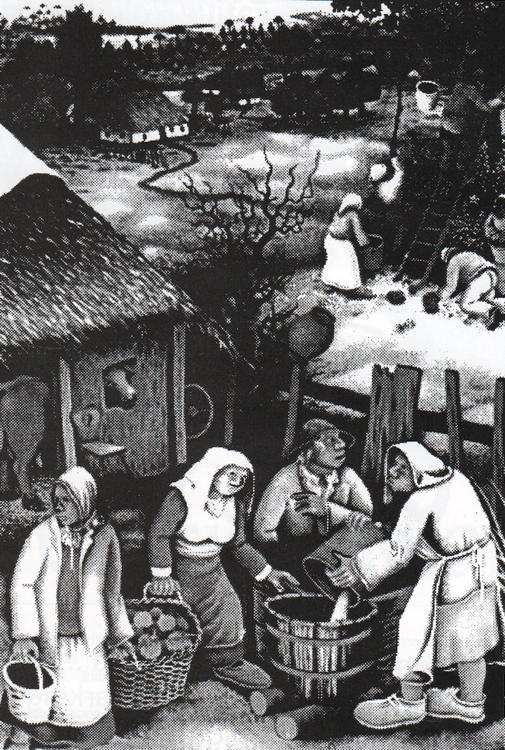 Eastern Europe is a region that many folk dancers are tied to by heritage, a heritage composed of traditions from the old peasant way of life that prevailed when Easter Europeans left for America in the late nincenth and early twentieh centures. Although changed, these traditions have continued into the present.
To understand the Eastern European heritage, we first need to know what peasant culture is. Only then will we be ready to look at the traditions themselves. Eric Wolf, who has Studied peasant culture thoroughly, locates the peasant midway in the range of people who grow crops. Somewhere between the primitive cultivator at one end of the spectrum and the modern farmer on the other. All "play the game with nature," as he puts it, but each has a different stake in this life-and-death game and each uses different rules. (Wolf 1969:3-5).
Primitive cultivators tend their crops and share the harvest with kinfolk in a more or less egalitarian group or tribe. Peasants, on the other hand, occupy the bottom of a hierarchy that includes landlords who extract rent, middlemen who purchase the crop, and overLords who tax the surplus. Peasantry emerged in neolithic times, about ten thousand years ago, when agriculture became so efficient that a ruling class emerged and took a portion of the surplus food raised by the peasants. This upper class consisted of administrators, soldiers, priests, and, eventually, skilled craftsmen and artists, including musicians. These privileged people created an urban, court-centered culture away from the peasant majority.
As the head of his household, the peasant must try to support his extended family (wife and children plus assorted relatives), but they all are part of a subject class. The modern farmer, on the other hand, is a sort of agricultural businessman who operates in a complex market economy. In today's industrialized world, land owning farmers may be better off than the working poor of the cities if they can learn to exploit up-to-date technology, marketing, and credit to create what we call "agribusiness," a far cry from the peasant. In the modern world, peasantry has diminished everywhere. Still, in large areas of Central and South America, the Middle East, and Southern, Southeastern, and Northern Asia, peasant life survives. In Europe, there are peasants still, or at least the memory of peasant folkways and life-styles is still alive, particularly in Eastern Europe. In Western Europe, advanced capitalist support systems have changed the rules of the game, while in Eastern Europe the older peasant may still be seen as a household head tied by strong bonds of kinship and mutual support to a locale where his forefathers are buried, trying to raise crops with little control over and great dependence on nature and an imposed marketing system.
An example of that heritage is a song called "Paparuda" (Come, little rain, come!) sung by Romanian children in a traditional village:
Come, little rain, come out and water us with your full buckets over the whole crowd.
When you come with the hose, let it flow like water; when you come with the plough,
let it run like butter; when you come with the sieve, let it be a barn-full.
Give me the keys, old woman, that I may open the doors and let the rain come down.
Come, little rain, come!
In the whole context of the Romanian song, no detail seems accidental. The children wear skirts made from flowers that are symbols of spring, and they carry sieves that are a survival of the rain symbol of ancient Greek gods. The children themselves are probably unaware that these symbols have lasted for centuries. The very presence of the children might stand for the rising generation, associated with the forces of growth (versus death). Growth is invoked when the adults sprinkle the singing, dancing children with water. The "old woman" mentioned who controls the keys to the train is probably related to the effigy of a hag carried and burned by children in other parts of Eastern Europe as part of a spring ritual: she stands for winter, and must die. Thus, a local village musical performance is connected to a network of regional beliefs and musical performances.
The entire performance of "Paparuda" can be interpreted as a magical ritual, with the children acting as ambassadors to the forces of nature. What seems to be a "simple" song can be seen for what it really is – a complicated cultural package involving props, social organization, and text, supported by deeply held beliefs.
A ritual is a formal practice or custom. The formality of rituals sets them off from everyday life, and the accompanying music is an important part of this formality. Ritual lies close to the heart of the peasant's expressive connection to nature and the forces of the universe. It is often hard for Americans to understand the importance of ritual music, since there is so little of it in American life. But think for a moment that even the most "far-out" modern weddings include some kind of music, and that every sports event demands the playing of "The Star-Spangled Banner."
Peasants have two major types of ritual events, related to the two great overlapping cycles of peasant life. One is "calendric," tied to the yearly recurring round of occasions, while the second is linked to the individual's own life cycle, from birth and entrance into his/her society through the passage to another world at death. The calendric cycle was traditionally divided into rituals related to nature and agriculture, and rituals connected to the circle of religious or national celebrations. These latter rituals are determined by culture, not nature, but the two categories often merge on a given day, such as St. John's Day, widely celebrated across most of Europe, which "happens" to fall on Midsummer Night's Eve, the longest day of the year (June 23). The Church claims that this significant natural event belongs to a major religious figure, St. John. In recent decades new red-letter days have been arbitrarily set for official celebration of great victories, the founding of a city or nation, or the establishment of a new form of government, such as November 7 in Russia, marking the victory of socialist power in 1917.
Looking at a festival calendar for any European people in a particular generation, we see a patchwork of solemn or joyous celebration representing pagan agricultural and Christian theological (e.g. Christmas) events, some purely local (a town's patron saint), others commemorations of local or national events. Also seen are extra-calendric ceremonies associated with times of trouble, such as epidemics, invasions, or droughts.
The songs and rites of the life cycle form an equally broad collection of music and ceremony. Here, the discussion of ritual music will be limited to the organization and music of just two traditional ritual categories, the wedding and the lament, largely in two areas of Easter Europe: Romania and Russia.
THE CRUCIAL ALLIANCE
 In peasant society, the wedding is crucial not only for the couple but also for the entire extended network of kinfolk on both sides. It represents an important moment in the life of a whole village, since any wedding makes an alliance between two rival, potentially conflicting households. Ritual is exceptionally elaborate, involving large expenditures of money and goods over the course of several days and many events. As Hungarian researchers have observed: "Weddings rank foremost among popular customs; they are a veritable accumulation of ceremonies containing mythical, religious, ritual, legal, economic, musical, and mimic elements. In some places they became almost festive plays with their chief and supporting characters, super-numeraries, fixed scene, time, music, dances, and audience" (Corpus Musica Popularis Hungaricae 1956, Vol. III/B Lakodalom, 689).
An example of the older style of wedding comes from the White Sea region of Russia, a remote and inhospitable corner of Eastern Europe near the Arctic Circle that, because of its isolation, is a treasure house of older folklore and music. Only the older people know all the songs and customs; even way out in the village of Varzuga the young folks have new and different ways.
Let us start with a wedding song, "Na Solnechnom Vskhode, na Ugreve" ("At dawn, at the warming").
As in the Romanian rain-song, the words here are symbolic in very standardized, well-understood ways. Often in Russian folksong, natural landscapes are described before the important human characters take center stage. Natural objects signify the humans; hence, the "curly birch tree" stands for the maiden, while the nightingale is her suitor. As the song progresses, it becomes clear that the words refer to the forthcoming union between Annushka and Ivan, the two families being Aleksandrovich and Mikhailovich. Using the imagery of fairy tales, the song tells of Ivan nightingale's flight to the parental high tower of Anna, who has not yet braided her hair in the married woman's knot. It ends by announcing that Anna must belong to Ivan and become the slave of his father and mother. Notice that Anna's becoming Ivan's bride is actually mentioned last in the song after her subordination to the in-laws.
At dawn, at the warming
A bushy white birch-tree stands.
Past that white bushy birch-tree
Goes no road, no path,
No broad way, no footpath, no passageway.
Gray geese fly, but do not honk;
White swans fly, but do not cry.
Just one young nightingale sings.
He flies to the father's courtyard,
To the mother's high tower;
He gives Annushka heartache,
Makes it known to Mikhailouna
That Annechka shouldn't be living
at her father's,
Sitting in the high tower,
Nor combing her unruly head,
Nor plaiting her blonde braid,
Nor twining a ribbon into her braid,
Nor wearing a red-gold belt,
But that Anna should be with Ivan
To be his father's slave,
To be mother's daughter-in-law,
To be Ivan's bride.
So hail to Ivan and Anna!
Let's congratulate Alexandrovich and Mikhailouna!
Ritual wedding songs emphasize this unfortunate outcome of marriage. No wonder the younger generation, who marry for love, not because of prearranged family alliances, have forgotten some of these songs and related customs, like the bride's lament. In some parts of Eastern Europe, a bride is not considered to have carried out her role properly if she fails to weep, wail, and bemoan her fate. Bridal laments are very similar in structure, and sometimes in imagery, to death laments. In the Eastern European Jewish tradition, a bride and groom fast before the wedding, as if it were the holiest day of the liturgical year, Yom Kippur (The Day of Atonement), and the customs are full of references to death, tying together all of the most solemn expressive aspects of traditional ritual at the wedding.
Let us now look at the music of "Na Solnechnom Vskhode." It is structurally similar to the Romanian rain-song in having more than one part. Here we have a leader who begins the song, followed by the chorus chiming in. This leader-chorus or call-and-response format is typical of many Eastern European genres, particularly among the eastern Slavic peoples (Russians, Ukrainians, Belorussians). But the piece gets one stage more complicated by having the chorus briefly split into two lines of music, creating polyphony (many-part music). The eastern Slavs are very fond of singing polyphonically, though not in the classical harmony of a Bach chorale or opera chorus. Rather, the voice quality is fairly expressionless. This feature seems to go along with the circular, nonstop quality of the singing: there are no clear line breaks. This detached manner of singing underlines and expresses the ritual nature of the song. It is as if the singers are saying: it's not ourselves in particular, but the village as a whole, indeed, the tradition, that is singing. Just as in many parts of the world (including parts of Eastern Europe) ritual dance and action are done under the cover of masks, so singers may sometimes seem to put an anonymous mask on their voices when singing ritual songs.
The Varzuga wedding is quite complex, consisting of eleven different stages with numerous small substages and ceremonies, most of which have their own set of songs. But the customs and songs may differ just down the road in nearby villages; how much more, then across the vast expanse of Russia! Individual variety is the lifeblood of folk music, whether from person to person or village to village.
Principals in the Varzaga Wedding include the bride and her parents, the groom and his parents, godparents, the matchmaker, a main organizer and master of ceremonies, a professional female lamenter, the best man, the groom's helpers, the bride's helpers, bridesmaids-cooks, and assorted kinfolk on both sides, many with special titles.
Stages of the Varzaga Wedding
1. Matchmaking. This is the domain of the matchmaker, who steps into the hut, but not beyond the doorway beam. Given permission to advance, he is offered tea, whereupon he proposes a match, using stylized phrases. If the family rejects the match, the matchmaker's head is smeared with flour. This professional hazard probably insures the matchmaker's careful choice of prospective bride and groom.
2. Handshaking. Now the pact, including the important financial matter of dowry (paid by bride's father to groom's family) is concluded with a handshake, and official festivities begin. The lamp by the family icon (holy painting) is lit. If the bride dislikes the match, she may try to put out the lamp to show her disapproval; this is the only act of rebellion she is allowed. She then begins to weep and bemoan her fate, standing at a designated spot. Older women pour in to watch the bride's lament.
3. Girlfriends' visits. The next day is full of song as the maiden's girl friends gather at her hut to lend moral support. Sewing clothes for the trousseau, the girls (all aged about fifteen) sing a song cycle about the forthcoming marriage. "Na solnechnom vskhode," is a "girlfriends'-visit" song. This period may continue for as long as two weeks.
4. Bathing. The day before the wedding, the chief bridesmaid-cook and her assistants begin the enormous task of cooking and baking. Meanwhile, the public bath has been heating (indoor plumbing was unknown in traditional peasant life and the bride is led there, sings a special lament on an improvised text, repeated after the bath. Thus in addition to the standardized, traditional music, the wedding repertoire also in cludes individualized songs in which the participant can express her personal feelings.
5. Gifts and Unbraiding. After the bath, the bride puts on a new outfit and sits in a special place. The male and female helpers organize the events. First, female kinfolk and girlfriends bid fare well and bring presents. The professional lamenter (a woman) helps the bride wail and sings songs specific to each type of guest-godparents, siblings, and so forth. Finally, a sister unbraids the girl's maiden plaits, later to be redone into the married woman's knot under a kerchief. Transformations are physically as well as emotionally marked in peasant life.
6. Greeting. Seated in a special place, the girl receives non-kin guests. Villagers flock to the porch to look in and listen to the songs.
7. Blessing. A formal blessing of the maiden by her parents must take place before the groom and his party arrive. It is a solemn and emotional moment.
8. Groom's arrival. Greeted by torch-bearing bride's relatives, the groom's party enters, following a prescribed route. Everyone is seated in a fixed order; wedding protocol is always strict. Bride and bridegroom are now called "prince" and "princess";relatives are "lords" and "ladies." Choral songs are sung until the bride, who in the meantime has left, is led back in by her father. She carries a tray with small vodka glasses, which she offers in predetermined order with fixed greetings to the groom's kinfolk. She is taken out to the side room to be dressed. Many songs have been sung, all in a similar style, unifying the event musically. Great care is taken throughout to avoid the "evil eye." This is a powerful force recognized by people in many parts of the world, and is often associated with bad people who can put a "hex" on someone. Should marital troubles arise later, it may be blamed on carelessness at the wedding.
9. Church ceremony. Only now does the couple, accompanied by the main participants (but excluding the parents) link up with organized religion. Proceeding to the village church, they are led in hymns by the village priest, representative of the Orthodox Church, who completes a brief ceremony.
10. Viewing and Banquet table. Now the action shifts to the groom's house. The bride's hair is rearranged. The bride and groom are finally fed. Now the bride's kinfolk arrive and sit in prescribed order. Full-scale feasting and singing commence. A chorus sings different songs for each type of guest-parents, relatives, friends, bachelors, old folks – service for which the chorus receives payment. Cries of "gor'ko, gor'ko!" ("bitter") are heard, requiring a drink each time. Eventually the guests join the singing, and dancing begins for everyone but the bride. As the party breaks up, the couple accompanies the bride's parents halfway home on a specially decorated reindeer, since this is, Arctic country.
11. Final feasts. The next morning, the first of her married life, the bride arises early and helps her mother-in-law bake. They make pancakes for a dinner held for all the kinfolk. Now the couple sits in the host's place at the table. The bride's kin then invites everyone to one last feast, where, likewise fresh, hot pancakes are served. Final gifts are exchanged and the wedding ends, completing weeks of elaborate and expensive preparation and days of carefully observed ritual. If all goes well, family feuds have been avoided, individual pride expressed, and a proper marriage begun.
In recent times much of this White Sea ritual has waned as modern ways reach even into the far North. Girls choose their own husbands and wail less. Many smaller details of food preparation and minor ceremony have vanished. Yet the songs remain, standing now as the clearest embodiment of the ritual. Once again we see music's lasting power to bind the village to the occasion.
Many aspects of the North Russian wedding complex do not occur in other regions of Eastern Europe. For example, the bride's lament is far from universal. Yet many of the basic concepts are quite widespread. Songs bewailing the bride's lot were indispensable among the Jews, but were performed by the badkhn (the professional master of ceremonies), rather than by the bride. A similar tradition exists among Romanian peasants.
Romanian peasant weddings may last for several days, and the celebrations are punctuated by ritual moments embellished with music and dances, some of magical origin... the most important wedding song, "Cintecul Mireșii" (The Song of the Bride) is sung as the bride bids farewell to her parents and their home and her former way of life. The moment is solemn, the song poignant, and the bride often weeps bitterly when it is sung.
Following is part of the text of a bridal lament performed in the 1950s by a professional peasant wedding entertainer. The context is described by Alexandru and Lloyd:
Oh, my child, you have your parents, alas! why ever are you getting married?
You'll find it hard to forget your parents' love, for the love of a husband is like the leaf of a dry pear tree.
When you put yourself in his shade you'll be bitterly sorry, for the love of a husband is like the leaf of a dry pear tree or an old fence post!
Little bride, little bride! ask your gotlfather not to decorate you with garlands but to leave your hair simply plaited by your mother and sister.
Till now you've been with the young girls, tomorrow you'll be with the married women,
and the day after with the old women, and on Wednesdays with your aunts, ay! on Wednesdays with your aunts."
THE LAMENT
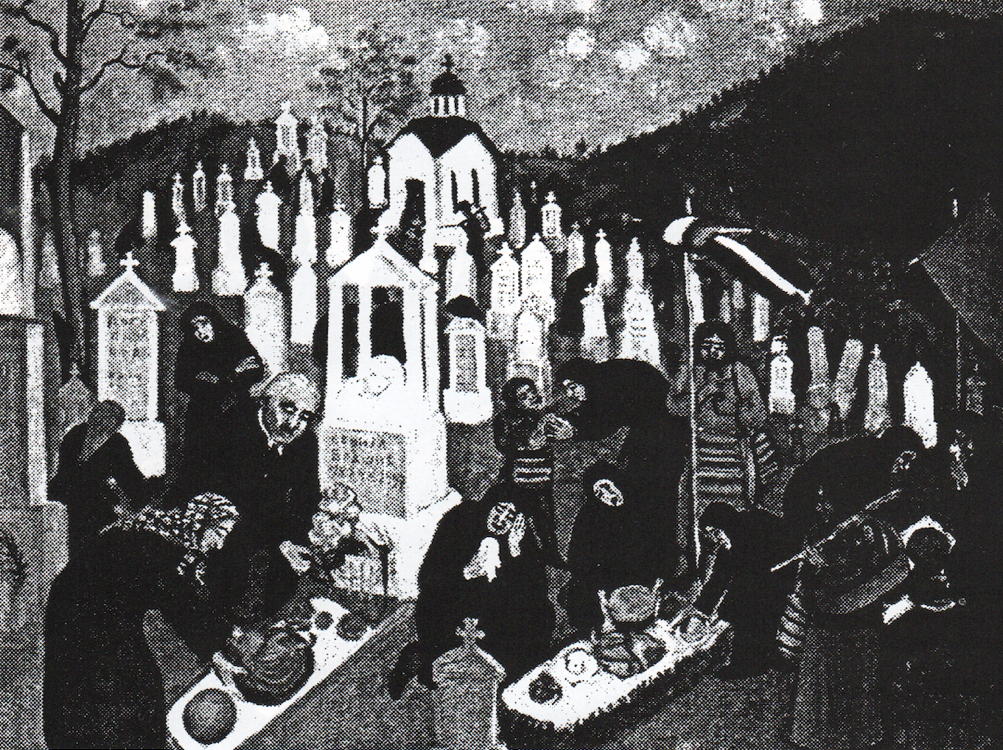
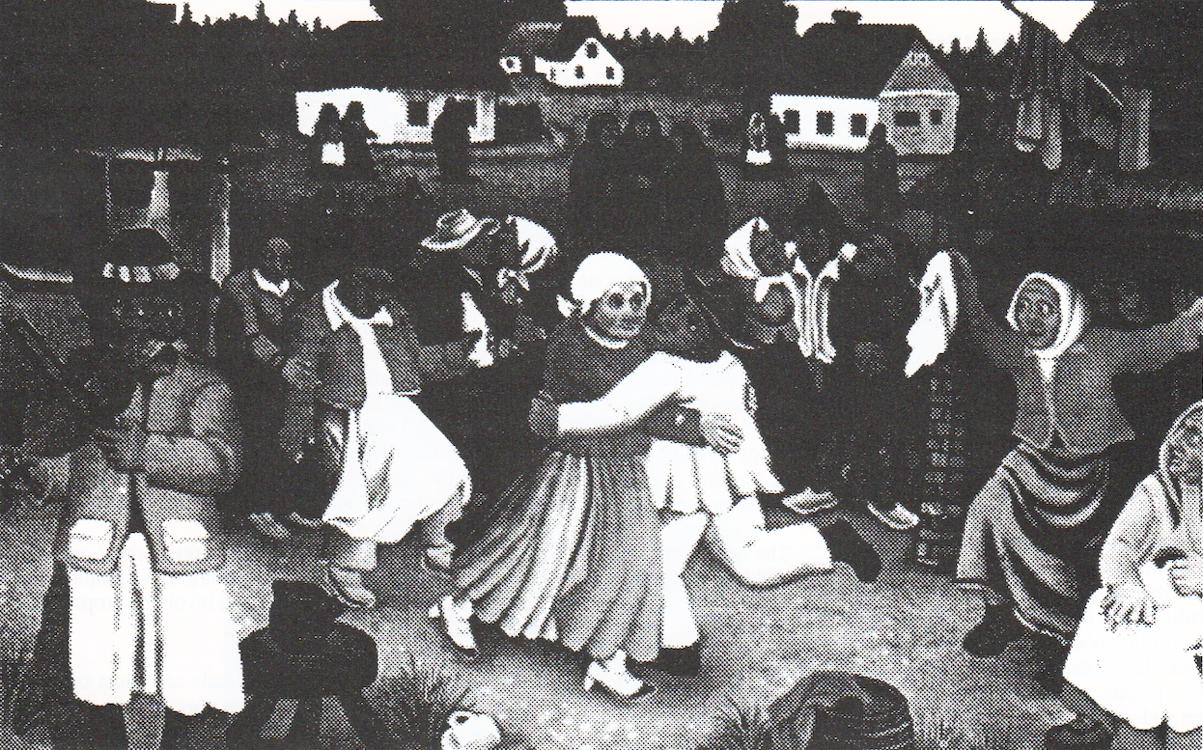 Like the intensely communal ritual of the wedding, the shock of death traditionally involves both personal and social expression of emotion, often through various types of songs of mourning, or laments. Finding and recording death laments is extremely difficult; as Zoltán Kodály notes for Hungary: "They [laments] are difficult to witness, because their existence is denied, and nothing will persuade people to perform before strangers. It is useless for the collector to attend funerals, for as soon as he is noticed, the mourning ceremonies are omitted, even where they are normally practiced" (Kodaly 1971:85). This reluctance to display strong personal emotion in public is based on genuine deep feeling. When a peasant woman has at last been persuaded to sing a lament in front of the tape recorder, she breaks down and sobs regularly, often at the end of each musical line, because the singing rouses powerful emotions and brings to her mind the original reason for singing the lament – the death of a loved one.
Relatives come to light, but the entire population is exposed to critical observation. The occasion throws into sharp relief the community life of the whole village. Those present or absent will be weighed and judged according to their behavior" (CMPH, 1966: Vol. 99). A person's passing from the world, like his or her emergence into adult life through marriage, is a matter of not just personal, but communal importance in peasant culture.
Musically, reflection of the collective nature of this type of lament is found in the social organization of the singing. Though Romanian songs are largely solo (as opposed to polyphony in Russia), this lament is performed antiphonally, that is, by alternating groups, as if to emphasize the face that group cooperation is required for the feeling of ritual solidarity. Interestingly, the two groups overlap, with one drawing out its last pitch to serve as a supporting drone, or constant, unchanging pitch, for the second group. Perhaps this musical support system parallels the emotional support of the community. Places where the two groups of singers come together small differences occur when different groups sing the same line, or when the same line repeats; these variable features, which people do not learn from a printed page, are the heart of folk music.
The individual lament differs radically from the group lament. First, it is not sung by outsiders to represent communal response, but by members of the immediate family, usually women. Assigning musical roles by gender, a characteristic of many music cultures, is often quite clear in the lament. Second, the private songs of loss make specific reference to the dead person, and seem to be intensely personal calls by the bereaved to the deceased. This quality is apparent in the text of the following Romanian woman's lament for her eight-year-old brother. She addresses her brother directly, and mentions other details of the family's life. The reference to going "behind the cross" might relate to the Orthodox Church belief that the other world lies behind the paintings and the cross of the church.
My darling, my little brother, now we two are parted,
You've gone behind the cross, you've gone behind the cross and hidden behind the door.
Someone has called you away to our mother because she loved you.
You wouldn't stay with father and you've broken his heart.
Just as he was counting himself lucky to have you, my little mother led you away beside her.
This solo lament is organized into short lines, which seem like outbursts of emotion, reinforced by the sob-like breaks at the end of each line. This is typical of the older lament style. The texts are partially or completely improvised by the singer; that is, she (or he) makes them up on the spur of the moment. Here we see a strong contrast to the fixed wordings and melodic structure of the communal lament; the individual is allowed to pour out grief through less restricted channels. As one Hungarian woman has said, "You can't guess what a relative of yours will say when she casts herself down on the coffin. When my little daughter died I could not have told you what I was going to put into the lament or what I would sing. All the time over her dead body until I stood up to sing. You don't think it out, you just speak as it comes to your lips" (CMPH, 1966, Vol. 94). There are time-tested formulas, however, of text and tune that act as traditional guidelines for this highly personal expression of emotion. Hungarian scholars find similar phrases and images cropping up in all the laments of a single village. Musically, certain repetitive phrases and endings are likely to recur. Alexandru and Lloyd note that the Romanian mourner's fellow-villagers "listen critically and do not hesitate to comment on how well she sings, just as Kodaly says that Hungarians "watch the performance carefully and discuss it afterwards: "she wailed beautifully,' 'she hasn't even mourned for him,' etc." (Kodaly 1971:85). This statement reveals that even in the shadow of death and grief, a community makes aesthetic evaluations, a key aspect of a music culture. It also shows how the group wants to keep even individual, improvised singing within the bounds of acceptable innovation, just as all individual behavior in the village is channeled within the bounds of tradition. In general, peasant music is a combination of group conservatism and individual expression. The former lends stability, while the latter introduces change.
Long after the funeral, the appeal to the dead embodied in the individual lament can be continued. In Jewish tradition, as well as for some Hungarian peasants, it was possible traditionally for a woman to ease her emotional burdens by addressing a long improvised song in lament style to a departed relative, often singing directly at grave side, for years after the relative's death. These songs might comment on current family problems, "updating" the deceased's spirit. In peasant life, the other world is fairly concrete, to be taken seriously, and numerous rituals seem to pacify the souls of the dead to keep them from returning to their old homes and causing trouble among the living.
Printed in Folk Dance Scene, February 1997