
|
Folk Dance Federation of California, South, Inc.
|

|
CLICK AN IMAGE TO ENLARGE
 The United Society of Believers in Christ's Second Appearing, or more commonly called "Shakers," believed in the reappearance of Christ in the form of a woman. The sect had its beginning in the mid-1700s and was one of the first societies to give women equal rights. The leading figure in the founding of the Shakers was Mother Ann Lee (born Ann Lees). In 1762, she was betrothed to a blacksmith named Abraham Standeric. By him she had four children, all of whom died in infancy. In an attempt to avoid further sleeping relations with her husband, she became ill and weak from too little food and sleep. It was in this state that Mother Ann first saw "the blessed world of God." She had a vision of the Garden of Eden, and "Christ made her the preacher of the gospel" for stainless life. She is reputed to have cured the ill, and to have spoken 92 languages.
Because of their unusual religious practices, the members of the Society were persecuted from the very beginning. In July of 1772, several adherents, including John Lee and his daughter, Mother Ann, were sentenced to jail for a month because of disturbances at the Mule Inn. John Townley, a member of the sect, was threatened by a mob that began to pull down his Cannon Street home. Despite all this, the sect began to grow rapidly in size.
During a ten-month period in which no further disturbances were recorded, the sect prepared for a voyage to the New World; then, on May 10, 1774, eight members, along with Mother Ann, departed from Liverpool on the ship Mariah. The captain forbade the sect, with its oddities and shaking, from conducting services on shipboard. (It was shaking that gave the Believers the nickname of the "Shakers.") During the voyage, the Mariah ran into numerous storms, and on one occasion, nearly foundered when a plank became loosened. All hands, including passengers, took to the pumps without success. It was then that Mother Ann reported to the captain that she had sighted the Angel of God, who guaranteed their safety, and at this moment, a wave struck the plank back into place and saved the ship. The captain rescinded his orders and gave the Believers his support and blessing.
In New England, as at home, the Shakers were at first persecuted, but with Mother Ann's lead, the Society still grew enormously. By 1800, there were 11 colonies. It was not, however, until another 30 years had passed that the sect arrived at its peak of influence, with 19 communities spread through New England, New York, Ohio, Indiana and Kentucky, with some ten thousand members.
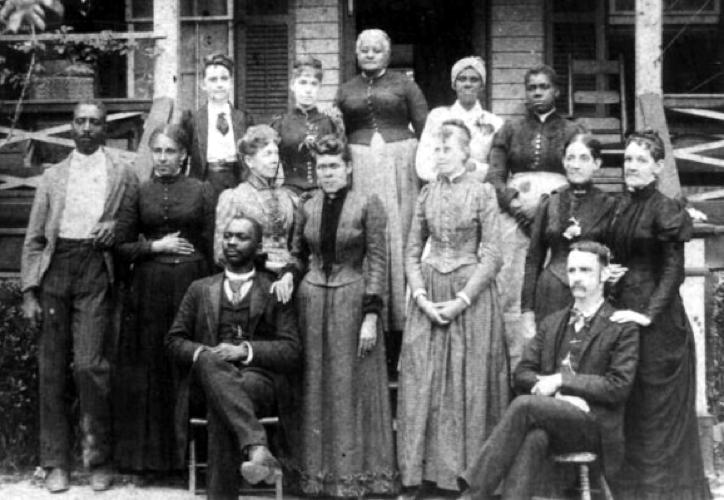 A colony consisted of a number of "families." A family was made up of no more than 50 persons, with each family being managed by two Elders and two Eldresses. A democratic equality existed within the community – one member, one share. Brethren and sisters alike shared in the work tasks. The family met at mealtimes and Meetings. Union Meetings (that is, colony meetings) varied from community to community – in New Lebanon, the Union Meeting was held on Tuesday and Friday evenings with two on Sundays. Four to ten Believers of each sex would meet in a retiring room where they faced one another and had conversation. If any transgressions had occurred, members were morally obligated to reveal such transgressions. Before every meal, brethren and sisters would assemble in separate rooms for a two-to-fifteen minute pause; then, led by their Elders and Eldresses, respectively, all marched two abreast in seating order to the dining hall. After a meal in silence, each in his own turn would kneel, then rise and depart directly to his labors.
Disorder and extravagance rather than structure were the rule for the early Meetings of the Shakers. The ceremonies gained in detail and structure. As the religious order developed and took shape, however, certain aspects of the ceremony continued and allowed for the development of many creative insights of the Shakers. "Gifts" were bestowed on individuals, such as speaking in unknown tongues. There were periods when love offerings were given one another, such as the washing of each other's feet, or perhaps holding Meetings with another settlement at a pre-planned time so that their spirits would be together.
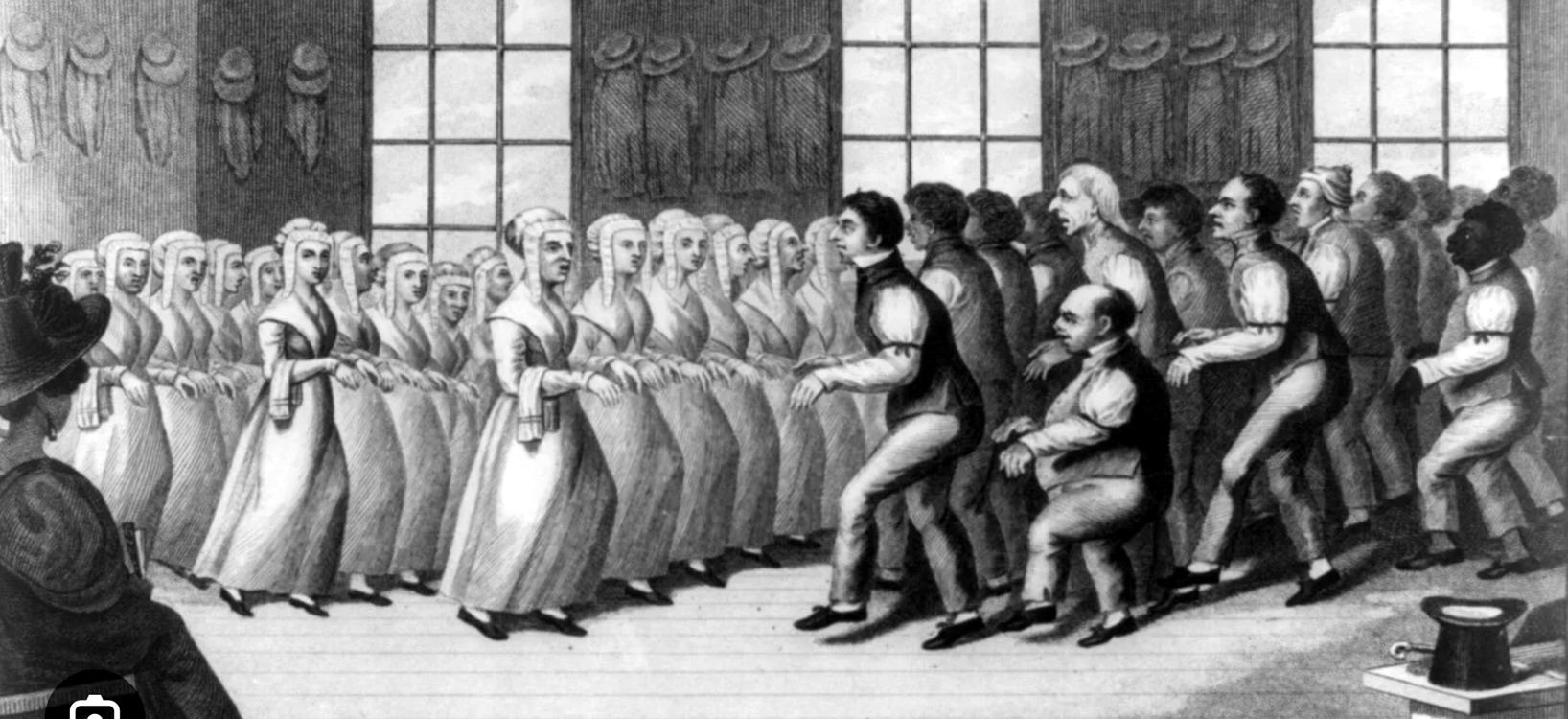 Special meeting houses were constructed for the Labor Meetings. Each family would rehearse for these (dance) ceremonies, and train new members during the week – bowing, bending, and shaking continued their appearance, with intricate steps, movements, formations, and songs. Ranks were expected to be straight, not only right and left, but forward and backward. Vacancies were not permitted because they caused (the appearance of) disunion.
Labor Meetings were held twice a week, Saturday evenings and one other evening, as well as on special holidays. Such Meetings were also used to attract new members into the ranks (their only means of growth as the Shakers held a strict celibacy rule). A couple of the rules: "Brethren and sisters must not work together," "Brethren and sisters may not pass each other on the stairs."
"...The system was also noteworthy for its many inventions and improvements: machines for turning broom handles, sizing broom corn, filling seedbags and herb packages, bending machine card teeth, twisting whip handles and lashes, splint making, basket making, box cutting, fertilizing, planning and matching boards, and so on. The Shakers are credited with inventing the screw propeller, Babbit Metal, the rotary harrow, an automatic spring, a turbine water wheel, a threshing machine, the circular saw, cut nails, a pipe machine, a pea sheller, a self-acting cheese press, a butter-worker, the common clothespin, the first one-horse wagon used in this country, a palm-leaf bonnet loom..." (Andrews, 1932:113) The furniture made by the Shakers is highly prized, and its clean, simple design is one that has been imitated extensively. The Believers; products were cherished for their consistency and quality.
The Shakers became known for their honesty, and some courts refused to hear any suits brought against them. Little is published on the decline of the Shaker faith. They were ahead of their time in mamy respects and they acted on many ideas before the rest of the world began to discover them. Perhaps this is one of the reasons for the decline – or was it that perhaps success made the Shakers close their ranks to recruits?
One of the Shaker songs goes:
"'Tis the gift to be simple,
'Tis the gift to be free,
'Tis the gift to come down
Where we ought to be.
And when we find ourselves
In the place just right,
'Twill be in the valley
Of love and delight."
Bibliography
Andrews, Edward. Community Industries of the Shakers,, University of New York State, Albany, New York. 1932.
Andrews, Edward. Gift to be Simple, J.J. Augustine, New York. 1940.
Andrews, E. and F. Shaker Furniture, Yale Press, New Haven, Connecticut. 1937.
Brown, Thomas. An Account of People called Shakers, Parker & Bliss, Troy, New York. 1812.
Greeley, Horace. A Sabbath with the Shakers, The Knickerbocker Magazine, New York, 1838.
Printed in Folk Dance Scene, July 1973