|
Folk Dance Federation of California, South, Inc.
|
|
CLICK AN IMAGE TO ENLARGE
The Shaman picks up his drum, warms it over the fire to bring the skin to the right tension and then sits down. The drum is held on his left knee. All conversation ceases as the shaman strikes the rim of the drum with his drumstick.
The ritual is about to begin.
For the shaman the drum is not so much a musical instrument as a vehicle for trans-portation. In Siberia it is pictured as a horse that the shaman rides to the World Tree. Beating a drum and shaking a rattle will transport the shaman to the Tree that stands at the center of the universe. The shaman's trance deepens until his soul slips out of his body and begins to climb. If he goes up into the branches toward the leaves, his destination is the heavens, culminating in the Lord of the Universe. If he goes down into the roots of the World Tree, then his destination is the underworld.
The shaman is in deep trance. Urgently his assistant grabs the drum, warms it over the fire and begins to beat it vigorously, calling to the shaman not to get lost in that dangerous land:
"Look at the fire," he yells. "Listen to the drum so you can find your way back!"
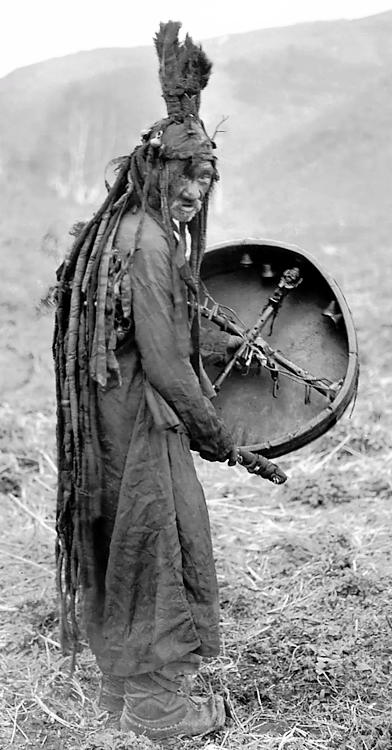 In most places, except some central Asian communities, the frame drum is in use as an instrument of trance. The shamans of Central Asia and the Jajouka musicians of Northern Morocco, as well as certain Indian and Oriental musicians, all use the frame drum to open the door to altered states of consciousness, resulting in such phenomena as trance and pain control, like the ability to walk on hot coals without damage or seeing into the "other world". Current lab research shows that certain drum beats act as a kind of pacemaker, "entraining" or regulating brain wave rhythms down into the alpha/theta border, which is that period just before sleep and, it is theorized, just before trance. The Khakass, a Turkish-speaking people living in southcentral Russia, say that the shaman's drum is constructed from a splinter of the World Tree that the Lord of the Universe made available for this purpose.
The Khakass shaman, while in a trance, receives special instructions from the "masters of the holy mountain". These instructions are precise plans for building a drum. They tell the location of the tree that is to furnish the wood for the body of the drum, they tell how the animal is to be killed that will supply the skin for the drum. The plans detail the kind of design that will be etched into the skin, what pendants are to be attached to drum, and how the handle of the drum is to be fashioned.
The wood for the body of the drum and the handle must be taken from the tree in such a way that the tree remains unharmed. If the tree dies, it is considered a very bad omen. The drum is made from crimson willow. A thin band, less than a half an inch thick and about five inches wide is shaved from the willow. The two ends are fastened with leather thongs, resulting in a hoop with a diameter of about thirty inches. Any splinters or shavings are gathered together and carefully buried. It is important no one walk on these splinters – particularly women. The hand grip of the drum is made from a birch tree and, on some of them, they hang four bronze bells with iron rings as clappers, plus five metal cones and six curved iron plates. All are arranged so that they clash together when the drum is shaken. These objects and pendants serve numerous functions. The bells are the shaman's messengers and also help in the recitation of the songs. The cones are used to drive away the bad spirits from the body of the sick person and to warn the shaman when a rival shaman is trying to damage him, that is, "devour his soul". The curved plates are called "swords". They, too, are used to ward off hostile spirits. The drum skin, made of horsehide, is stitched to the body with tendons. The birch hand grip is called "mars" (tiger), and it represents the master spirit of the drum. There are six pairs of holes in the hand grip which represent the eyes of the tiger. It is through these eyes that the shaman's spirit allies enter and depart from the drum. When they're inside the drum, the shaman enjoys their powers.
Once the drum has been made, the power of the instrument is slowly awakened through a special process. Before anything else can happen, the drum must be played by a young child for three consecutive days, right before bedtime. This is called "lightening" the drum. Next, the skin of the drum is decorated with symbols from the shaman's spiritual world map as it is laid out in his head, and the surface of the drum is divided into two parts: the upper world and the lower world. The map of the lower world usually predominates. There are figures drawn on the skin – dogs and frogs and toads and bears and reindeer and snakes and lizards. These represent not only his spiritual allies but familiar landmarks that he will encounter when he goes into his trance.
Once the world map has been drawn, the shaman begins to play an active part in awakening the drum. He goes into a trance and he begins seeking the soul of the animal whose skin now covers the drum. In his trance, he searches the animal's favorite grazing spots. He even locates the place where the animal was born, and he eventually captures the soul of the wandering animal. Then the shaman prepares a banquet. He slaughters a white lamb and gets a birch tree, roots and all. This he erects at the banquet and decorates it with rings and bands. The shaman now takes up his new drum for the first time, examines it to make sure his instructions have been precisely followed, and then goes into a trance and rides to the world tree to show his drum to the Lord of the Universe who, in turn, makes sure that all his instructions have been carried out. If the drum is approved, the Lord of the Universe assigns the shaman his animal allies. He also tells the shaman how many drums he will play in his lifetime, which is a measure of how long the shaman's powers will endure. When the shaman's drum dies, so does the shaman's power, and frequently, so does the shaman.
Most examples of percussive trance fall into two broad categories. In the first, drumming is used to summon the spirits or the gods down into the body of someone other than the drummer, usually a dancer. This is known as possession trance, which is generally found amongst agricultural peoples. In the possession trance, spirits are said to descend into the body of the dancer leading to such phenomena as trance and pain control. The dancer will not remember what he/she did or said while in the trance. Usually the dancer will speak in "tongue" and the shaman interprets what is said. It is believed that the spirit is speaking through the dancer. Vodun (voodoo) is a classic example of this type trance.
The second type of trance is the shamanic or communion trance, the opposite of possession trance in almost every way. In a communion trance the shaman's soul slips out of his body and flies across the world to the Tree that stands at the center of the universe, and bring back the information he obtained there. Sometimes the shaman transforms into a wolf, an eagle, a bear, a fish, a reindeer, or some other animal form to make the trip. In cases of healing, the shaman often sends one of his spiritual allies to retrieve the errant soul of the sick member of the tribe, which is seen as wandering aimlessly outside the body.
Shamans are there primarily to serve their community, their consciousness roaming far beyond the fires of the human body, keeping watch over those who cannot traffic in the spirit word. They are healers and wonder workers, people who have developed techniques that allow them to enter esoteric states of consciousness. They lobby the spirits to ensure a good hunt; they keep a watch on the future, and are capable of tapping into the deep past.
Shamans rarely inherit their special place within these societies, although you do find families where the disposition carries through several generations. Shamans are usually discovered, then refined. The role of shaman has often been thought to favor the flawed, the weak, the crippled, the outcast. A shaman is often someone who has undergone a symbolic death and been reborn into a higher incarnation. In order to accomplish this, symbolic death it is often necessary to actually bring the body to a point approaching death, thus allowing the spirits to gain a foothold. Only after the body has been weakened and the spirit world contacted, is the shaman able to leave his/her body and go adventuring up and down the World Tree – a dangerous journey.
"Look at the fire!" the assistant yells. "Listen to the drum so you can find your way back!"
The shaman is in deep trance. Having joined his ally in the underworld, he is no longer in this time. The drum becomes louder and louder. Suddenly the shaman screams. He leaps to his feet and begins dancing for the return of his chief ally. Presumably he now knows the nature of the bad spirit that is causing his patient's sickness, and has followed the sound of the drum back to this world.
Printed in Folk Dance Scene, November 1995