|
Folk Dance Federation of California, South, Inc.
|
|
CLICK AN IMAGE TO ENLARGE
The Tancház movement and performing groups in Hungary and America
There were two important moments in the history of folk dance:
one, when it went up onto the stage, and the other,
when it left the stage to return to the soil.
~ Sándor Csoóri
While this observation by the renowned Hungarian poet (and father of an excellent young folk musician) has meaning for many forms of ethnic dance, it is especially relevant to Hungarian dance, which is now evolving in fascinating directions both inside and outside Hungary. Performing groups and recreational dancers alike are discarding the artifices of an outmoded aesthetic tradition in an attempt to recreate the spirit of Hungarian dance and music as it existed when it was an integral part of village life.
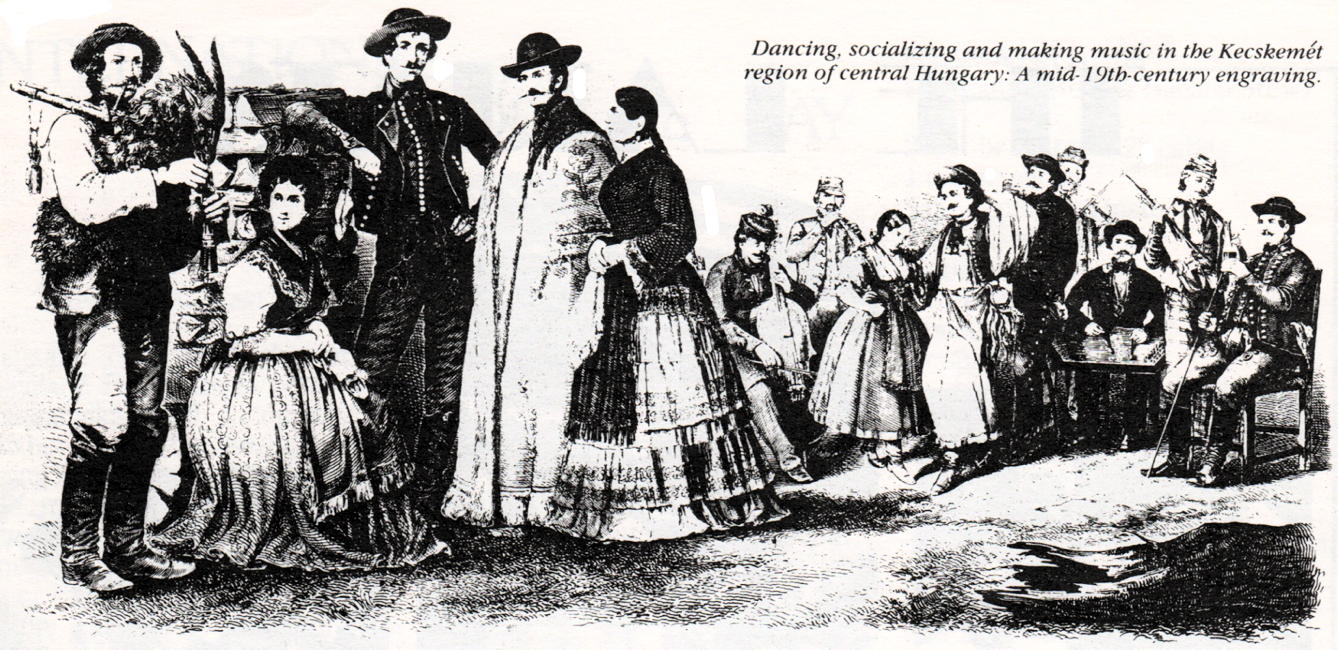
The vehicle for this artistic transformation has been the Táncház movement, which began among the amateur performing groups in Hungary around 1970. Táncház means "dance house" in Hungarian, and refers to the old custom of hiring musicians for a few forints and all they could eat and drink. Renting an inn or other building to hold a public dance was a major social event in the life of the village. In most of the regions within Hungary's current borders, this tradition has given away to more modern form of entertainment, and imported Western social dances have replaced most of the older Hungarian dance forms, except for the slow and fast csárdás.
This loss of contact with living village traditions was evident in the performances of professional folk companies in Hungary after World War II, most notably the Hungarian State Ensemble. Their repertoires, like those of most other Eastern European national ensembles, imitated the balletic, sentimental, and fanciful choreographic style made popular by the Soviet troupe of Igor Moiseyev. One choreographer for the Budapest Ensemble, for example, concocted a syrupy suite of dances he called Dobozi csárdás, which became so popular that some villagers of Doboz swore they they recognized "old" steps that, in fact, had never been seen there or anywhere else.
Hungarian dance groups in other countries – e.g. Kárpátok in Los Angeles and Kodály in Toronto – were strongly influenced by this style of performance. Kárpátok itself staged Dobozi csárdás as recently as 1983.
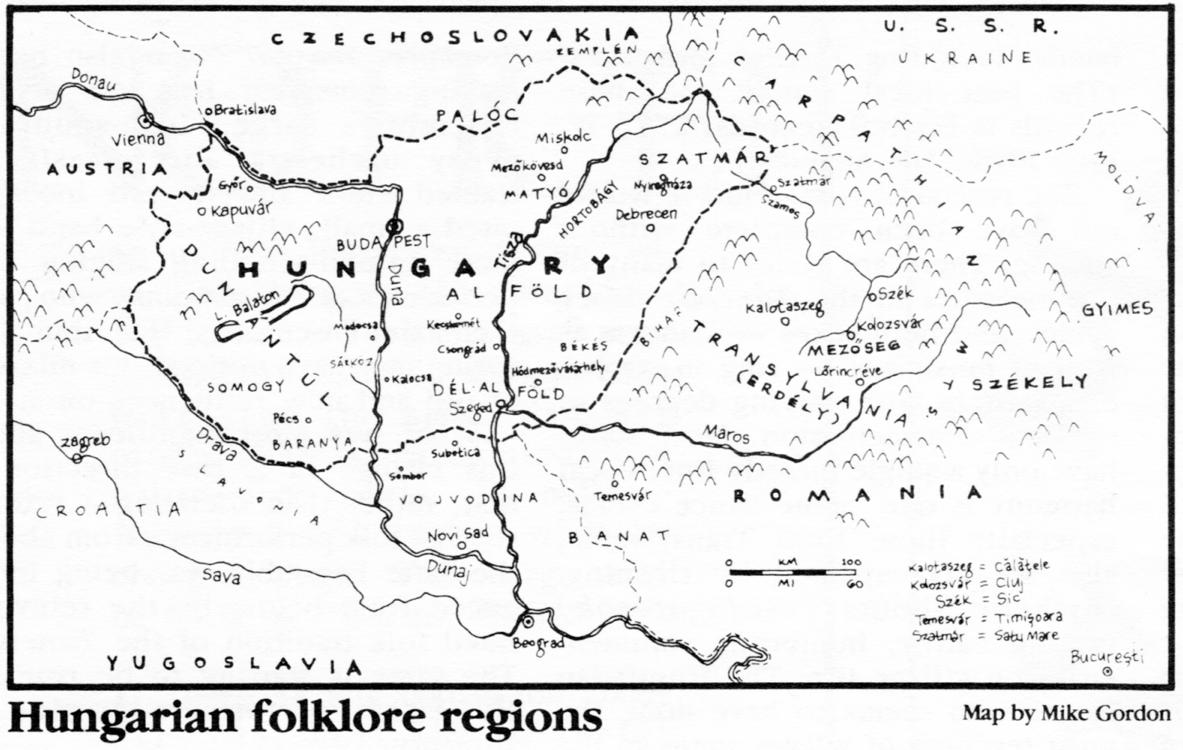
Seeds of change were sown in 1970 when some young Hungarian folklorists visited the Hungarian-speaking village of Szék in Transylvania (now part of Romania) and found the old Táncház tradition still alive and well there. The same proved to be true in other remote Hungarian villages, and researchers like Sándor Timár, Zoltán Kallos, and György Martin were able to observe living village dance, song, and music traditions formerly known chiefly from the pioneering musical studies of Béla Bartök, Zoltán Kodály, Lálazló Lajtha, and other Hungarian folklorists between 1905 and 1940.
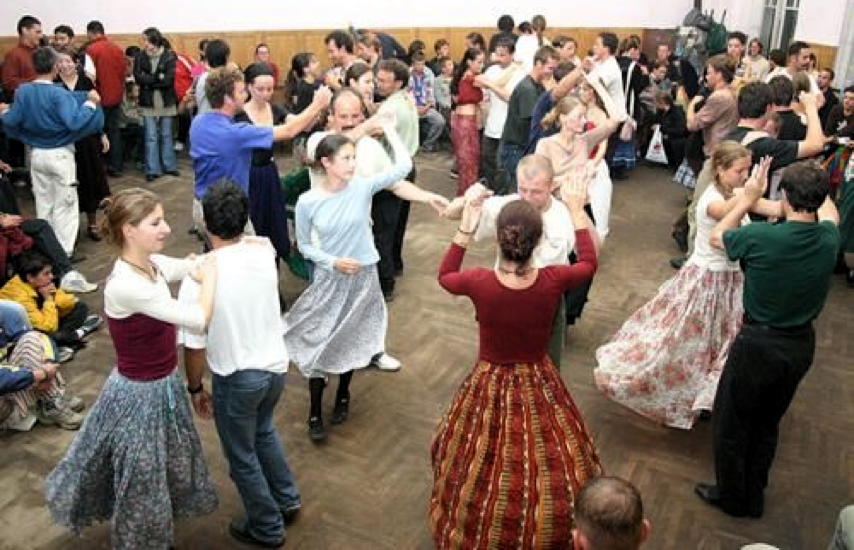 Instead of disappearing into museum archives or doctoral dissertations, however, the field research of the 1970s sparked a revival of the Táncház tradition – not in rural villages, however, but in urban Budapest, chiefly among well-educated young people: the Yuppies of Hungary, so to speak. With Ferenc Seb and Béla Halmos leading the way, young musicians began learning to play Hungarian peasant music in the manner of small traditional bands, and members of amateur performing groups like the Béla Bartók Ensemble, under the guidance of Timár, began learning to dance in the way Hungarian peasants once did: by improvising sequences of steps to what is called a dance cycle. A cycle is simply a series of rhythmically distinct dances known in a particular area and performed in a traditional order, in the manner of a 19th-century ball in America or Western Europe. In a Hungarian dance cycle, however, pauses between dances are brief or nonexistent and each dancer or couple, rather than following a set pattern of steps for each dance, improvises their own sequence from a regional repertoire of dance motifs. A typical cycle may begin with a young women's circle dance (karikázó) or athletic young men's dance (verbunk, legényes, and others), followed by couple dances that gradually increase in speed.
These Hungarians' rebirth of interest in their own folklore reflected on one hand the considerable aesthetic appeal of the material itself and on the other a sense of national consciousness that, because of foreign domination, had to be expressed culturally rather than politically. The performing groups' revival of village dances and music began attracting recreational dancers as well, and it was not long before cycles were being taught and a Táncház was being held at one club or another in Budapest almost every night of the week. These events frequently included lectures, concerts, or other cultural activities before ending with general dancing to live music – on a typical evening, perhaps three cycles, often beginning with dances from Szék and ending with those from the Mezöség. The fledgling Táncház movement did not immediately affect professional Hungarian ensembles or American performing groups and recreational dancers, who continued to do choreographed dances completely removed from their original context.
By the mid-1970s, however, the Táncház movement began to have a wider impact. Amateur performers of the new material became more numerous and started to receive national recognition. In particular, the Bartok Ensemble under Timár had increasing success in adapting the wealth of newly researched folklore to the stage. Instead of adapting it to meet the standards of "high" art, in the State Ensemble tradition, his choreographies accepted folk material on its own aesthetic terms and tastefully edited it for performance on stage. At the same time, American and other foreign dancers visiting Hungary became aware of the Táncház phenomenon and began learning and teaching the new material in the United States and elsewhere.
This change in tastes gradually became evident in Hungarian recordings available in the U.S. Once the domain of Rom violinists and operatic singers, the Hungaroton label in the late 1970s released a number of LPs of Táncház music, much of it by the Sebo and Muzsikas bands, complete with lyrics and translations. Foreign labels, including Hungaria and Vuka in the U.S. and Ocora in France, also have released valuable recordings of other village-style bands, including Ujstilus and Téka.
The revival of village music would not have been complete without singing. There are lyrics to many of the melodies in the Táncház dance cycles, and both sexes – dancers as well as musicians – sing in strong, clear voices with varying degrees of regional ornamentation. Most songs have only a single melody line; vocal harmony is rare. Some dance cycles, especially those from Transylvania, also are accompanied by rhyming, rhythmic shouts (csujogátasok) making earthy, humorous commentaries on village life. The Hungarian singer who seems to have done the most teaching of village songs in the U.S. is Agnes Gaug, who has recorded with the Téka and Ujstilus bands. Other fine young village-style singers include Martá Sebestyén, who has recorded with Sebö and Muzsikas, and Hona Budai.
All these trends in the Táncház movement have reinforced each other and begun to flower in the early 1980s. Sándor Timár was appointed artistic director of the State Ensemble in 1981 and promptly began introducing village-style choreographies, a shift that was somewhat controversial in artistically conservative circles. (One sensitive area, in the U.S. as well as in Hungary, is the amount of Transylvanian dancing in the Táncház repertoire. Because many Hungarian traditions survived in rural isolation longer than in more urbanized areas, the new dance cycles drew heavily on Transylvanian material, and some older Hungarians are less than comfortable with its undeniably Romanian flavor.) Timár also began making somewhat less use of the Ensemble's large, lush-sounding Rom orchestra and classically trained choir and instead incorporated a small, village-style band and more natural-sounding singing into performances. Americans who saw the State Ensemble's U.S. tour may have noticed this mixture of old and new influences on stage.
What was most significant about this change in artistic direction is that, rather than dictating a refined style of folk performance from above, the State Ensemble was being influenced from below by the reinvigorated folk tradition of the Táncház. The same is starting to be true for Hungarian performers outside of Hungary. Here in Los Angeles, for example, Kárpátok director Tibor Toghia has shelved a number of old State Ensemble suites and has introduced his dancers to new choreographies in the style of Timár, including several Transylvanian numbers. Instead of using recorded orchestral music for performances, he now relies on live music played by Americans who are learning the style of the new Táncház bands rather than Rom-style orchestras. The impact of these changes on Kárpátok's repertoire and style of performance will be seen in a full concert presented by the company at the Wilshire Ebell Theatre in Los Angeles. After a series of other California appearances, Kárpátok will complete the folkloric circle by taking its new material back to Hungary to perform in the Világ (World) Festival's competition in August. Its band also is scheduled to play at several Táncház events in Hungary – the first time, as far as we know, that an American band will have done so.
"It will be fascinating to see what Hungarian audiences make of Americans performing the new-style choreographies," says Toghia. "A few years ago, they might not have been sure What to think. But Sándor Timár's choreographies with the Bartok and the Allami (State Ensemble) have paved the way for us, and now many Hungarians will be interested to see how successfully Americans have mastered and interpreted the new style." This changing taste in stage material also is reflected in performances by Kodály and Hungária in North America and by Hungarian groups in West Germany, Sweden, South America, and Australia. Kárpátok also has helped establish a recreational Táncház movement in Los Angeles. Since April 1983, the group has sponsored a monthly dance-cycle workshop and Táncház party with live music at the United Hungarian House. It now regularly draws sixty or more participants, almost all of them Americans. In general, though, recreational folk dancers in America have been slower to accept Táncház material.
So says the best-known teacher of Hungarian dancing in the U.S., Andor Czompo, who is Kárpátok's artistic adviser and travels to Hungary yearly. He now teaches improvisational dance cycles as well as his recreational choreographies to American folk dancers. (In his only current West Coast appearance, he will present the Délalföldi cycle in a Táncház workshop sponsored by Kárpátok at the United Hungarian House in Los Angeles. Czompo says that outside of Los Angeles and perhaps one or two other cities, the choreographed dances remain more popular with folk dancers who do a wide variety of international material. "They want pre-packaged choreographies that are two or three minutes long and fit on one side of a 45 record," he says. "The dance cycles have to be at least six or seven minutes long to allow for real improvising, and at a lot of folk dance clubs, that's too long a break for people who don't know the dances. Because Táncház material is more difficult than many other types of folk dancing," he adds, "beginners often find it daunting." Even so, hundreds of Hungarian dance enthusiasts in the U.S. have enthusiastically adopted the improvisatory dance cycles. The Forrás and Barátsag camps on the East and West Coasts concentrate exclusively on Táncház-style dancing to live music and now have waiting lists each summer. At least three Táncház bands have been formed in the U.S. – Kárpátok in Los Angeles, Erdély in New York and, most recently, Hegedüsek in San Francisco. L.A.'s two leading international ethnic companies, AMAN and Avaz, both included a suite of Hungarian village dances in their repertoires, as do performing groups in other cities.
It may well be that performing groups are leading the way for the Táncház movement outside of Hungary, just as they originally did in Budapest. At the same time, a growing number of recreational dancers who perhaps knew little of Hungarian dance beyond the choreographed sequences of Somogyi karikázó or "Michael's Cárdás" now are being exposed, if not converted, to the subtleties of improvisation in the dance styles of Mezőség, Szék, the Szekelyföld, Gyimes, Kalotaszeg, Szatmár, Palóc, Sárköz, the Délalföld, and other Hungarian-speaking regions. It is foolish to think that choreographed dances are "wrong" and Táncház cycles "right"; good recreational choreographies can be pleasing and faithful representations of Hungarian folklore, and there is no reason not to dance and enjoy them. some can mingle happily with Táncház material on the dance floor. Most of the Hungarian village dances now being seen on American stages, moreover, are as strictly choreographed as any of the old favorites. But when they were still being danced in Hungarian villages, many of these dances were improvisatory in nature, and so it seems reasonable to believe that recreating them in the same fashion more closely approximates the original experience. A similar attitude contributed to the rise in popularity of unchoreographed Balkan line dances in Southern California during the early 1970s, in which performing groups and live music also played an important part. Since then, influential local teachers such as Dick Crum have been encouraging dancers to improvise within the framework of Balkan dances.
Another parallel between the Hungarian and American experiences is worth noting: In both countries, Táncház enthusiasts have had to learn this new style of dancing from the ground up, so to speak. Few, if any, of the young supporters of the Táncház movement in Hungary grew up with improvisational dancing in a living village culture. As urban people deliberately adapt unfamiliar folk traditions to their own recreational and social purposes, they thus have much in common with American folk dancers, including an interest in cultures other than their own. Hungarians now sometimes play and dance to music of ethnic minorities in Hungary – Serbian, Croatian, Slovak, Romanian, Bulgarian, Greek – at Táncház events in Budapest. Hungarian bands have recorded albums of South Slavic and even American folk music. One LP by the Téka Ensemble includes a selection of Croatian music by Hungarians playing tamburica instruments and singing in Croatian – the sort of trans-cultural performance that is the province of many American folk companies.
Where will the Táncház movement go from here? In large part, that depends on its development in Hungary, where dancers, musicians, and folklorists set trends for and generally remain several years ahead of the movement in the U.S. But as the circle of interest widens in America and other countries, more folk dancers will take up the challenge of learning to improvise in the village tradition, more musicians and singers will listen to and learn from Hungary's Táncház bands and more performing groups will heed Sándor Csoóri's reminder that folk dance has its roots not on the stage, but in the soil.
Printed in Folk Dance Scene, January 1985