|
Folk Dance Federation of California, South, Inc.
|

|
CLICK AN IMAGE TO ENLARGE
Over the years, I have noticed that folk dancers are often quite knowledgable about various dances from surprisingly obscure countries and regions, but usually in the dark when it comes to music and the instruments thereof. So, as an attempt to help enlighten those who love things ethnic, I am writing a series of articles on music and instruments.
In this issue, I am going to discuss some of the lesser known instruments in Polish folk music. Most who dance obereks and polkas know that the standard Polish folk orchestra uses a bass, an accordion, and a B-flat Boehm system clarinet all of which were successfully transplanted to the American Midwest with such interesting additions as guitars, saxophones, and occasionally banjos. However, the Polish peasant has (and does) play upon locally-produced folk instruments.
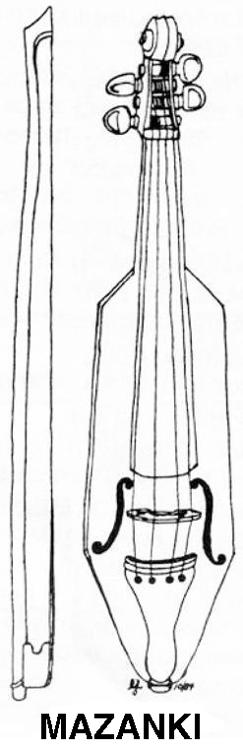 One of the most unusal Polish instruments is the mazanki, a local answer to the violin. Its ancestor is the rebec of medieval times and is related to the gadulka, the lira, and the lirica. However, the nasal-stopped strings have been replaced with more conventional violin-style strings stopped against a fingerboard. In teh Shamotuły region, a small violin with an angular body is played in consort with a cello-sized contrabass called a maryna.
 Throughout eastern Europe and the Balkans, a wide variety of bagpipes is found. The Poles are not exempt from this love of them, from small bladderpipes (siesieńki) to the koziol family of bagpipes. The koziols are members of a family of pipes found in Romania, Hungary, Poland, and Czechoslovakia. They usually have a stylized goat's head with the chanter emerging from the mouth and a drone that has a right-angled bend and hangs over the right shoulder. Under the left armpit a bellows is strapped onto the arm and feeds air into the dry-blown pipe.
The Polish koziol comes basically in two sizes, small and the large economy size. The smaller pipe is the koziol ślubny (wedding bagpipe) used at weddings as a ritual instrument and played up until the dinner when the big koziol the koza wielkopolska is played. A more archaic type can be found in the Tatra Mountains. It is mouth-blown rather than bellow-blown and has a straight drone with a small hole about midway up the drone. The hole is usually plugged, but it can be removed so the drone will play a fifth about the tonic rather than an octave below (actually it is a fourth below, but that is an octave below the normal fifth. Confused? Good! If you know too much, no one will read these articles). A friend of mine once showed me his pipe from the Tatras, and it was an excellent example of the peasant instrument maker's mind at work. It had a carved miniature of a bagpiper playing the same pipe in the middle of the drone. The small plugged hole was placed in a most appropriate portion of the little bagpiper's anatomy, rearword.
Some other Polish folk instruments include the fujarka wielkopostna (a more advanced version of the Romanian tilinca), a flute that is only a tube with no finger holes. It is blown across the rim and the finger is used as a valve at the other end for pitch control. There is the fujara salašnicka, six feet long and blown through a tube from the top down to the player, like a bass recorder. There is the trabita, a carved wooden trumpet shaped like a giant cow's horn.In the Lubsko region, assorted whistles and ratchet noisemakers have survived as children's toys.
Now, next time you hear a Polish band, remember that there is more to Polish music than oberek, polka, clarinet, accordion, and banjo.
Printed in Folk Dance Scene, December 1984