
|
Folk Dance Federation of California, South, Inc.
|

|
CLICK AN IMAGE TO ENLARGE
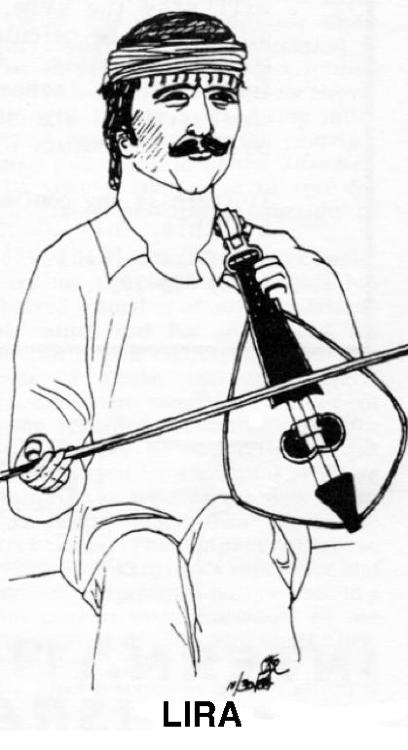 The island of Crete is in the Aegean Sea, south of the mainland of Greece. It is the home of a sturdy and handsome people who are proud of their culture and their music. Central to their music is a small bowed instrument, the Cretan lira.
The lira of Crete is a member of a family of bowed instruments that are modern survivors of the medieval rebec. This family includes the Bulgarian gadulka, the Macedonian kemene, the Yugoslav ian lijera and lirica, and the Turkish classical kemençe. In Greece, the members of this family are called lira. The most primitive is found in Greek Thrace, and is used by the Anasteria in their fire walking ritual. It has not changed since the seventh century. On the other hand, the Cretan lira is a highly refined and responsive artist's instrument.
The modern Cretan lira has a fingerboard, unlike other members of this family, but it acts only as a guide for the fingers because these modern rebecs stop the strings by touching them from the side not by pressing them against a finger board. Some, such as the gadulka, touch the strings with the fingertips, but the lira player touches the strings with his fingernails. The lira now uses a tuning in fifths – g d' a', but sometime before World War II used a tuning in fourths – A D' G'. The modern player uses machine pegs to tune his instrument and a modern violin bow in place of the older hand-carved bow that had hawk bells wired onto it.
The lira player is usually accompanied by a laouto, a large member of the lute family that is tuned in fifths usually – Ce – Gg – dd' – a'a'. The laouto may double the melody line or provide rhythmic chordal background. Ideally, a consort of one lira and two laoutos will be used with a singer who is often the lira player himself. Occasionally, an older player may be accompanied by an outi (the Turkish lutem ut), or a drum called a toumbi, played with two sticks.
The musical forms on Crete have not had the heavy Turkish influence seen in some of the other Greek islands. This is probably due to the tough and independent nature of the Cretans themselves. The result is that Cretan music comes closest to Byzantine music to be found anywhere in Greece, outside of church music.
The musical forms themselves consist of a poetic improvisational form, "Mandinades," a recitational form for heroic epics "Rizitiko," and dance music. The dances include "Pendozali" (dizzy five-steps) which is supposed to have originated as a soldier's training step for agility, "Haniotikos Syrtos," and "Maleviziotikos." Fortunately the "Maleviziotikos" is also known as "Kastrinos" for those of you who find it a bit of trouble trying to pronounced "Maleviziotikos."
An evening's entertainment in a Cretan taverna will not usually have an electrified bouzouki band and omnipresent farfisa (electric keyboard organ common to the Mediterranean countries). There will be instead a lira player and one or two lauto players. The lira player will play non-stop for hours, broken only when the hydraulic pressure forces a recess. One lauto player will play the straight melody line against the lira's highly decorated version. The second laouto will provide rhythmic backup. The first laouto player may have more than one lauoto in different tunings for different songs. When you leave the taverna for your lodgings when you are completely worn out from listening, the lira player will go on tirelessly, until all others have left. Cretan musicians are a hearty bunch!
Printed in Folk Dance Scene, January 1985