|
Folk Dance Federation of California, South, Inc.
|

|
CLICK AN IMAGE TO ENLARGE
 The musical culture of China is an ancient and very complex subject. Because a broad discussion of it is not possible in the space available, I will discuss only a bit about some of the musical instruments.
Like most cultures, the Chinese have a full complement of drums with the skins held on by large nails to variable tension drums with hourglass-shaped bodies. Most of these drums originated in India where they have been replaced by Persian models of even greater complexity. These drums were taken as far as Japan where they form a mainstay of the ancient Japanese traditional music. The Chinese also have transverse and notched flutes, and in ancient times they had odd pot flutes, rather like small jugs from a jug band. There also is a full complement of cymbals, bells, and gongs.
Among the stringed instruments are the tube zithers. They are called that because they are shaped like a section of the side of a tube with strings stretched over standing bridges. The Koreans and Japanese both have instruments derived from older Chinese forms of these instruments. The Japanese koto is an example. It is thought that they were developed from primitive bamboo zithers that use strips of the fibrous outer coating to form the strings.
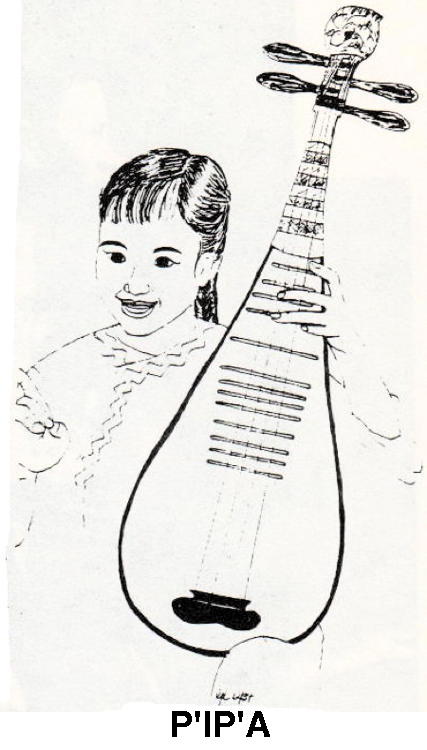
Among the various zither and lutes are some instruments that originated in foreign lands and were changed to match Chinese musical needs. Paramount is the short-necked lute, the p'ip'a. This is directly derived from the ancient Persian barbat. The barbat is the instrument first mentioned in the conquests of Alexander the Great as the barbiton. Barbat means "breast of a duck" and there is much puzzlement and speculation as to where it got that name. It was changed by the Arabs about the seventh century and given the name aloude. Going eastward, it arrived in India during the Gandhara period and a form of it was popular for a while. Going further eastward, it entered China and was changed again. Eventually it arrived in Japan as the biwa.
In China, the p'ip'a became the modern virtuoso's instrument that requires great training to master. It preserves the ancient pear-shaped body carved into a shallow shell from a single piece of hardwood and often lacquered black. The face has no sound hole, another ancient feature lost on most lutes. It has almost twenty frets on the face, most of strips of wood, and four on the neck. The frets are deep and on the neck are formed from blocks that allow the player to pull the silken strings into them so as to subtly shift the pitch and intonation.
The p'ip'a is played with the fingernails, flailed across the strings in the manner of a flamenco guitarist's rasgaudo technique. The resulting sound is delicate, yet continuous and quite subtle. In ancient times, the p'ip'a player was described as being able to produce the sounds of dogs barking, birds singing, children laughing, etc. Although these must have been great virtuosos on this instrument.
Unfortunately, space being limited, I cannot go into detail about the other instruments this time, but there are other Chinese New Years in the future!
Printed in Folk Dance Scene, February 1985