|
Folk Dance Federation of California, South, Inc.
|
|
CLICK AN IMAGE TO ENLARGE
 Dia duit! In Irish, this means "God be with you," a lovely greeting from a land of wonderful beauty, of poets, and of music.
In the Ulster cycle of stories of the Red Branch Heroes, part of one tale relates how three heroes are thrown into a pit: "Without the essentials of life; food, water, and music." I think this illustrates the importance of music to the Gael both then (3rd century CE) and now.
Although Ireland was inhabited since the end of the last Ice Age, Celts arrived only around 1,000 BCE, and the Gaelic speakers arrived around the 6th century BCE. From 540 BCE is a reference to a musician who was looking for a piece of willow to repair his cruit. The early cruit was a lyre type of instrument, later to mean a wire-strung harp, and today meaning any small harp.
There are stone standing crosses upon which can be seen many lyre-type instruments. Some are apparently Saxon (music of evil triumphant, or the damned) and some are native Irish instruments (music of the Heavenly Host). The triangular harp does not make an appearance until after the 9th century CE.
This early true harp was triangular with an outwardly bowed fore-pillar and metal strings. Some less than 20 have survived time, foolish servants and English soldiers destroyed them, but copies have been made and played. The tone is that of sweet chimes and bells quite unlike the ordinary harp tone.
Also on the old stone crosses are what appear to be fipple flutes of unusually large size (for Western Europe) and possibly conical bore, like a saxophone. (A fipple is a block or constricted mouthpiece inside an end-blown wind instrument.)
The Medieval Irish harp was well known in Europe because of itinerant Irish harpists. There is a reference from the Crusades by a chronicler that without Irish harpists there would have been no music for the Crusaders. Their music was popular enough that Irish tunes have been found in 14th century CE French music manuscripts.
During the 17th century CE the English embarked upon wars of cultural genocide against the Irish, and succeeded in destroying the legal system, the social system, and native dress of the Irish. When the Irish failed to become Protestants, they imposed British Catholicism upon them ending the native church that had endured for a thousand years.
However, they failed to stop Irish from being spoken, even upon pain of death. Hedge school teachers kept the literary tradition and language alive. Harpers were often executed, but music not only survived the English, but continued to develop.
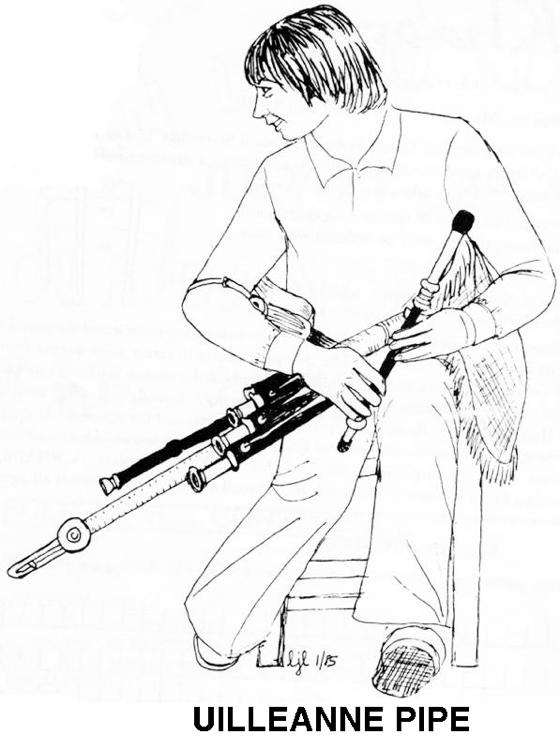
During the 17th century CE the Irish also started development of the Uilleann pipe, from a Scots instrument that is still played in border areas as the half pipe. During the mid-18th century CE it became known as the Geordie pipe and was popular in the border areas of Scotland, but died out before 1800.
In about the beginning of the 19th century CE the traditional music of Ireland started to develop. The fiddle was common. Itinerant musicians went from hamlet to hamlet, fair to fair, and played for wakes, weddings, and general celebrations. In the 1820s the first concertinas and accordions made their appearance with the result that Irish music took to the little button boxes with delight. The concert flute starts being used when they became available cheaply enough for Irish peasants to afford. This flute is different from the modern boehm flute with conical rather than cylindrical bore and fingering similar to the oboe.
During the late 19th and early 20th centuries CE, Irish immigrants brought back guitars and banjoes. These are still in use although they are less favored since the introduction of a new family of instruments starting in 1974 with the Sobell cittern.
The Sobell cittern is a Portuguese guitar with a banjo neck and octave mandolin tuning. This has the sustain of a guitar without its overly filled chords. Along with the cittern have appeared Irish bouzoukis tuned in fifths, octave mandolins, and flat mandolins.
The modern traditional orchestra might include any of the following instruments: Guitar, violin (fidil), two-row diatonic accordion in B-C (ceol bosca or cairdin), tin whistle (feadog stain), flute (consairt fluit), neo Irish harp (cruit), cittern, and bodhran (frame drum derived from skin-bottomed tray daikin drum).
The new instruments have not displaced the older traditional instruments, but have added to the richness of Irish music.
Printed in Folk Dance Scene, March 1985