|
Folk Dance Federation of California, South, Inc.
|

|
CLICK AN IMAGE TO ENLARGE
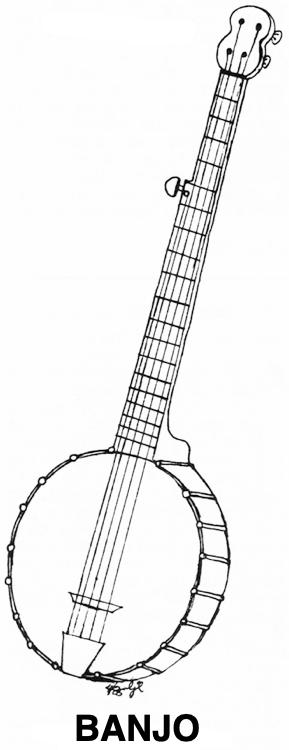 Over the years, I've studied and played all sorts of exotic instruments, from distant places and times. There have been the Arabic quanun, the Greek lauoto and lyra, the Romanian cobza, the Persian dombak, the Irish bodhran and feadog stain, the Turkish baglama saz, the Basque txistu, the 16th century Dutch trommel, and the list goes on. In the course of years, one of the strangest and most exotic also has a pedigree of four thousand years in its ancestry, and it can be found in our very own ethnic back yard. It is the familiar banjo.
The modern banjo comes primarily in two flavors (with a few variants): the four-string tenor banjo tuned in fifths and still the mainstay of ragtime enthusiasts, and the older five-string banjo which is commonly tuned in d' d g c d'. The five-string banjo is the central member of this family, where as the tenor banjo was developed near the turn of the 20th century for popular music. Other forms appeared and died out, like the deep-bodied banjoes used in New Orleans early jazz and blues or the seven- to fifteen-stringed experimental comes from the late 19th century. The design in use today dates from shortly after the Civil War and hasn't changed significantly since 1875.
Going backwards, we find the five-string banjo becoming popular around the 1860s and being credited, though erroneously, to a popular banjoist named Sweeny. Thie earlier banjo had one odd feature: the fingerboard was not straight as in modern instruments, but flame shaped with one curl of flame turning outward to support the short fifth string and its peg. Going further back in time, we arrive in the time of Thomas Jefferson who wrote about his slaves playing upon an instrument that he liked called a banjar. This instrument had a gourd body with a piece of skin tacked or nailed to the body with a flat stick attached for a neck. Simple pegs held four gut strings tuned in various patterns of fourths and fifths. This instrument survives as the fretless Appalachian banjo which is intermediate between the slave banjar and the instrument played by Sweeny in 1860.
The banjar was obviously an import from west Africa where a similar instrument called a bania or banya is still played. This instrument developed from the North African gunri (plucked lute) played by northwest African peoples who trade along the coast with the Black peoples south of them. The gunri is currently a poor man's substitute for the Arabic al-oud (commonly tuned to C F A D G C, and has 3 or 4 strings tuned in fourths. It is constructed from a tear drop shaped piece of wood with a round piece of wood for the neck and long pegs at the end. It is the direct descendant of the ancient Egyptian nofret.
The nofret was also a skin faced instrument with gut frets and played with a large pick that was tied to the end of the instrument by a cord to prevent loss. It seems to have been part of the orchestra used around 1500 BCE and is descended from the older Hittite long lute. Even the Egyptians noted the foreign origins of the nofret.
The Hittites played a long-necked lute with what was apparently a skin face and seems to have been in use by 2000 BCE. There's a charming figurine in the Berlin Museum of Mitanni of a musician playing a long-necked lute.
Around 2000 BCE, the long-necked skin-faced lute disappears into history with only the earliest names to give a clue to the origin. They were called pantur from Sumerian pan-tur, meaning "small bow." This implies a simple split from the arched harps (large bow) and the one-stringed bow with a resonator stopped against the body of the bow (small bow).
So, from the modern banjo to its earliest supposed ancestor, we have followed a trail of musical begets to Africa, Egypt, to Asia Minor, and eventually into the mists of time. Truly an impressive lineage for a "simple" folk instrument.
Printed in Folk Dance Scene, June/July 1985