|
Folk Dance Federation of California, South, Inc.
|

|
CLICK AN IMAGE TO ENLARGE
 Sometimes when two cultures meet, strange and wonderful things happen. The distinctive art, food, and music of Mexico is the result of such a meeting, melding Indian and Spanish cultures, plus a fair sprinkling of spice from other immigrants.
When the Spanish conquistadors arrived in Mexico, they found two native civilizations. The Mayans in Yucatan were in decline, but the Aztecs in central Mexico were at their peak. The Spanish formed an alliance with local tribes that were not happy with the Aztecs in particular and proceeded to conquer them. The Roman Catholic Church stepped in and started a program of conversion and destruction. They tried to obliterate the traces of civilization and replace it with a Spanish type of culture, although they did not quite succeed. The influence of the native Indian culture is clear to anyone who has eaten Mexican food, seen Mexican murals of Xochimilco, or heard the different regional styles of Mexican music.
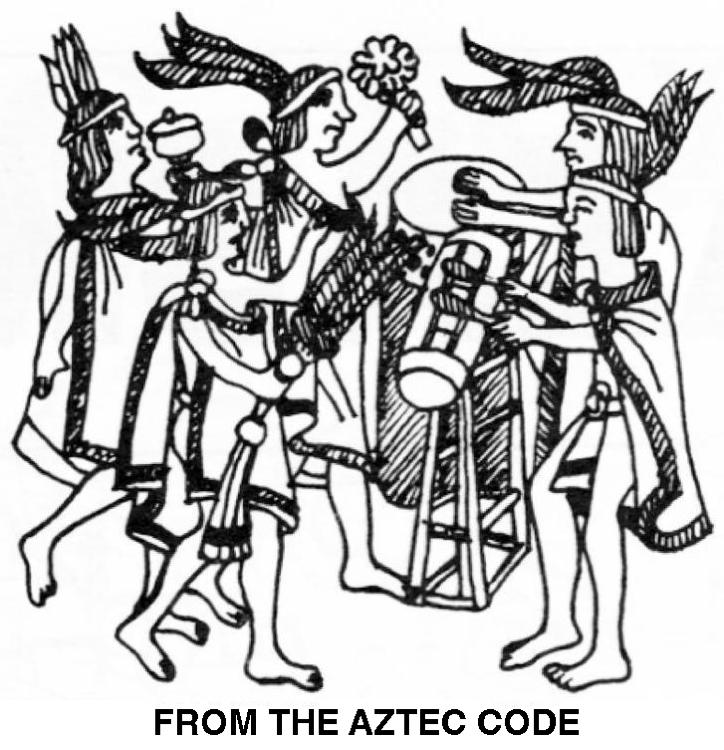
When the Spanish arrived, they found the Indians playing on clay whistles, drums, slit drums, and scrapers. The Spanish introduced the guitar family, the military drum, pipe (fluiol), and tambori (two-headed drum). The Spanish also introduced the chirimia (double-reed woodwind), and harp. These have been mixed in various ways to produce the regional types of bands seen in Mexico.
In Veracruz you will find beautiful music played on harp, guitar, and quinto (small ukelele-like instrument played with a long slender quill feather). The harp is the central instrument with the guitars providing fuller accompaniment. The quinto plays syncopated rhythms across the complex patterns already weaving rhythms against themselves on the harp. Add to this the wonderful sound the sight of the girls dancing in their "butterfly" dresses and the young men in white, and you may discover why so many regard this the most charming music made anywhere in the Americas.
In the south we find the ancient Mayan culture still living with the clay flutes and various drums, rattles, and scrapers. To hear this music is to step centuries back in time to before the Spanish came. This also is used to accompany the brilliantly costumed Indian dancers.
In the Rio Grande Valley we find what happened when German settlers came with brass bands and accordions in the 19th century. The locals still dance polkas and schottisches, but with a distinctive Mexican flavor. The dances are played to Mexican tunes with no recognizable German flavor on the German band instruments, and the dances have taken on less the flavor of bratwurst and more the flavor of chile colorado. Here is the odd step in the dances where the man will actually step on the side of his foot with the weight on his ankle. Ow!
Last, but certainly not least, we may find the music most of us think of when we think of Mexico – the Mariachi band. This style from central and northern Mexico has banked violins and trumpets. The band forms a straight line facing the audience and stands. The trumpets take lead, alternating with the violins, and are accompanied by several guitars. Sometimes the Mariachi band is augmented with a quinto, a marimba (tuned wooden bars struck with mallets), a guitarone (base guitar), and a Veracruz harp. This should also have girls dancing in brightly colored dresses and good Mexican food with bottles of Dos Equis beer at hand.
There is not enough room here to touch on the many musical cultures in Mexico, but with a little luck, you may get to do your own personal research, with the food and beer handy.
Printed in Folk Dance Scene, September 1985