|
Folk Dance Federation of California, South, Inc.
|

|
CLICK AN IMAGE TO ENLARGE
 The modern homeland of the Armenian people is a small plot of land in the southern Caucasus Mountains. The Armenians once had a small empire in southeastern Anatolia, and there were even two Armenias competing with each other for a time in eastern Anatolia. The Armenians have at one time or another been overrun by Mongols, assorted Turks, Persians, Arabs, Greeks, and even other Armenians.
The turbulent history of Armenia with various conquerors marching across Armenian lands left a wide range of cultural impact, and the music of the Armenians bears the clear imprint of this history. One very clear indicator is the mixture of traditional musical instruments used in Armenian music.
The Armenian music and instruments we are most familiar with here in America are of the Turkish Armenians who started arriving in America shortly after Sultan Abdul Hamid II began the deportations when he ascended to the Sultanate in 1877. These immigrants came mostly from the Turkish provinces of and Erzurum and Kars. The instruments they favored were the Turkish urban instruments and instrumental combinations used around the turn of the century. The common ensemble was composed of the oud (Turko-Arabic lute), kanon (Turko-Arabic psaltery), violin, darbuka (Turkish goblet drum), and clarinet. This ensemble provides the core of the music played by Armenian-American bands with modern additions of electric organs and guitars. The repertoire is a mixture of old Armenian folk tunes from Erzurum, modern popular Armenian tunes, and old Turkish urban popular songs.
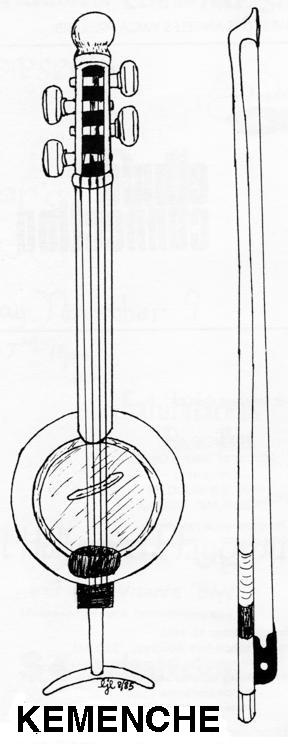
Soviet Armenia has kept the tradition of Armenian culture which is more Caucasian and which has less Turkish influence. Their musical cultural shows clear Azerbaijani, Georgian, Persian, and Central Asiatic influences. The traditional orchestra was originally composed of a tar (membrane-faced long-necked lute), kanon (plucked string instrument), duduk (small cane-reed pipe), doli or dhol (small double-headed drum) or daire (frame drum), kemenche (spike fiddle), and occasionally an oud (short-neck lute-type, pear-shaped, fretless stringed instrument). The modern traditional orchestra will use from three to five kanons, two to four tars, and two to four kemenches, along with an oud, a doli, and a duduk player. Sometimes there will be two duduk players or a whistle player. On occasion the orchestra will be filled out with a clarinet and even an accordion (though accordions have not gained favor in Armenia as they have in neighboring Azerbaijan and Georgia).
The favorite instruments for playing solo or with drum in the oldest traditional forms are duduk, tar, and kemenche. The Persians are better technicians on tar and kemenche, but they lack the Armenian's expressiveness on these instruments. Perhaps the kemenche is the most expressive of all instruments used by traditional Armenian musicians, being the symbol of the great Armenian poet Sayad Nova.
Another instrumental combination in traditional Armenian music is the larger doli played with two sticks, one large and one small, and a pair of zurnas. The zurna is a rush-reeded shawm (conical-bore double-reed woodwind) that is very loud and used in outdoor music for festive occasions. One zurna will play drone while the other plays melody. This drone technique is not common in this part of the world but seems to be a common Armenian habit.
The music of Armenia tends to favor rhythms in six-eight meter with some fast two-four and some four-four. There are pieces in five measures and some in slow nines. The music of the American-Armenians have more of the two and four meters, and they have a tendency to play old Armenian pieces in slow six meters as tens in a beat called jour jouna. This rhythm is common in an area encompassing Erzurum and parts of Îraz and is popular with the Turks, Kurds, and Arabs living there today. Because most American-Armenians originated in Erzurum, it is not surprising that they prefer the slow ten rhythm to the Soviet Armenian slow six versions.
The modern popular music in Soviet Armenia may range from full traditional ensembles to various mixtures with modern Western musical instruments to full jazz ensembles, rock, and classical music. This kind of mixing is only to be expected in a people who are as music-mad as the Armenians. At least one of the many fine Armenian composers has become commonly known in Western classical music – Aram Khachaturian. The other composers of Armenian music also deserve attention from the world, and perhaps in time they will also become recognized by the world outside Armenia, and Armenia's true musical genius may become known to the world.
Printed in Folk Dance Scene, October 1985