
|
Folk Dance Federation of California, South, Inc.
|

|
CLICK AN IMAGE TO ENLARGE
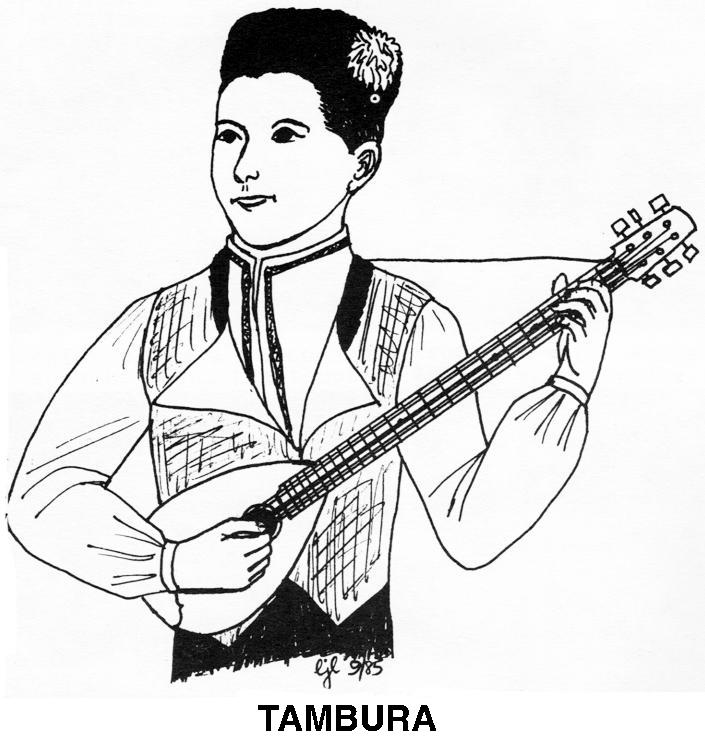 Balkan folk dances are special favorites of international folk dancers, and the dances of Bulgaria and Macedonia are especially loved for their great variety and challenge. The music also holds a special interest for lovers of folk music because of its complex rhythms and melodic patterns. Like most areas of the world, the instruments are specially suited to the music and often are highly developed while showing clear signs of their ancient lineage. One group of instruments in the southern Balkans is the tabura family.
Around 605 CE, the Slavs threw off the Pannonian Avars and invaded southward, penetrating as far as central Thessaly in Greece, even taking part of the Peloponnesos. Around the same time, the Utigur Huns and the Kutigur Huns merged north of the Sea of Azov to form the Khanate of Greater Bulgaria. In 679, the Danube Bulgars rose from the original Khanate. By the end of the 8th century CE they were separated from the Volga Bulgars by the rising Magyar nation and in turn separated the southern Slavs from their northern kin. In 1018 CE the Byzantine Empire swallowed up the Bulgars and the Serbs, while the Croats escaped conquest. In about 1200 CE, the Byzantine Empire crumbled into over half dozen squabbling little states and the Bulgarians and Serbs finally freed themselves from the Byzantines for a time before the Turkish conquests (1521-1541).
During the time from their conquest in 1018 until they freed themselves around 1200 the Turkic speaking Ulgars adopted the language religion, and customs of their neighbors, the Slavs, who were the direct ancestors of today's Macedonians. In turn, the Bulgars introduced the Central Asiatic long-necked lutes that are depicted on some medieval Bulgarian carvings.
Although the Slavs of the southern Balkans were familiar with long-necked lutes by the end of the 12th century CE, the modern tamburas were developed from other long-necked lutes introduced by the Turks after their conquest of Bulgaria in 1371 CE. It is my guess that at least an early tuning pattern survives in the A D pattern of the two course forms of the Tambura, although the physical layout of the instruments originally derive from Turkish instruments.
In the Rhodopes, the local form of the tambura shows a close relationship to the Turkish saz family. The body still has a small hole drilled on the left side as the Albanian cifteli and sharki which are obvious saz derivatives, with the sharki even maintaining the saz tuning pattern. The Rhodope tambura uses string for frets tied around the neck or partly around the neck and through holes on the neck.
In Bulgaria generally, the tambura is usually made from maple with three courses of strings tuned to DD aa dd. It has inset metal frets in a raised fingerboard, a moderately large sound hole, a shallow body, and usually a tear-drop shaped face. Sometimes it is made with four courses of double strings tuned DD GG, bb, ee.
In Yugoslav Macedonia, the tambura is made with a lozenge-shaped face and a deep rounded body, often with a dark red-brown lacquer finish. It has a veneer pickguard glued above the sound hole and the fingerboard is flush with the face. Some older ones have the staple frets seen on tamburicas but the newer ones use standard metal frets. It is strung in two double crosses tuned aa dd. Sometimes it will be made with three double courses tuned DD aa dd.
Printed in Folk Dance Scene, November 1985