|
Folk Dance Federation of California, South, Inc.
|

|
CLICK AN IMAGE TO ENLARGE
 From October 31st to January 6th are a series of celebrations, some international and some local, that are often referred to in America as "The Holiday Season."
Most of these holidays are considered to be of a religious nature, usually Christian, but most are in fact survivals of ancient pagan celebrations with a very thin Christian veneer.
The first date, October 31st, is part of a dual holiday we call All Hollow's Eve, or Hallowe'en, or Halloween and the following November 1st is called All Saint's Day. These are the ancient Celtic holidays of the Feast of the Dead with the Celtic New Year on November 1st. The night before was the time when the boundaries between this world and the world of the Grey Man who ruled the dead and traveled from the east to the west seeking the Tir Na n-Og (pronounced TEERS nah nogh) or land of the young. This Celtic holiday on November 1st was and still is called La Na Sammna (pronounced law nuh SOW-nuh) or Sanain (pronounced shuh-NAWN) in Ireland.
Another common holiday is The 12 Days of Christmas, celebrated in many different lands. In America we celebrate only the first day, December 25th, and in Greece the festivities are low keyed until January 6th, but in some lands the full range between December 25th and January 6th are celebrated from western Christmas to the Feast of the Epiphany. Although very heavily disguised as a Christian holiday, this is the ancient Roman Lupercalia.
In Western Europe and North America Germanic, influence has combined the Lupercalia with the Germanic Yule celebration. In English-speaking lands, this Yule ceremony derives from the Saxon mid-winter celebration of Giuli (meaning Yule) that ended the Blōtmōnaþ (pronounced BLOH-moh-nahth) or Blod-month when the herds were thinned and the animals were converted into sausages and preserved meats for the winter.
Among the other holidays we and other lands observe are the American Thanksgiving and the Jewish Chanukah, but in parts of Europe there are still very clearly pagan rituals observed on one day in particular, Saint Steven's Day. On this day we find a common thread of maskers, mummers, music, and ribaldry and it's one of the failures of Christianity to totally obscure the ancient origins of the celebrations.
In Greece, Jugoslavia, and Bulgaria men dress up in fantastic costumes of animal skins with goat bells attached by belts and strings. In Greece, this celebration still involves the use of the zygia, a folk band composed of two large zurnas or pipizas accompanied by a large double-headed drum, the dauli. Although this band is largely displaced by the Koumpania of Klarino violi, santouri and lauto, it is still de rigueur for Saint Stephen's Day.
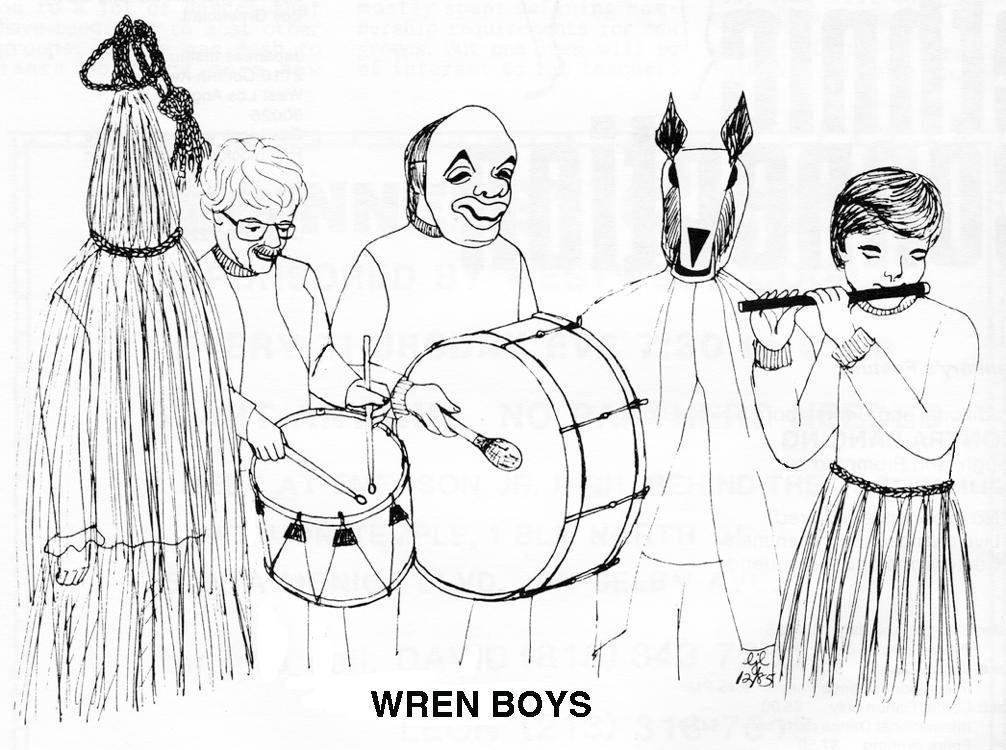
In Ireland, this day is also called Wren's Day because of the now-defunct custom of killing a wren and displaying it on a pillow, in a hoop, or on a pole in the procession of the Wren, as the musicians and maskers are called, or a Dreoilin (pronounced DROH-il-leen) in Irish. The Wren will be composed of musicians who in Dingle traditionally use old British military fifes in B-flat and a bass drum with side drums. No one is quite sure how this old British military band became part of the Irish celebration, particularly in Dingle which is still primarily a Gaelic-speaking area and not a place for those who love things British, but there it is, and only recently some are starting to use penny whistles or wooden concert flutes in D as the old fifes become rarer.
The fully traditional Wern will have its musicians and strawboys who wear costumes made from oat straw, preferably of the pilfered variety. The strawboys are supposedly not recognize by anyone else. In times past, the strawboys also would appear at weddings as well as Saint Stephen's Day, but their misbehavior put them into such disrepute that the custom is only now slowly being revived, but with better manners. Others may wear costumes chosen for satirical or topical reasons. In 1939, in Dingle, one troupe of celebrants appeared as Nazi Stormtroopers and in 1982, one person came as the Ayatollah Khomeini.
Another element of the Wren is the Láir Bhán (pronounced LAW-ir vawn), a hobby horse that once had very sexual overtones and is related to the worship of Epona, the Celtic horse goddess, but now is only a tradition whose memory is forgotten. It seems related to the hobby horses of Padstow in Cornwall that also has sexual connotations, and is involved in a Saint Stephen's Day procession with a concertina and a drum.
Unfortunately, the Wren's Day celebrations in Ireland are mostly concocted for tourists and the music is only the usual celidh (pronounced KAY-lee) band combination, but in Dingle it is still a true living tradition.
Printed in Folk Dance Scene, January 1986