|
Folk Dance Federation of California, South, Inc.
|

|
CLICK AN IMAGE TO ENLARGE
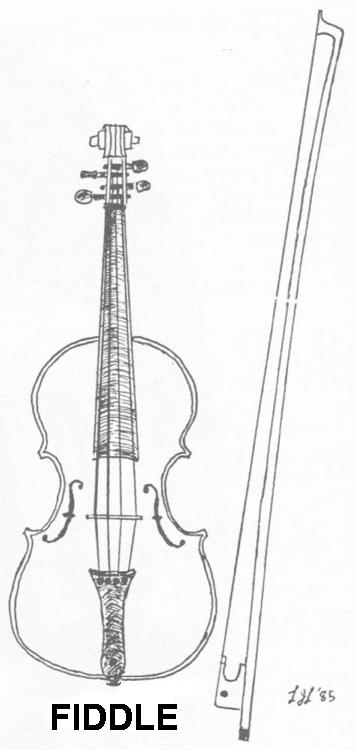 I have enjoyed and played music from all over the world. Sometimes it is from a well-known land or sometimes from some obscure corner that most people have never even heard of. The local musical culture in each land is usually rich and varied, and gives a good accounting of the soul of the people it represents. Looking into my own back yard I find the folk music of America is also rich, deep, and varied. Central to American folk music is the violin, commonly called the fiddle.
The violin itself has origins in the Middle Ages from an instrument called the fidel or fidele. This instrument was a relative of the viols that were tuned in fourths. The fidel, however, was tuned in fifths and had five strings. It was tuned as follows: C g d a' e'. By the 16th century the first violins appeared. They had modified viol bodies and four strings tuned in fifths: g d a' e'. This instrument had immediate wide appeal. It replaced the older rebec partly because in England the rebec was banned because of its popularity with the lower classes. Soon after the introduction of the violin, the English tried but failed to ban the violin for the same reasons. In the centuries since, the violin has become the closest thing I have ever seen to a universal musical instrument siince it has won a place in art and folk music all over the world.
The violin was introduced into America with the colonization of the 17th century and succeeding waves of immigrants right into the 20th century have brought their own folk music and style of playing the violin with them to contribute to the cultural mosaic of this country.
In America, folk violins are called fiddles and playing of fiddles is called fiddling. Each area of America has produced its own distinctive style of fiddling clearly derived from a particular immigrant population that tended to settle there.
In the Midwest, large groups of German and Scandinavian immigrants left an indelible mark in the local styles with some echoes of the fjords and mountains of Scandinavia. I remember listening to Tim Rued playing his nyckelharpa (resembling a cross between a hurdy-gurdy and a viola) and informing me of the strong Scandinavian influence to be found in the fiddling around the Great Lakes area.
In Louisiana, there are Cajuns, descendents of Arcadian French immigrants who originally settled in Canada but were forcibly sent to the swamps of Louisiana by the British when they invaded and capture Canada from the French. They have an unusual style of playing with double stopping and droning, and they make extensive use of scordatura (non-standard tuning) for effects. They also hold the violin either closer against the chest or on the upper arm and pressed into the armpit in the 17th century fashion.
In the Ozarks and in the Appalachian Mountains, we have old English, Scottish, and Irish fiddle styles surviving with their heavily articulated fast and furious bowing for rhythmic effects.
In the Central Midwest, we have old gentle English styles blended with German styles for the sentimental music sometimes heard in Missouri, Kansas, Iowa, and Nebraska.
In Tennessee, we hear the highly decorated and very exciting bluegrass style that has its roots in the older Appalachian style. In Texas and the Far West, we have music that is from 19th century migrations into the West and bear a strong resemblance to the Appalachian and Ozark styles.
In the summer there are often fiddle contests and music meets all over America. In the Los Angeles area, there is the Annual Bluegrass Fiddle and Banjo Picking Contest that used to be held in Topanga Canyon. Each of these music festivals is distinctive and full of marvelous musicians. I would make a hearty recommendation that you look up the nearest such music festival and spend a day listening to America's own rich folk music.
Printed in Folk Dance Scene, February 1986