|
Folk Dance Federation of California, South, Inc.
|

|
CLICK AN IMAGE TO ENLARGE
 The Scots are a branch of the Celts who have in common with their cousins a love of music and dance and who have a highly developed musical culture of their own. One aspect of this culture is the wide variety of musical instruments and dance found in Scotland.
The Scots play the violin and Scottish immigrants have left their mark on American fiddling in the quick stroks and rhythmic style found in American fiddling, mixed with the techniques found in England and Ireland. Also popular is the accordion in the form of the three-row button Marine accordions from Italy. The Scots also play conventional keyboard accordions. Guitars have made headway into Scotland from immigrants returning from America and Canada.
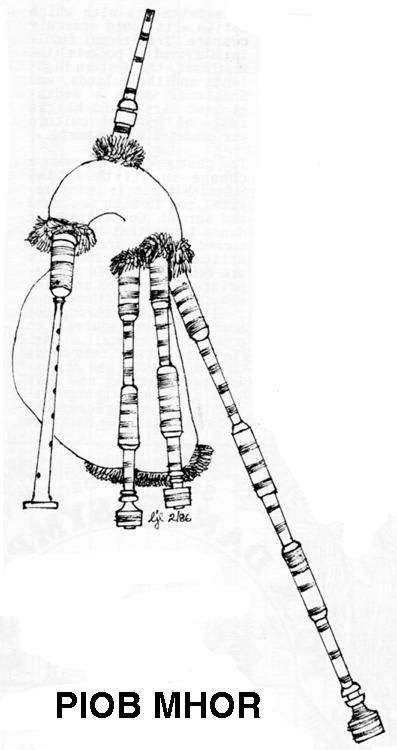
The bagpipe is usually associated with Scotland but there are at least five different bagpipes found there that I am aware of. There is the piob mhor (pronounced PEEB mohr) or great pipe that we think of as the Scottish bagpipe, the reel pipe which is a piob mhor with a one-key chanter for playing fiddle tunes, the parlor pipes which are small, quiet versions of the piob mhor, the half pipes which are bellows blown pipes using a piob mhor chanter, and the diminutive and charming Northumbrian smallpipes which are also bellows blown and so quiet that a violin can easily drown them out.
One institution found both in Scotland and Ireland is the ceilidh (pronounced KAY-lee). This is simply a music party. In Scotland it takes a somewhat structured form whereas in Ireland it is a kind of jam session. In Scotland the evenings will start off with a band playing accordion and fiddle and they will perform dance tunes for the partygoers. Reels, jigs, strathspeys, and flings are the order with waltzes mixed in for a slower pace. Later in the evening they will want to rest, so they often bring in a piper who will then play more dance tunes on the piob mhor. In the West Highlands and along the Western Isles, another rarer instrument will be used in place of the pipes. This is the lap harp derived from the original wire-strung harps used until the end of the 17th century in the western part of Scotland. Usually a lady will sit and sing ballads with the harp. The modern form of the harp is usually a small standing harp somewhat larger than the modern neo-Irish harp.
After some time, the lady with the lap harp will run out of tunes and the revelers will have recovered sufficiently to return to the dance floor and attempt to wear out the floor until the end of the evening.
Formerly to be found in Scotland were such instruments as the Geordie pipe and the cruit. The Geordie pipe got its name from its popularity in the Lowlands in the middle of the 18th century and is an early Irish Uilleann pipe with only one regulator (pipe with keys for chords. The cruit is the ancient wire-strung harp essentially identical with the Irish model and played until the end of the 17th century.
Then there is the music of the Shetland Islands with their distinctively Norse flavorings, but that is another story for another time.
Printed in Folk Dance Scene, April 1986