|
Folk Dance Federation of California, South, Inc.
|

|
CLICK AN IMAGE TO ENLARGE
 Until the end of the war between Greece and Turkey in 1919-1922, there were three groups of Greek-speaking minorities in Asia Minor. Along the western coast were the direct descendants of ancient Greek settlers who were living in Asia Minor even before Alexander the Great met them as he started his historic conquests. Their largest concentration was in Smyrna (İzmir) in Western Turkey. Another group was concentrated around the city of Kayseri (Caesarea) and in the region of Cappadocia. Although these people are culturally Greek, their ultimate ancestry is largely Celtic. They are mostly the direct descendants of the Trocmii, Tectosages, and Tolistobogii who sacked Athens in the 3rd century BCE and ended up in the center of Asia Minor. These are the Galatians of the New Testament. They were conquered by the Romans and still maintained their Celtic language until early into the start of the Byzantine Empire when they lost their Celtic culture and became Greek, culturally.
Later in the 15th century CE after the Turkish conquest of Byzantium, some became Turks. The rest remained Greeks and to this day would deny any non-Greek origins.
After the Greek-Turkish war, Greece and Turkey traded ethnic populations with much misery on both sides. The Greeks from Cappadocia (in Pontos) became totally absorbed into the Greek cultural mainstream and the Smyrna Greeks held onto their culture for a few decades, but the initial poverty they suffered after being exiled from Smyrna eventually caused their merger into the Greek main culture. They did leave their mark on Greek urban culture by being the largest single source for the musical form of rebetika that became the heart and soul of Greek urban performing arts.
The third Greek speaking group that was deported from their homeland in Asia Minor was the Pontian Greeks, named for their home in the Pontos mountains along the Black Sea coast. This was largely a rural group who managed to maintain their own culture along with their Moslem cousins, the Laz. The male costume of the Pontians reflected their martial character in the all-black close-fitting pants and short jacket with heavy cartridge belt and military pistol at the side. He wears a black headdress and high boots. The costume is trimmed in gold at the headdress and small red bands atop the boots. These people were among the few who caused even the Turks to sleep poorly.
The Pontians were resettled in northern Greece, in Thrace. There, they held tightly to their own culture and have succeeded in continuing their own music and dance where the other Asia Minor Greeks have lost most of their own culture.
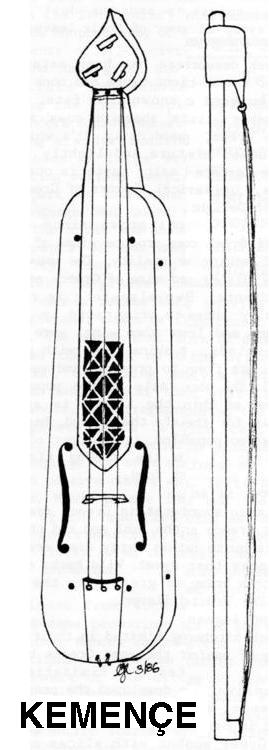
Central to Pontian music and dance is the Pontian kemençe (lira). This is a narrow-bodied fiddle usually tuned in fourths: g d' a'. It is played with a simple bow and is fingered in double stops (two strings at a time) in rapid and complex rhythms. The player may even hold it by the neck, dangling the body downward, and actually dance at the head of the line with the other dancers in the war dance "sera." The rhythms are usually remarkably fast, in meters such as 7/16 or 9/16, or even a more sedate 2/4 or 9/8. The player often will syncopate in even more complex cross rhythms or even ignore the beat entirely while still managing to remember the pulse.
The Pontians have enough security in the strength of their own culture that it has even undergone modern developments without needing to blindly freeze the old ways.
Modern popular Pontian music uses electric organs and violins, and borrows tunes from their neighbors, such as Serbian "u šests," and then they change the music to suit themselves. Still, with all these modern influences, the kemençe remains the central instrument in Pontian music, just as when they were in Asia Minor. They were known to play the ut (Turkish lute), dümbelek (Turkish clay goblet drum), and tulum (Turkish double-chanter bagpipe) alongside the kemençe.
The three groups of Asia Minor Greeks have each added their own flavo to Greece, but each in a differing degree and style, with the sad sounds of bouzouki in the cities and the exotic sounds of the Pontian kemençe in the northern countryside. I personally hope these sounds will continue to be a part of Greece for many years to come.
Printed in Folk Dance Scene, July/August 1986