
|
Folk Dance Federation of California, South, Inc.
|

|
CLICK AN IMAGE TO ENLARGE
The musical culture of India is both ancient and extremely variegated. Trying to make a description of Indian culture at any level in the space available is really impossible because we are dealing with a collection of differing cultures rather like the variety of cultures in the subcontinent of Europe. Comparing a musical form from Delhi is as valid as comparing the music of Portugal to Albania. So, instead of trying to go into depth, I will give a quick tour of some of the various instruments in use in India.
STRINGS
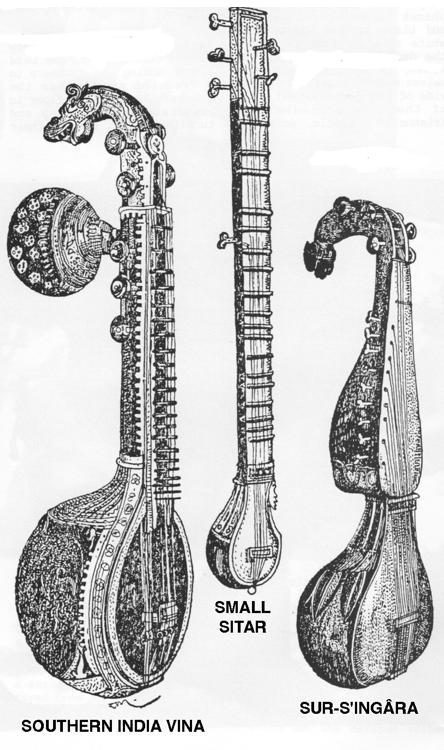 The variety of stringed instruments in Indian music is almost as wide and imaginative as in their drums. The most familiar stringed instrument to most non-Indians is the sitar (three-stringed) with is 19 strings. It has three main strings, six chikara strings (spike-fiddle strings), and twelve sympathetic strings. It has a larger relative, the sur-bihar, also called the sundari. Usually used to accompany the sitar is the tambura, a simple relative with four strings tuned to the tonic two dominant, and one to the lower octave of tuning used by the sitar. They usually use C# as their referent pitch.
The vina is an ancient instrument in India. The most developed form is found in the south where it resembles the sitar, but the older form is still used in the north, where it is clearly a stick zither. The older form is a heavy stick with two gourd resonators attached to the ends facing downwards. The strings pass over very deep moveable frets and have side drone strings. Both forms of the vina are held with one end over the left shoulder and played with the free right hand and the left pressing the strings toward the shoulder. It is sometimes called the kinnari in the north.
Most Indian art instruments with strings will have a set of small strings offset from the main strings whose only function is to be stroked occasionally. There are musical instruments whose only function is also to have the strings occasionally stroked. These strings are called chicara that only has a set of strings for this function. There are often a set of sympathetic strings on string instruments, and the stringara and sur-sringara are only a big collection of sympathetics to enhance the effect of another instrument.
BOWED STRINGS
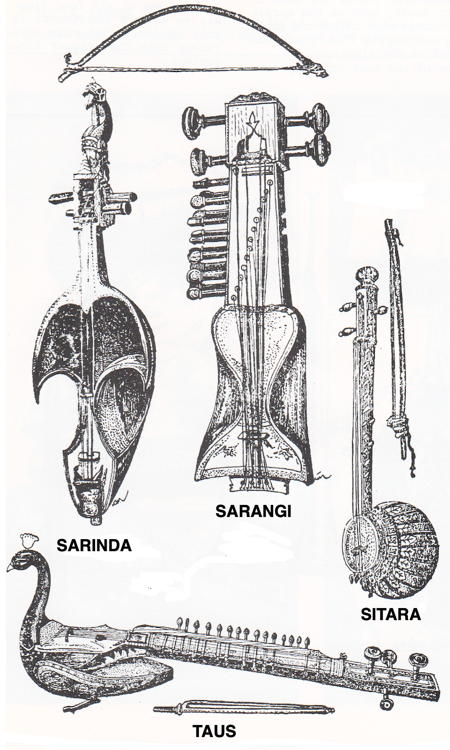 The most familiar bowed instrument to non-Indians is the sarangi. It has three heavy gut main strings and up to 52 sympathetic strings that pass over a bridge on a parchment face. It also has a bad reputation because of prostitutes using it to attract customers.
The sarinda is a relatively simple instrument most often found in Baluchistan. It has a small skin face and and unusal resonator chamber. The chamber is a horn that curls around from the face to flare open just above the skin face.
One instrument that is both bowed and plucked is the rabob or rubab. This instrument is the direct ancestor of the modern sared (developed in the 20th century). This archaic instrument can be bowed, but has recently started to be played with a pick. It has a skin face and four heavy frets. It has four gut strings but no sympathetic strings. It is more popular in Pakistan and Afganistan.
Another bowed instrument more popular in the south is the fanciful taus. It looks like a sitar with an animal for the main resonating chest. Usually it is shaped like a peacock whose tail ends in the neck of the instrument. Sometimes other animals are used as a model for the body.
Among the folk instruments we find the primitive yektar or iktara (on string). The body can resemble the Persian spike fiddle kemanjeh or kamancheh (bucket), or virtually anything else that will work. The string is tuned to one note and plucked, no other notes being played other than the tonic.
Another instrument is the sitara, not to be confused with the sitar. This is a more archaic three-stringed version of the Persian spike fiddle kemanjeh with a set of sympathetic strings attached to the side of the main spike that acts as the fingerboard. This is an ancient instrument once known to the Persian empire but survives only in parts of north India.
WINDS
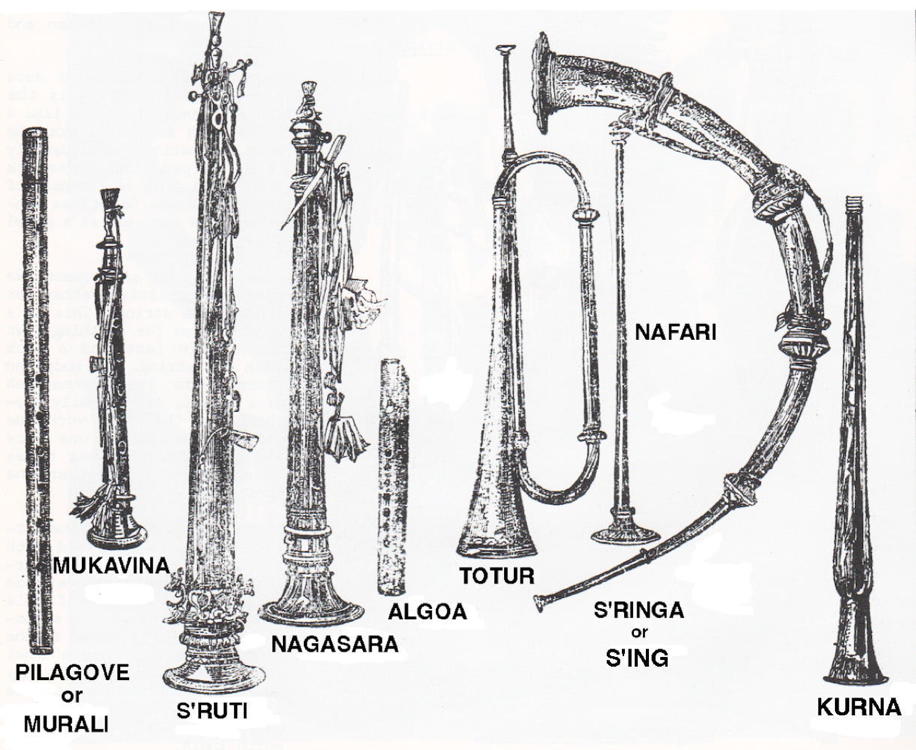 The Arabs and Persians brought the soornai to India with the Mogul conquests, and they spawned a whole family of reed instruments. One is the sweetly artistic shenai, whose sound is best described by that favorite of all English words used by Indians, "auspicious." It comes in two main sizes, the s'ruti and the nagasara, or larg and small. In the south of India is the mukavinam, a more archaic form of the instrument with an all-wood construction with no metal bell, as is used on the shenais.
Transverse flutes are used in art music, such as the murali which is also called the pillagove. Fipple flutes abound, such as the algoa.
One of the most unusual features of the winds used in India is the use of four fingers on each hand rather than the usual three on the left (or upper) hand and usually three and sometimes four on the right (or lower) hand. Even the use of all four fingers on Western instruments is only for the use of the extra keys rather than the primary fingering.
DRUMS
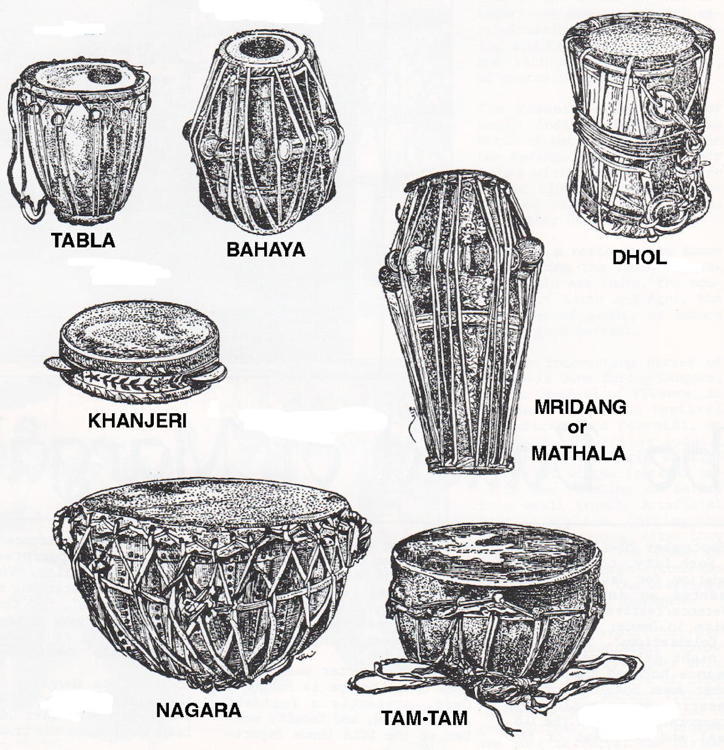 India has to be a paradise for those who love drums. Virtually every method of making and playing drums has been tried here in many different varieties and each conqueror has left some mark. The Arabs left the small deff in the form of the khanjeri. The Persians left the dhol and it became ancestral to the dholak and pakhawaj which in turn became ancestral to the most familiar drum to non-Indians, the tabla bayan. The Arabs also brought the kette drums nagara and tam-tam.
In the south of India we have the mridangam, a double-headed drum with an unusual ringy character. We also have the old clay drum khol, whose whole body is dried unbaked clay coils and the main playing head is crusted with clay.
This is only a small quick tour, but at least it may give a bit of the flavor of the wondrous musical instruments found in India.
Printed in Folk Dance Scene, October 1986