|
Folk Dance Federation of California, South, Inc.
|

|
CLICK AN IMAGE TO ENLARGE
 In 1964 a nine thousand year old settlement was found near Paracas in Peru. The people who once lived there had a surprisingly high cultural level and had such things as stone dishes, coral necklaces, stone mirrors worked with inlay work, and most of interesting of all, a wooden flute. The most remarkable thing about the flute was that other than surviving nearly intact for over nine thousand years, it closely resembled the modern Peruvian Indian flute qena.
The qena is one of several flutes played in an area encompassing parts of Peru, Ecuador, and Bolivia. This is the area that once was the Inca Empire. The modern qena is made of wood, bamboo, or llama leg bones and has seven finger holes. The ancient qena had only five holes and played a scale closely resembling the Chinese pentatonic scale. This similarity has misled some into believing that Inca music was influenced by ancient Chinese travellers. The actual source of the five finger holes and the five note scale is the reverence for the five fingers of the hand of the god Pachacamaco. Pre-Inca peoples such as the Nazca, Chima, and Tiahuanaco had a fuller scale and a richer body of music. The modern qena gained its full octave scale as a result of Spanish influences after the their conquest of Peru (1532–1572).
Other flutes used by the Indians are the mala which is a smaller version of the qena, and the tede. The tede is usually made from bird bones. There is a folk ocarina called the ayariche and a kind of tube fluite made from wood or terracotta called the aylliqepa or the hayllai-quipac or the tock oro in different places. The aylliquepa can only produce a few harmonic notes.
A special panpipe is found throughout Peru, Ecuador, and Colombia. In Peru it is called the antara, and in other areas it is also known as the silbader and the sico. The sico comes in two sizes, the larger having its longest pipe exactly twice the length of the smaller pipe. They are usually played in choirs of six to twenty, and the choirs are called the "Musicos de Madera" or "Wooden Musicians."
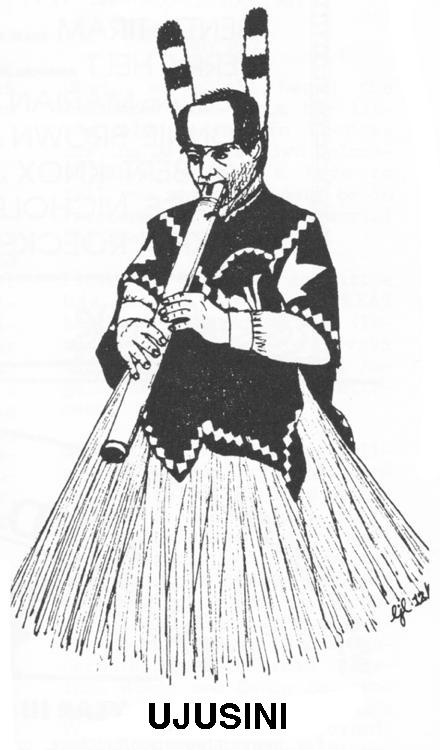
Another flute found in the old Inca areas is the ujusini. The ujusini is a large bamboo notch flute. It resembles the Japanese shakuhachi except for its much larger size, up to three and a half feet long.
There is a folk trumpet, a simple affair of bamboo and a ram's horn called the pututu. There also are simple horns, sometimes covered with brass.
Among the idiophones are odd square wooden bells and a kind of instrument made from a llama's skull called the sukcha. The familiar maracas are called chil-chil in this region and they are one of many kinds of rattles use in local folk music. There is a barrel drum called the tynia. It's heads are often covered with animal hair rather than being bare as are most drums. There also is the single headed huancar. The tynia seems to be derived from drums brought by the Spanish but the huancar is native drum which was covered with human skin. One Inca king punished treacherous chieftains by covering huancars with their skins.
Many instruments came from outside, such as the guitar and modern brass instruments. The guitar and charango may have come into the area from Mexico, but the charango has become almost the national instrument of the area. The charango is a charming little instrument with twelve strings and an armadillo body. It is usually played by flailing the fingers across the strings and is often accompanied by a guitar and a small flute. The music from this small ensemble is most charming yet haunting.
One of the more unusual instruments is the bass flute aykhori. The aykhori closely resembles the Slovak bass flute fujara both in size and construction. Of course, this is not surprising when we see that Slovak immigrants brought the fujara to this area in the 19th century and the local Indians adopted it to their use.
The musical instruments used by these modern descendants of the Inca, Ayam, Nazca, Chima, and Tiahuanaco Indians are a mixture of their own ancient instruments and derivatives of Spanish instruments. The music they make is a haunting memory of the loneliness of the Altiplano and of the ancient Inca.
Printed in Folk Dance Scene, January 1987