|
Folk Dance Federation of California, South, Inc.
|

|
CLICK AN IMAGE TO ENLARGE
 The sights and sounds of flamenco music and dance are especially evocative of the world's image of Spain. The music and dance seem to entwined with the culture of Spain that most of us forget that it is only one facet of a complex and varied music and dance culture. We even forget that flamenco, like all things, once was new and had a beginning.
Flamenco, is a word closely related to the bird, flamingo. Both words are derived from the Spanish word for a Fleming, one of the two peoples that make up Belgium. The source of the word dates from when the Spanish occupied the Netherlands in the 16 century. When a Spaniard went on leave from his duty of generally oppressing the Dutch, he often would go over the border to visit a Flemish town. What he saw there often resembled a Breughel painting of the time. The Flemings often would have parties and dances for amusement. They usually dressed in bright colors, which was unusual in Europe at the time because sumptuary laws banned certain colors and precious metals for non-noble wear. To Spanish they seemed wild party animals because of their peasant celebrations and bright colors. Sometimes a Spaniard would obtain a brightly colored Flemish jacket or coat and take it home with him. The Flemish then became the people who evoked the image of a wild and dissolute life style, or a "flamenco."
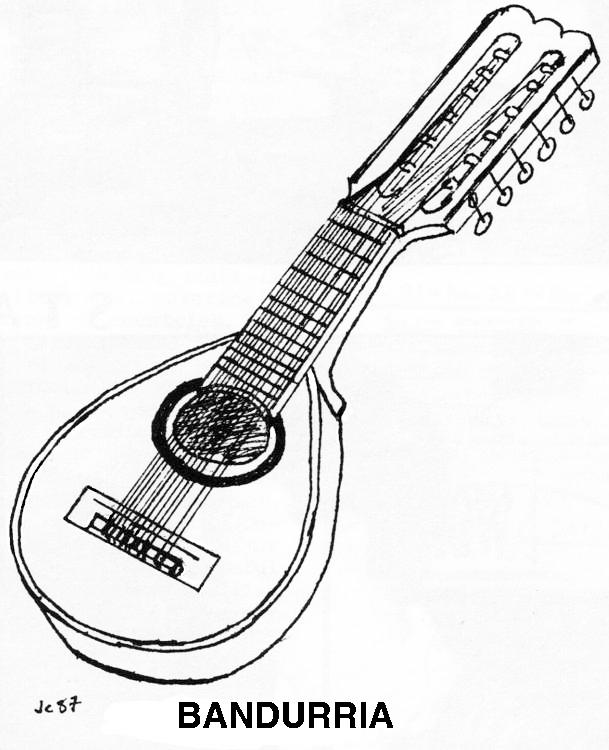
The Flamenco performers did not always use the guitar. This instrument seems so deeply involved with flamenco music that it seems not able to be performed without it. Before 1854, when Antonio Torres developed the first concert-sized guitar, the smaller guitar simply did not have the force needed for a flamenco performance. However, a clue can be found in the habit of flamenco guitarists performing older pieces of placing a capo (a bar) at the fifth fret. Then they will play two guitars, one playing the melody line and the other playing the chords in support. This is directly taken from folk instruments, the bandurria and the laúd. In some regions the bandurria is accompanied by the laúd playing chords. The bandurria resembles a flat mandolin with a short, broad neck and twelve strings in six double courses tuned ee laúdbb f#f# c#c# g#g# d#d#. The laúd is similar except the it is longer necked and tuned in six double courses AA EE CC GG DD AA. This is exactly like a guitar barred at the fifth fret.
It is apparent that early flamenco guitarists did what their counterparts in Greek rembetiko and American blues did; they drew from their own folkloric roots and then developed them. Most of the rhythms used are found in scattered Spanish folk music, as well as at the root themes in regional folklore. Spanish folk music is often emotional and sometimes fiery, although the merging of Spanish Rom with the urban flamenco tradition took its own special path, creating a vital and powerful hybrid we know today as Spanish flamenco.
Printed in Folk Dance Scene, July/August 1987