|
Folk Dance Federation of California, South, Inc.
|

|
CLICK AN IMAGE TO ENLARGE
 At the southern part of the Caucasus Mountains on the border between Georgia and Turkey is the modern homeland of the Armenian people. Once they dominated Eastern Anatolia, and even ruled Byzantium during the time of the Iconoclast Emperors. Today most people of Armenian descent are a people of the diaspora as are the Jews and the Irish.
Armenia is the modern spiritual and cultural center for the world's Armenians, and here we find the purest Armenian culture of all. Throughout their 3,000-year history they have been in contact with Persians, Romans, Assyrians, Arabs, Kurds, Georgians, and Turks. They have absorbed some elements of each and adapted them to their own culture. The music and dance culture of Armenia shows this influence most clearly.
There are dances closely related to those of their neighbors the Kurds and Ashuri (Assyrians) such as Kochari, The dances will differ mostly in styling and sometimes in name. Dances such as Lezginka and Shalakho will be identical in performance to their Georgian neighbors, even to using the same tcherkeska costume and using the same music, although musically the style may differ.
The modern "traditional" Armenian orchestra is derived from Azerbaijani and Turkish sources. The Azerbaijani instrumentation is ultimately a variant on instruments from the Persian cultural area (Iran, Azerbaijan, Afghanistan, and the Central Asian republics). These are the tar (long-necked lute with a double skin face), kemenche (spike fiddle), duduk or balaban (reed pipe), tutek (small rim-blown flute, diatonically fingered), dayereh (frame drum), and doli (small version of the Persian dohol (double-headed cylindrical drum).
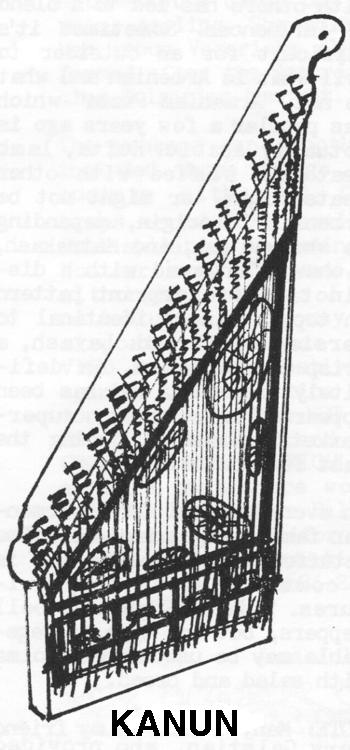
The instruments of Turkish origin are the kanun (75-string zither) and oud (oriental lute). Turkish Armenians also favor the dumbeg (goblet drum).
Originally, the Armenian ensemble was the same as the Azerbaijani ensemble. This was kemenche, tar, doli or dayereh, and clarinet. The Azerbaijanis later used the garmon (from Russian garminika), and a small accordion. Both would occasionally use the duduk or zurna for dance pieces. Sometimes during the 20th century the Armenians added oud for bass lines and kanuns.
The Armenian ensemble most familiar to Americans consists of the oud, kanun, clarinet, dumbeg, and sometimes guitar and accordion or organ. This is the old Turkish urban orchestra. The Turkish flavor of American Armenians is because they are families of refugees and immigrants from Ottoman Turkey's Erzurum and Kars districts. Even the repertoire of the Kef Time records is mostly old Turkish tunes rather than Armenian tunes!
The music is clearly related to the Persian cultural system with its preference for slow six-eight rhythms. Some older Armenian songs have even been adopted as Persian Tasnifs (classical song tunes). In performance, the Armenian style tends to be very emotional and expressive. The most expressive of all is the ancient duduk. The duduk is a simple cylindrical reed pipe with a very large reed. The Armenians will use a double-lip embouchure and use the flesh of the lips to dampen the reed and control the pitch. The resulting sound resembles the most sweet saxophone tone imaginable. This instrument is often considered the ultimate Armenian instrument. I might agree, but I am prone to prefer the Armenian approach to the kemenche. The Persians are the uncontested technical masters of the instrument, but none but an Armenian can make it speak so elegantly or with such haart-warming sadness.
In classical music we have all heard the Sabre dance from the Gayne Ballet by Aram Khatchaturian. I have a recording of selections from the same ballet but done by a traditional Armenian orchestra rather than the usual European orchestra. I can tell you it is much more powerful with the extra brightness and percussive character of the plucked kanun and tar dominating the sound.
The Armenians are a people with a special genius in dance and music. It is the world's misfortune it has not yet heard how many more composers and performers of Khatchaturian's class are working in Armenia.
Printed in Folk Dance Scene, September 1987