|
Folk Dance Federation of California, South, Inc.
|

|
CLICK AN IMAGE TO ENLARGE
 Thousands of years ago the great ice sheets and glaciers of the last Ice Age retreated northward. Bands of hunter-gatherers moved into the newly available lands in Europe and became the new hunters and neolithic farmers of Europe. Around 2,000 BCE, new groups of Indo-European speaking peoples invaded Europe and absorbed the older peoples they conquered. In a few locations, some of the older peoples survived the invaders and kept their old cultures alive into the present day. Around the Baltic we find the Finns, Lapps, and Estonians, among others. Another surviving group is found today in the Pyrenees Mountains of Spain and France. These peoples are the Basques.
The Basques are a hardy mountain folk who have kept their own language and customs alive in the face of ancient Hamite, Indo-European, Celtic, Roman, Gothic, Moorish, and Spanish invaders and conquerors. Even today there are Basque groups who seek to oust their Spanish rulers and establish their own country.
One story the Basques tell about themselves tells of the time the Devil sought to learn to speak Basque. He spent seven years trying, but at the end of those seven years he could only say "bai" (yes).
The Basques have remained unusually resistant to any outside influences of authority that they did not wish. In the Middle Ages they did not believe any man could truly remain celibate, so to protect their women from unwanted priestly attentions, a priest was made to take a concubine or be expelled.
This cultural independence also shows in their own music and dance culture. They have taken some outside influences and changed them to suit themselves. The accordion is played in a specially tuned form called triktixa. The tambourine looks much like the Spanish pandere and is played in similar fashion, but they chose to call it the yetzale. Another musical instrument they took and changed is the medieval pipe-and-taber. The pipe is called txistu and is unusually large in bore and length and is played with the thumb and two fingers of the one hand. Hanging from the left arm is the drum tamboril. The rim is unusually large for this type of instrument, surpassed only by the Provençal tambourin in size. The txistu is usually made of blackwood and fretted in chromed brass rings and fipple. The tamboril is made like a small snare drum about 18- by 18-inches in size and is played with a single stick in the other hand.
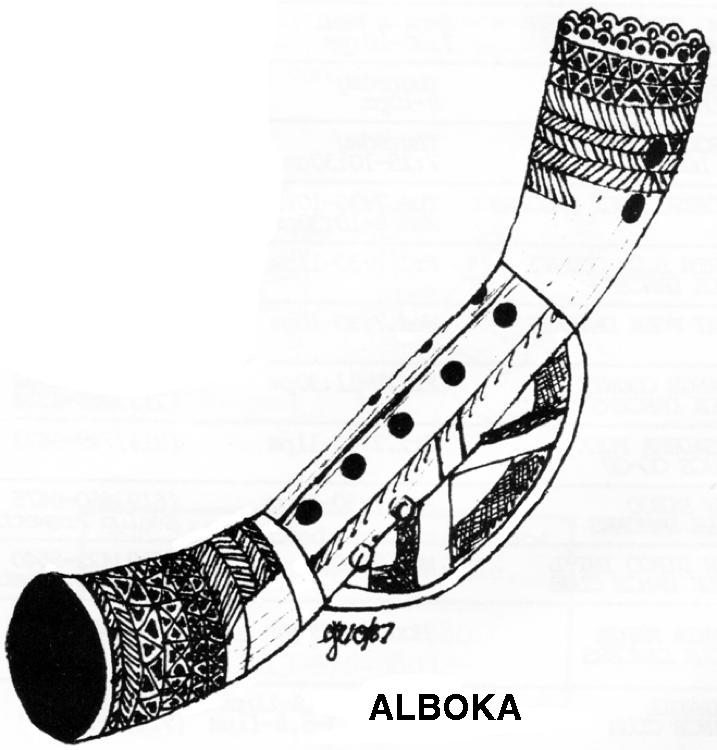
More unusual are some instruments that are native and may date from before written history. One archaic instrument is the double clarinet alboka. Other double pipes usually have a horn fitting at the end and the double pipe's clarinet reeds (single bleating tongues cut in a cane joint) are blown together with the player's mouth covering them. The alboka has a cow's horn on both ends of the double pipe and one end cups over the mouth to form an air-tight seal to blow the pipe with less fatigue on the player.
Last in this article, but certainly not least in uniqueness is the archaic txalaparta. This is an idiophone composed of two hardwood billets per player (more than one is possible) and one or two planks suspended over chairs or from tables. The billets are about two feet long and two to two and a half inches thick. The player takes the billets and stamps them endwise against the plank to produce the rhythms.
The uniqueness of the musical culture of the Basques is obviously the direct result of a strong and independent people. May their special contributions continue to flourish.
Printed in Folk Dance Scene, November 1987