|
Folk Dance Federation of California, South, Inc.
|

|
CLICK AN IMAGE TO ENLARGE
 In the late 9th century CE, the first of the Slavic kingdoms appeared from a mixture of pagan tribes as the Cristian Kingdom of Greater Moravia, covering much of modern Poland, part of modern Czechoslovakia, and part of modern Hungary. Two generations later the Magyars invaded and overran them. The smaller Bohemian kingdom survived until the later part of the 10th century CE when the Hungarians (formerly Magyar invaders) swallowed them before the Hungarian's expansion was stopped at Lechfield in 955 CE.
The modern Czechoslovakians are a nation composed of the older Moravians and Bohemians, and the Czechs and Slovaks who gave this nation its name. They are a fine example of Slavic culture with no Moslem influences. The few foreign influences are easily spotted and allow the folkloric scholar a good chance for study.
One of the first things that struck me was the large number of wind instruments and how few string idiophonic instruments are to be found. With the exception of the zither they play, which obviously is related to the Hungarian citera, I could find no native string instruments. The only windwood that was not a flute was the gajdy (bagpipe). The bagpipe was essentially the same or only a variant of the Polish bagpipes and other similar pipes found throughout this area of Europe.
The gajdy has a stylized goat's head from which the chanter emerges and an ornate horn and brass fittings on the other chanter and drone. This pipe is rather quiet and is often played with two violins in small village bands.
Another instrument that may hae foreign origins is the bachovská trouba (Slovak), also called pastýřská trouba (Czech), or fujara trombita. It is a large trumpet made of rolled bark and often reaches 18 feet in length. There also is a smaller version called vážecký roh made from a root of a fir tree with a turned-up bell. This seems alost identical to the Romanian bucium and is used as a cattle call.
Most characteristic of the region are the many flutes. The most common is the flageolet (end-blown duct flute) called pastierska píšťala (shepherd's flute). This flute is unusual in that it is fingered in a partial-stopped hole and cross-finger techniques that allows it to be fully chromatic. Another variant is the dvojačka. It is a simple double flageolet with one tube fingered and the other supplying a drone.
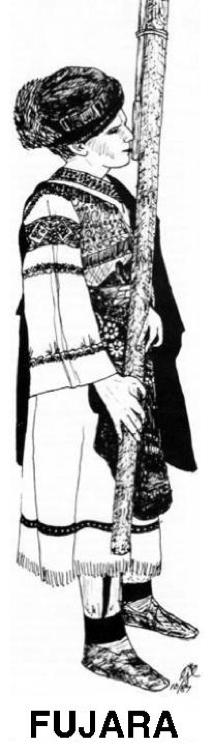
The most unusual, and the most characteristic folk instrument of the peoples of Czechoslovakia is the fujara. The fujara is an enormous folk flagolet that may reach meters in length. The player holds the tube close to his body and reaches downward to the finger holes. The fipple is fed air from a smaller tube folded back downward so the player's mouth can reach it. The most surprising thing is that it is capable of playing a full diatonic scale. The fujara plays a mysclydian and hypoionic scale based on overtones on the fundamental. The opening notes of a performance is the rozfuk, in which the player runs through all the tones in a two-octave scale and then into a high nasal tone from an upper overtone. He then descends into the melody in a descending pattern and improvises a series of small motifs and decorations on the basic tone. This instrument has been surmised to be the true source of the characteristic musical motifs of the region. Whether or not this is true, it is one of the most fascinating folk instruments I have ever run across.
I hope some of you can check further into Czech folk culture, because it seems to be one area of potential interest that most people in folk dance and music have yet to really explore.
Printed in Folk Dance Scene, January 1988