
|
Folk Dance Federation of California, South, Inc.
|

|
CLICK AN IMAGE TO ENLARGE
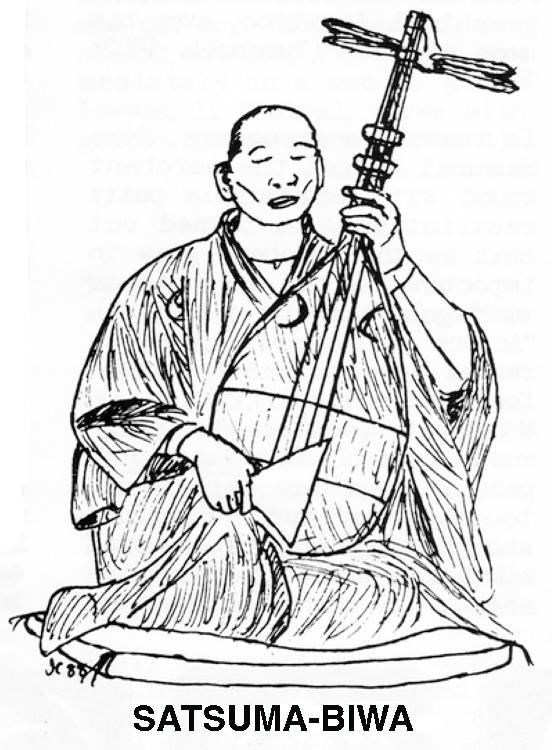 Japan has an ancient and highly developed musical culture. There is an enormous variety of drums, gongs, claves, clappers, rattles, zithers, long-necked lutes, and short-necked lutes. There also are several flutes and one lonely little reed instrument.
Among the drums, gongs, and rattles are the daiko, familiar as the sake-barrel drum. There are several forms of the taiko (hourglass drum). Along with these are claves and clappers like the hyoshigi and yotsudake. Gongs include the dora, soban, ari-gane, and hitotsu-gane. This is only a tiny sampling of the drums and gongs found in Japan.
Probably the most familiar instrument to non-Japanese is the koto, often associated with the grace and beauty of a geisha in the Western mind. The koto is the latest in a long line of tube-zithers and the name simply means a string instrument. The 13-string koto is played with three picks on the fingers of the right hand and the pitch is controlled by pressing the strings on the non-playing side of the bridges to the player's left. The koto is the popular version of the older gaku-so still used in gagaku court music. This instrument is very close to the koto except for size and styling when played. This instrument itself derived from the ancient wagon. The wagon looks like a small koto with only six strings and is played in much the same fashion. The wagon probably was derived from either Korean or Manchurian zithers, but could also be taken from the archaic ninenkin. This astonishing range of instruments, all relate and of such widely varying ages and traditions still being played in Japan, is equivalent to finding the guitar, the lute, the al-oude, and the ancient Greek kithara all being played side by side in living and continuous tradition!
In the midst of all of these musical instruments and the musical forms with which they are associated, I looked most closely at the biwa. The biwa was introduced from China during the Nara period after China itself received the p'i-p'a from India. India, in turn, got the ancient lute from the Persians during India's Ghandhara period. The biwa is the ultimate ancestor of the al-oude, the lute, and the guitar.
The biwa is the traditional instrument of the blind Buddhist performer-priests, and many tales were told with the biwa as an accompaniment. Probably the best story that illustrates the importance of music in Japanese feudal culture and shows the way the Japanese feel about it is the "Tale of Genji."
In this tale, a blind biwa priest-performer finds himself being summoned each night to play his music and sing his songs at the court of an ancient ghost king. A ghostly samurai would come and take him to perform. At length, he seeks help from other Buddhist priests. They cover his body with magic symbols that will render him invisible to the ghostly samurai who, as promised, cannot find him. However, the priests made one small mistake. They forgot to cover his ears with magic symbols, so the ghostly samurai can only see his ears. He cuts off the priest's ears to take back to the court as the only part of the biwa player he could find.
I would suggest that those who may have an interest in investigating Japanese music will find a rich and powerful as well as ancient wellspring of the Japanese spirit in the hogaku, or traditional music of Japan.
Printed in Folk Dance Scene, March 1988