|
Folk Dance Federation of California, South, Inc.
|

|
CLICK AN IMAGE TO ENLARGE
 In 1071 CE the Seljuk Turks defeated the Byzantine army at the Battle of Manzikert, and the gates to Turkish expansion into Anatolia were opened. Around 1360 CE, the Osman clan (Ottoman) began its expansion and eventual conquest of the Byzantium Empire with the fall of Constantinople in 1453 CE.
The Turks came from Central Asia and brought the music and instruments of that region with them. Turkish music is the result of centuries of musical experimentation that never quite lost its Central Asiatic flavor.
The folk music has stayed closer to the Central Asiatic source than has the art music, but even here foreign influences have helped to create forms that are distinctively Anatolian. The Aşik singers, the troubadours of Turkey, have Arabic influences of the Sufi. Even their name is from the Arabic ashwaq (meaning forlorn). Pahlivan is from the Persian word for wrestler and is usually performed at wrestling matches.
The instruments show the same influences as does as does the music. Art music has the ud (short-necked lute), kanun (Arabic zither), darbuka and dubelek (metal and clay goblet drums), and ney (rim-blown cane flute) from the Arabs. Art music and folk music both draw on the Persians for the tanbur (long-necked lute in art music), zurna or surnai (reed pipe), davul or dhol (large double-headed drum), and kabak kemençe (gourd spike fiddle), a simple folk version of kamancheh (skin-faced spike fiddle). From the Greeks the Turks got the classical kemençe (small pear-shaped fiddle), not to be confused with either the kabak kemane (gourd fiddle) or karadeniz kemençesi (Black Sea fiddle) of the Laz people, a bottle-shaped fiddle very similar to the Pontian lira. The Georgians also gave the Turks the mey (reed pipe) with a large reed and a quiet sound.
From Europe comes the klarnet (clarinet), the keman (violin), the gitar (guitar), and accordion. They also are joined by modern trap drums and the electric organ.
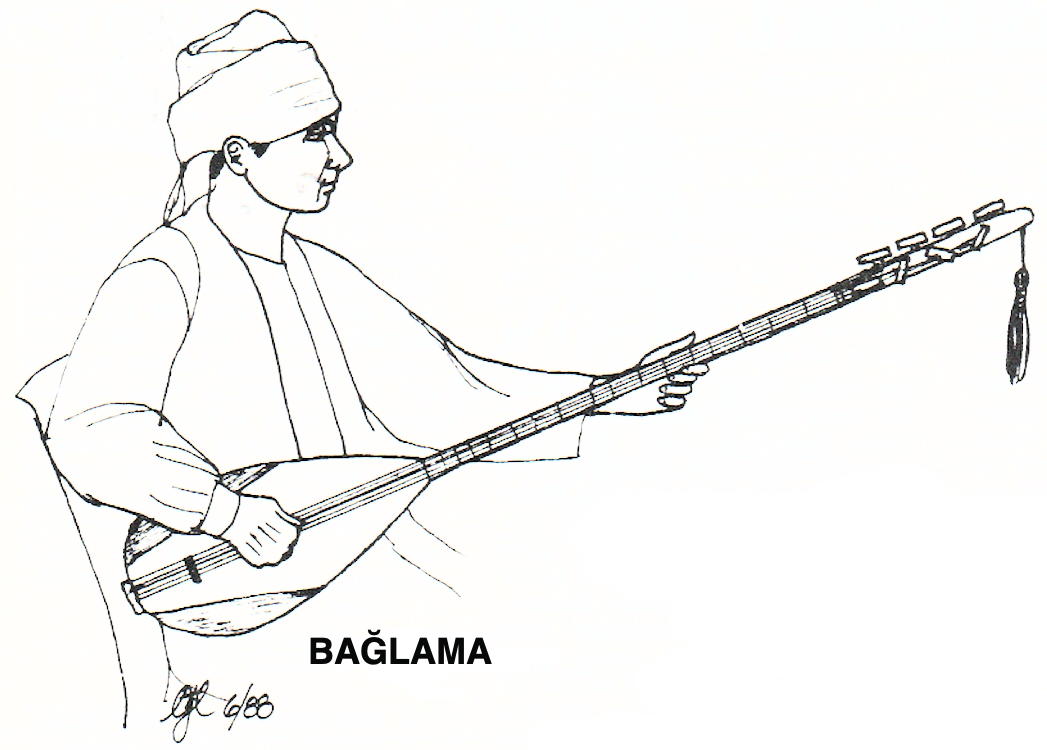
The purest form of Turkish music is to be found performed upon the family of instruments generally called saz, from the Persian word for musical instrument. The saz family ranges from the tiny cura (sparrow hawk) to the popular bağlama (to tie) and up to the divan (big) saz. Between these sizes are found the orta (middle) saz and the recent dambura saz. The cura plays an octave above the bağlama (tuned G D A). A low-octave string is added on some instruments. The divan saz is tuned C G D and the dambura is tuned an octave above with the C and D strings and low-octave strings added. The dambura is about the same size as the bağlama, but is used as a more-manageable substitute for the divan saz.
The saz family is often played in groups of as many as twenty instruments using all sizes. The bağlama and sometimes the dambura are used as the main body, much like the violin in a European orchestra. The divan and meydan (square), a larger version of the divan) sazes are the celloes and basses, and the group will have only one cura playing clearly and freely at the top. The dambura is about the same size as the bağlama, but is used as a more-manageable substitute for the divan saz.
The sazes also are used to accompany singers with the rhythm being tapped on the face with the fingers of the right hand along with the strokes of the pick. The songs are of love, sometimes sad, sometimes happy, and sometimes unrequited.
The Turks have long been lovers of music, and have taken from any source that they felt would enhance their own. They have treated music rather like a good cook, borrowing a good spice for a little improvement of the flavor of a favorite dish. The result is a fine musical stew of many flavors that never wears out its welcome to those who appreciate it.
Printed in Folk Dance Scene, July/August 1988