|
Folk Dance Federation of California, South, Inc.
|

|
CLICK AN IMAGE TO ENLARGE
 In the southwestern part of the Soviet Union lies the Ukraine. In the early Middle Ages, Norse traders and settlers of the tribe Rus founded the city of Kiev as a trading center. By the 12the century CE the Norse settlers had intermarried with the native Slavs and their descendants have become culturally Slavic, giving rise to the modern Ukrainian and Russian peoples.
The Ukrainians are closely related to their neighbors the Great Russians to the northeast and the White Russians to the north. To the west and southwest they are bordered by Poland, Czechoslovakia, Hungary, and Romania. After World War II, the Ukraine was given the eastern part of Poland in a "restructuring" of Russian borders. Coincidentally, the newly annexed land was some of the finest farmland in that part of Europe.
The Ukraine has had musical influences from each of its neighbors. The dulcimer came to them from Hungary and Romania. Various bells and psaltries used during the Middle Ages came to them from Hungary and Austria. Violins became popular by the 17th century CE. Accordions made their first appearance in the 1840s, and soon had several local variants often named for the towns in Russia and the Ukraine where they were made, such as harmonica – also garmonika, garmon, and garmoniya – saratjovskaya (for Saratov), livenskaya (for Livna), kasimovskay (for Kasimov), cherepovetskaya (for Cherepovetz), and bayan (for the singer Bayan).
Among the natives found in the Ukraine is the sopilka or dentsivka. It is essentially the same as the Jugoslav frula: a simple tube with six finger holes and the fipple is on the underside rather than the upper side of the tube. The Ukrainian players have an odd habit of partially covering the open hole of the fipple with the lower lip to produce a curious burbling sound. Also found in the Western Ukraine is the telenka, a simple wind-blown tube with no finger holes that is played by producing overtones with the embouchure and tilting a fingertip over the far end of the tube. This is identical to the Romanian telinca. Because this is near the Romanian border, the origin of this instrument is easy to guess. Also found is a simple fipple flute called floyara or zubovka, and from the west is the wooden trumpet the trembita, essentially the same as the Romanian trombita, used in hilly regions as a signalling horn.
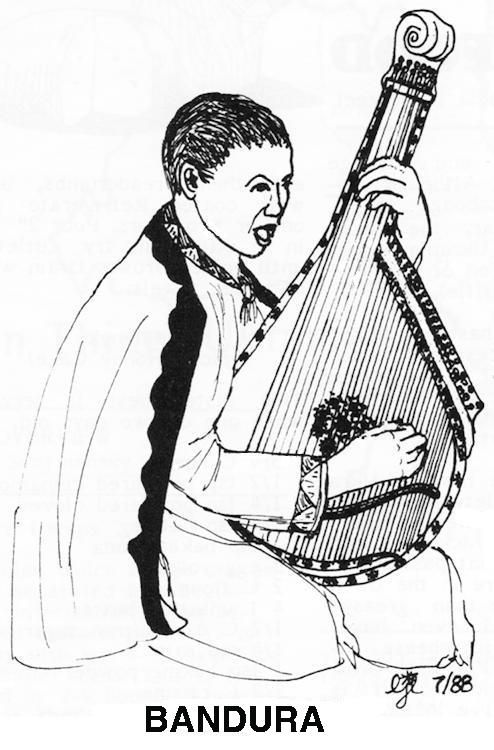
The most interesting instrument of all musical instruments used by the Ukraine is the bandura (plucked-string folk instrument). Old woodcuts from the 17th century show an early form of bandura in use. The bandura originally had a flat, shallow body and was circular in shape. The strings were stopped against the fretless fingerboard. The wide spray of side strings so characteristic of the present-day instrument had not yet appeared. Over time, the bandura became larger and added side strings. It appears to have eventually combined with the gusle zvonchatye (multi-string plucked instrument) to produce its modern form.
The present instrument has thirty or even more strings tuned chromatically and played with a pick fixed to the forefinger in the same manner as the gusle. On the neck are longer strings derived from the archaic cobza (pear-shaped string instrument) and the characteristic peg-box scroll shown in 17th-century woodcuts has been preserved.
The sound of the bandura tends to be sweet and bright, lending itself to music of a gently romantic nature, rather like the music most favored by the Ukrainians themselves.
Printed in Folk Dance Scene, September 1988