|
Folk Dance Federation of California, South, Inc.
|

|
CLICK AN IMAGE TO ENLARGE
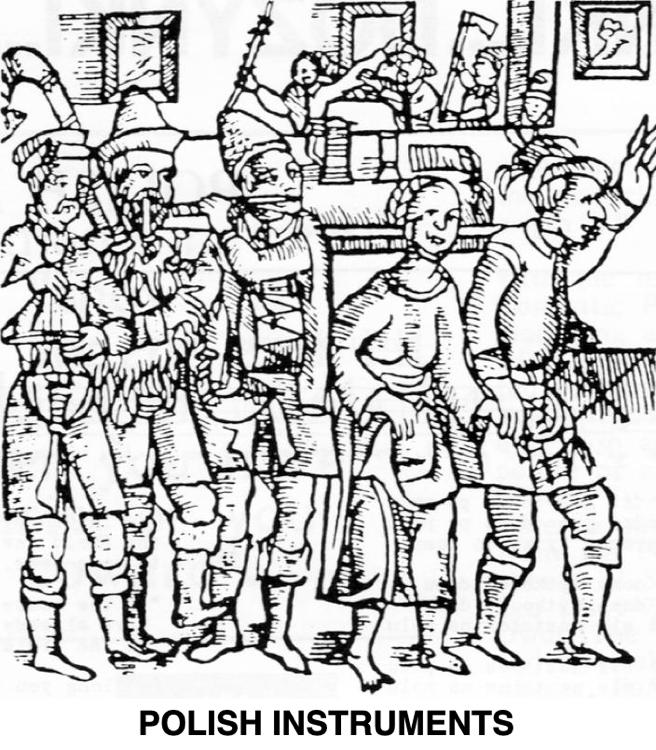 Throughout their history, the Poles have been one of the few Slavic peoples not to come into direct contact with the Turks, excluding the Avars in the early Middle Ages and the Mongol invasions in the later Middle Ages. Most of the cultural influences on the Poles have come from their historical neighbors the Hungarians, the Germans, the Russians, and the Ukrainians.
Like most Slavic peoples, the Poles seem to have a preference for wind instruments, most notably flutes and bagpipes.
Among the flutes we can find the fujarka wielkopostna, a flute that is only a simple tube. It is blown across the rim of one end in the manner of a kaval or ney and a finger is tilted over the other end to produce both stopped and open overtones. This flute is identical with the Romanian telincă, the Slovak koncova and the Ukrainian telenka.
Another ancient Slavic instrument in Poland is the fujara salasznikowa (shepherd's fujara). This flute is nearly two meters long and the bottom opening must use a valve to close it. This is very similar to the Slovak fujara, also two meters long, and uses a folded pipe to allow the player's breath to reach to fipple (a block or constricted mouthpiece inside an end-blown wind instrument) without the necessity of being twelve feet tall.
The Poles also have the trabita, which is identical to the Ukrainian trembita, the Slovak fujara trombita, or the Czech pastýřský trouba. This is a long signalling horn formerly used to communicate in mountainous regions of southern Poland. It is becoming very rare. Few are seen today.
In the Lubsko region, whistles, clappers, and rattles have survived as children's toys.
The Poles have long had a love of bagpipes. The simplest of pipes is the siesieńki, a bladderpipe. A simple clarinet beating reed drives a cylindrical tube with six fingerholes and a thumbhole. The tube ends in an upturned horn bell. They have the dudy, from the German dudelsak and the gajdy (from the Turkish gayda, and ultimately from the Arabic ghiata, a reed pipe). The gajdy has a bag of goat skin with the fur on the outside and the chanter emerges from a stylized goat's head. It hasa a drone that breaks at a right angle in the middle and hangs over the shoulder of the player. The gajdy is a bellows-blown pipe with the bellows held under the left arm of the player. The koziol resembles the gajdy except that the koziol is larger and the chanter emerges from a kid's head rather than a goat's head. The koziol ślubny is a special, smaller version of the koziol used at weddings by the wedding party. Later it is exchanged for the koziol at the wedding dinner.
Among the folk string instruments are the mazanki and maryna. The mazanki is a survival of the medieval rebec. The modern mazanki has a fingerboard, three strings tuned in the fourths and is played violin-fashion. The medieval form more strongly resembled its more archaic relatives to the south, the lira, lirica, and guldula. Agricola described it in 1545 CE as being played with the fingers between the strings, unlike its modern descendant. The mazanki is often used to accompany the koziol ślubny. Also found in the Szamotuły region is a simple folk bass, the maryna. It is about the size of a large cello, angular in outline, and has two gut strings tuned either to G-d or A-e in fifths.
Of course, there is the familiar polka band, originally composed of clarinet, accordion, and bass. This has been expanded in recent times, especially by Polish immigrants in the American Midwest, to include banjos, saxophones, and electric guitars.
Printed in Folk Dance Scene, October 1988