|
Folk Dance Federation of California, South, Inc.
|

|
CLICK AN IMAGE TO ENLARGE
Once upon a time, many years ago, like twenty-five or more, there were a lot of very popular dances done in California. They had come to this country from their homelands over a period of nearly 300 years – from Westfalen, Silesia, the Schwarzwald, Rheinland, Hesse, and other states, duchies, landgraves, and kingdoms of the German confederations, and were danced by the early settlers, first in Pennsylvania, in North Carolina, then in New York, Wisconsin, the Midwest, and the Plains. Until the international folk dancer types began doing them in the mid-1940s they remained with these immigrants and their descendants – except for those few occasions when they were taught in schools as recreational subjects.
These dances were the "Bunte Tänze" – quadrilles that usually were composed of several figures interspersed with one or more choruses. Some of our more popular square dance patterns may be traced directly to these dances, where they were observed and incorporated, especially in the midwestern and western parts of this country. The term "Bunte" refers to the kaleidoscopic colors of the costumes rather than to the fact that they had a certain pattern. However, the generalization was convenient and it stuck.
It was probably in 1946 – it may have been earlier in Northern California – that the first of these, Windmueller, became a very popular dance in the Southland. There was no commercial record available, but the Pasadena Co-op, Hollywood Peasants, and Westwood Co-op danced it regularly and one of their members made a "cut" from sheet music score that was played by piano and this was used until the commercial record came out on Imperial Records.
Drosselnest was another that was often danced. In the summer of 1949, the International Dance Circle (IDC) introduced a new dance at a summer festival – Der Wolgaster, and soon everybody was doing it. During that year and the next two or three, the IDC introduced several additional German group dances, under the direction of Paul Erfer.
When the Folkdancer Records came out with a new album, Puttjenter and Mein Mann ist Gefahren ins Heu began to be danced. Others, such as Sunrose and Ich habe meinen Strumpf verloren (I Have Lost My Stocking) didn't make the grade.
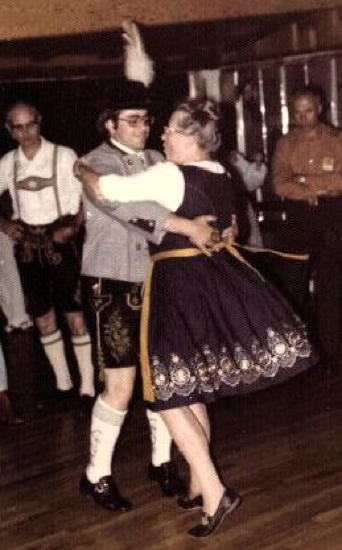 About the same time, after a visit to San Francisco, members of the Gandy Dancers brought back the Schüddelbüx which became very popular for a time. It was in 1953 that Paul and Gretel Dunsing came to Stockton Folk Dance Camp, then to Lighted Lantern Folk Dance Camp in Colorado, and to Los Angeles with their delightful dances. Achtouriger mit Walzer took hold, but Jaegers Quadrille didn't.
About this time, however, the interest began to wane, and quite rapidly, too. The German couple dances remained – though not so popular as previously, and a few clubs retained Windmueller and Wolgaster in their repertoires for some time. A revised sequence of Schüddelbüx to fit a new recording created confusion and the ultimate demise of that one. One place where you could find Puttjenter and Mein Mann ist Gefahren ins Heu (Man in the Hay) was at the Happy Valley School in Ojai and the Ojai Folk Dancers quite regularly. The old war horses of the Bavarian region, the Schuhplattlers, Im Gasthaus (At the Inn), Seftenberger, and such couple dances rolled merrily along, but the only new quadrille that was introduced – and has survived magnificently – was Dunsing's Saurlander Quadrille.
Since 1960, it has been rare indeed that any of the old Bunte Tänze have been taught at clubs – and even rarer that they have appeared on festival programs in Southern California.
We cannot help but notice that there is a direct relationship between the decline of the quadrilles of Germany and the increase of the Kolo – (a sort of generic for a while for ALL line dances, whether Kolos or not – the "Kolo Hour"). Is it because the one demands that a group of eight people work in concert with each other while the other gives a dancer an opportunity to "shine" at his own thing? A multitude of sins can be masked in a line dance under the guise of "variations" but a big mistake or a bad dancer in a set dance stands out like a, well, a bad dancer.
Yet, this cannot be – for some of the most popular dances of recent years have been Scottish dances – and they certainly call for group cooperation and precision. Perhaps we need a some teachers to reintroduce us to some Hobelbank, Schneidertanz, or Dunkelschatten. How about it, camp directors?
Printed in Folk Dance Scene, September 1975